Most decorated · 12 medals and honours, 0 for gallantry
Lieutenant-Colonel Gilbert Archey
Gilbert Archey was a zoologist and director of the Auckland Museum for forty years. A New Zealand Field Artillery officer in the First World War, he was made an OBE in 1919, and after a long scientific career became CBE (1958), a knight (1963) and Hector Medallist (1968). He is on the list for the sheer number of honours: 12 items across both wars and a long scientific career, none for gallantry.
12medals and honours
0of them for gallantry
His medals and honours
Every other medal and honour (13)
His story
Born in York
Son of schoolmaster Thomas Archey; the family reached New Zealand in 1892-93 and settled in Canterbury.
Source: Te Ara DNZB, 'Archey, Gilbert Edward' (via web archive), https://teara.govt.nz/en/biographies/4a20/archey-gilbert-edwardTerritorial gunner and museum curator
Joined the NZ Field Artillery in 1912; MA with honours in zoology at Canterbury College in 1913; assistant curator at Canterbury Museum from 1914.
Source: Te Ara DNZB, 'Archey, Gilbert Edward' (via web archive), https://teara.govt.nz/en/biographies/4a20/archey-gilbert-edwardOverseas with the NZEF
Embarked as a lieutenant with the 22nd Reinforcements on the Aparima (Feb 1917 per Cenotaph; the DNZB says September 1916); 13th Battery, 3rd Brigade NZFA; Passchendaele campaign 1917; pneumonia.
Source: Online Cenotaph record C85902, https://www.aucklandmuseum.com/war-memorial/online-cenotaph/record/C85902; Te Ara DNZB, 'Archey, Gilbert Edward' (via web archive), https://teara.govt.nz/en/biographies/4a20/archey-gilbert-edwardDivisional education officer; OBE
Became a captain and divisional education officer in 1918; returned to New Zealand in 1919; gazetted OBE on 12 Dec 1919.
Source: London Gazette supplement 31684 p.15457; Te Ara DNZB, 'Archey, Gilbert Edward' (via web archive), https://teara.govt.nz/en/biographies/4a20/archey-gilbert-edwardDirector of the Auckland Institute and Museum
Appointed director in 1924, oversaw the building that opened on 28 November 1929 and the museum's growth over forty years.
Source: Online Cenotaph record C85902, https://www.aucklandmuseum.com/war-memorial/online-cenotaph/record/C85902; Te Ara DNZB, 'Archey, Gilbert Edward' (via web archive), https://teara.govt.nz/en/biographies/4a20/archey-gilbert-edwardHome defence command
Commanded the 4th Battalion, Auckland Regiment of the National Military Reserve (1942-43 per the Monuments Men Foundation; 1940-43 per another summary).
Source: Monuments Men and Women Foundation, https://www.mmwf.org/monuments-men-and-women/gilbert-archey; Online Cenotaph record C85902, https://www.aucklandmuseum.com/war-memorial/online-cenotaph/record/C85902Monuments officer, South East Asia Command
Lieutenant-colonel on the civil affairs staff of the British Military Administration, the only Monuments officer working in South East Asia (Malaya, Sumatra, Java, Thailand, Indo-China).
Source: Te Ara DNZB, 'Archey, Gilbert Edward' (via web archive), https://teara.govt.nz/en/biographies/4a20/archey-gilbert-edward; Auckland Museum blog 'Gilbert Archey, Monuments Man' (2023), https://www.aucklandmuseum.com/discover/stories/blog/2023/gilbert-archey-monuments-manGalathea Medal, CBE, knighthood, Hector Medal
Danish Galathea Medal for support of the 1950-52 expedition; CBE 1958; Knight Bachelor 1963; Hector Medal 1968.
Source: Auckland Museum Collections record 1384513 (Archey's nine-medal bar, accession 2024.46.3), https://www.aucklandmuseum.com/discover/collections/record/1384513; London Gazette 41406, 43012; Te Ara DNZB, 'Archey, Gilbert Edward' (via web archive), https://teara.govt.nz/en/biographies/4a20/archey-gilbert-edward
Rank and insignia
The ranks he held, and the badge a soldier of that rank wore. These are simplified illustrations.
His ships
Afterwards
Archey returned to Canterbury Museum after the war and published mostly zoological papers (centipedes, the native frog Leiopelma, fish and crayfish) before moving to Auckland in 1924. As director he oversaw the move into the Auckland War Memorial Museum building (opened 28 November 1929), raised the funds that the Carnegie Corporation provided in 1935, and wrote the standard monograph on the moa (1941) before turning to Maori carving and art, publishing some thirty works including South Sea Folk, Sculpture and Design and Whaowhia (1977, posthumous).
He was a Fellow of the Royal Society of New Zealand from 1932 and its president in the early 1940s, a member of the University of New Zealand Senate (1941-61) and of the Queen Elizabeth II Arts Council, and was awarded an honorary DSc in 1941 (a degree, not counted here). He retired in 1964 as Director Emeritus and died at his Remuera home in Auckland on 20 October 1974. In 2023 the Monuments Men and Women Foundation recognised him as the only Monuments Man in South East Asia.
Later awards, not counted here: War Medal 1939-1945; New Zealand War Service Medal.
His sign
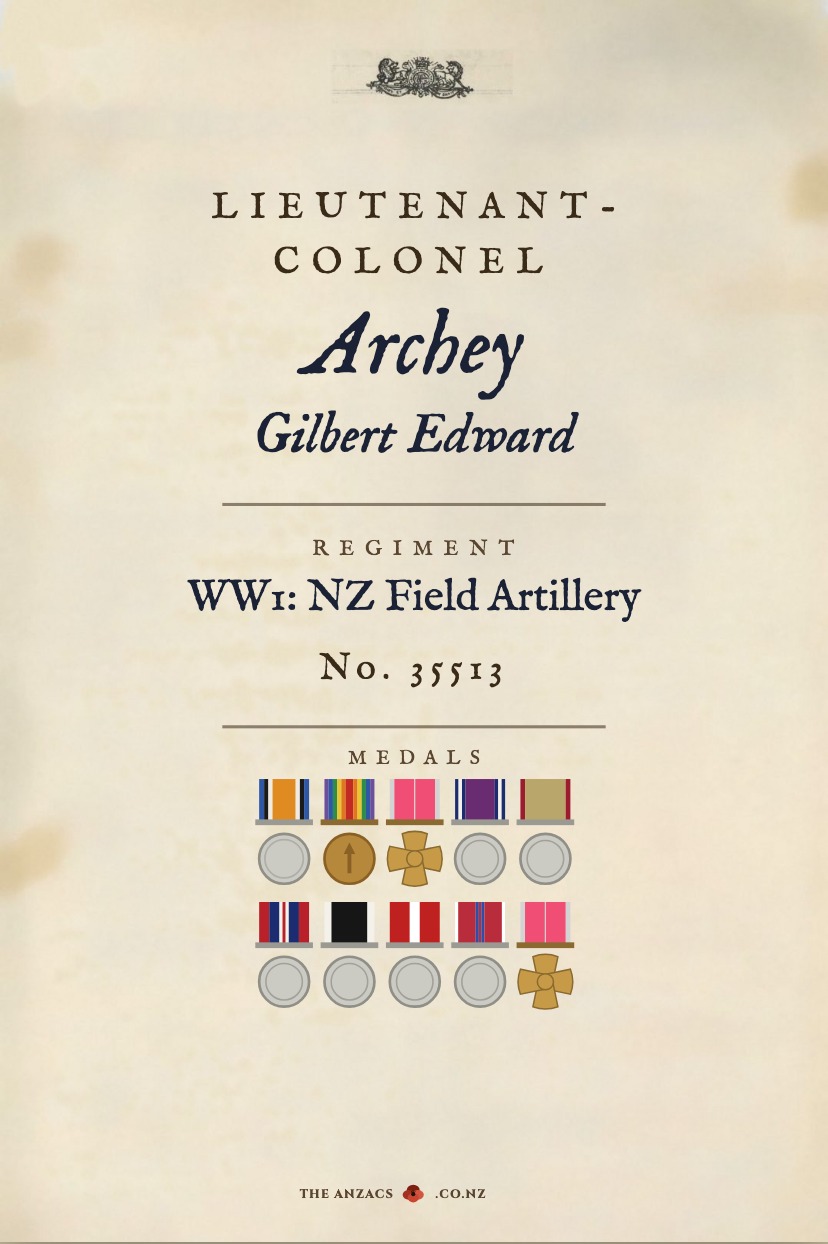
This is the Service Record sign as we would make it from his record: his rank, name, regiment, number and date of embarkation. The medals on the sign are worked out automatically, so the medals listed above are the ones to rely on.
Photograph
We haven’t hosted a photograph here
Rather than copy someone else’s image onto our own site, we’d rather send you to see it where it’s properly held: his full record at the Auckland War Memorial Museum’s Online Cenotaph.
Sources
- Gilbert Edward Archey, Online Cenotaph, Auckland War Memorial Museum.
- Online Cenotaph, Gilbert Edward Archey
- Auckland Museum Collections: Galathea Medal bar (nine medals)
- London Gazette supplement 31684, 12 Dec 1919, p.15457 (OBE)
- London Gazette supplement 41406, 12 June 1958, p.3554 (CBE)
- London Gazette issue 43012, 31 May 1963, p.4831 (knighthood)
- Te Ara DNZB, Archey, Gilbert Edward (web archive copy)
- Wikipedia, Gilbert Archey
- Wikipedia, Hector Memorial Medal
- Auckland Museum blog: Gilbert Archey, Monuments Man
- Monuments Men and Women Foundation, Sir Gilbert Archey
What we could not confirm
Online Cenotaph lists 14 entries. I count 12: removed the 'General Service Medal 1918-62' (not on his nine-medal bar at Auckland Museum, and I could find no service that would qualify him; Malaya clasp is for 1948-60, not 1945-46) and set the Congressional Gold Medal aside (below). The Cenotaph's other 12 entries are all confirmed.
Congressional Gold Medal: a collective award to the Monuments Men and Women (Public Law 113-116, 2015). In 2023 the Foundation gave bronze replicas to his family and Auckland Museum; there is no individual award or presentation to him. Excluded from the 12; would make 13 if accepted.
Honorary DSc (1941) is a degree and Fellowship of the Royal Society of NZ (1932) is a membership; neither counted.
Embarkation conflict: Cenotaph says Feb 1917 (HMNZT 76 Aparima, 22nd Reinforcements); DNZB and Auckland Museum blog say NZEF service 'from September 1916'.
Knight Bachelor year: Gazette and Cenotaph 1963; Auckland Museum blog and MMWF say 1962.
Wikipedia cites the OBE gazette with the wrong date (26 May 1953); Gazette is 12 Dec 1919. Wikipedia and the DNZB say OBE (military) 1919; the Gazette heading reads 'valuable services rendered in connection with the war'.
Jubilee and Coronation Medal evidence is from Wikipedia citations (Evening Post, NZ Gazette) and the medal bar; I did not read the Papers Past or NZ Gazette pages.
WW2 role: DNZB says SEAC civil affairs, Monuments officer, Malaya, lieutenant-colonel 1945-46; the Foundation says he also commanded 4th Bn Auckland Regiment (National Military Reserve) in 1942-43 (another summary says 1940-43). No WW2 campaign star found; none counted.
Te Ara was blocked directly (403); read via a web.archive.org copy.
Born in York, England but arrived in NZ aged two; counts as a New Zealander. He was not decorated for gallantry; WW1 service was as a field artillery officer and education officer. The list's 'who served in WW1' test is met.