First Contingent 1899 · Manawatu Mounted Rifles · Main Body 1914 · Gallipoli and the Western Front
Lieutenant Colonel Arthur Batchelar
Arthur Batchelar was a Fitzherbert farmer's son from Palmerston North who sailed as a trooper with the First Contingent in 1899 and, after fifteen years in the Manawatu Mounted Rifles, left again with the Main Body in October 1914. He was wounded at Gallipoli in August 1915 and again in France in 1916, and rose from lieutenant to lieutenant colonel.
Newspapers briefly reported him killed at Gallipoli in 1915, to the grief of his family, before the correction came through that he was alive but wounded. He came home in 1919 and lived on in Palmerston North until 1964.
His story
A Fitzherbert farming family
Arthur was the third son of John Octavius Batchelar of Fitzherbert, Palmerston North. He went to the old Campbell Street School, farmed in partnership with his brother, and was known as a keen sportsman. He joined the Manawatu Mounted Rifles as a young man, in 1899, just before the war.
Source: Manawatu Times 3 Sep 1915 (Papers Past MT19150903.2.15); Online Cenotaph record C34815; NZHistory soldier recordSailing on the Waiwera
Batchelar sailed as Private 67 in 1 Company of the First Contingent. At a 1919 dinner in his honour he was described as the first man of his squadron to offer himself for South Africa. NZHistory notes that the embarkation rolls spell his name 'Bachelor', but his own signature and his family confirm 'Batchelar'.
Source: Online Cenotaph C34815; NZHistory soldier record (Batchelar); Manawatu Times 1 Oct 1919 (MT19191001.2.37)South Africa
Batchelar served through the whole campaign, in the Orange Free State, at Johannesburg and at Diamond Hill, and received the Queen's South Africa Medal with clasps. He came home in 1901 on the SS 'Harleck Castle' (as the Cenotaph spells it) and was commissioned lieutenant in the Manawatu Mounted Rifles in November 1901.
Source: Online Cenotaph C34815 (citing Stowers, Rough Riders at War, p. 155); Manawatu Times 3 Sep 1915Territorial officer
Back in Palmerston North he stayed with the Manawatu Mounted Rifles as an officer, taking part in the regiment's shooting and tournament life, and earned the New Zealand Long and Efficient Service Medal and Territorial Service Medal. By 1917 he had sixteen years' qualifying service, and before the war he had been placed on the reserve.
Source: Manawatu Times 9 May 1917 (MT19170509.2.25); Manawatu Times 1 Oct 1919; Online Cenotaph C34815 (medals)Main Body
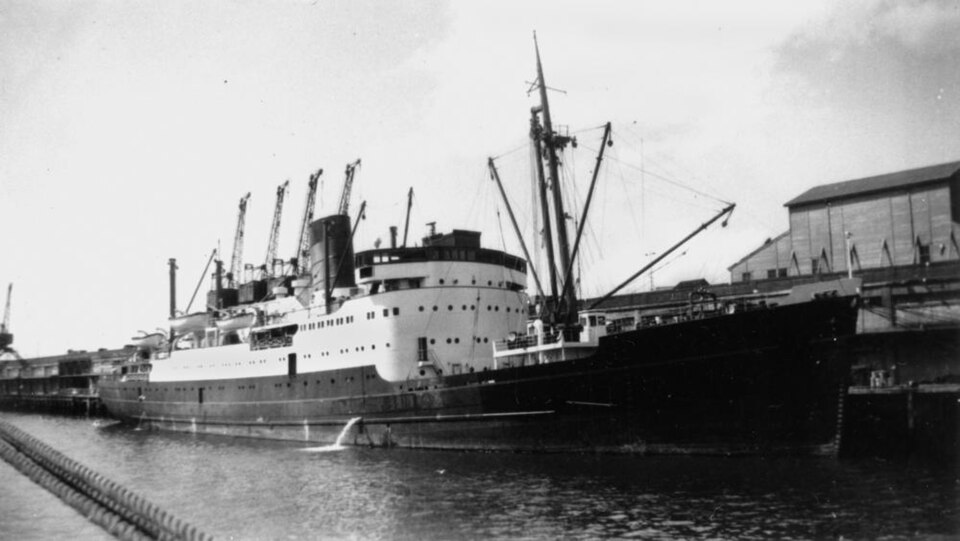
When war broke out Batchelar volunteered at once, went into camp at Awapuni and sailed with the Main Body as a lieutenant in the Wellington Mounted Rifles. The Cenotaph lists his transport as the Orari or the Arawa (HMNZT 6 or 10), 16 October 1914. His regimental number was 11/13.
Source: Manawatu Times 3 Sep 1915; Online Cenotaph C34815 (NZEF Nominal Roll Vol. I)Wounded at Gallipoli
On 29 August 1915 Batchelar was reported killed in action and the Manawatu Times printed a notice of his death on 3 September. On 9 September his father learned that he had not been killed but wounded. By November he was a captain, writing home from hospital that he had been hit by shrapnel at the Dardanelles.
Source: Manawatu Times 3 Sep 1915 (MT19150903.2.15) and 10 Sep 1915 (MT19150910.2.15); Feilding Star 12 Nov 1915 (FS19151112.2.11)Wounded again in France
By August 1916 he was a major, and the casualty list of that month recorded him as wounded in France, the second time he had been wounded.
Source: Hawke's Bay Tribune 14 Aug 1916 (Papers Past HBTRIB19160814.2.31)Officer Commanding Troops
The Cenotaph records him as a major on the Headquarters Staff, Officer Commanding Troops on the Tofua (HMNZT 98), leaving 13 November 1917. He was promoted lieutenant colonel on 17 March 1919.
Source: Online Cenotaph C34815 (NZEF Nominal Roll Vol. III; Williams Album note); Manawatu Heritage retirement letterHome to Palmerston North
Batchelar returned in 1919. On 30 September 1919 past and present members of B Squadron, Manawatu Mounted Rifles, gave a complimentary dinner for him in Palmerston North, where he was praised for having risen from lieutenant to lieutenant colonel. He retired from the New Zealand Military Forces in July 1927 and died on 13 November 1964, aged 88. He is buried at Kelvin Grove Cemetery. The family farm land is now the site of the Batchelar Research Centre, and his papers were given to Palmerston North's library and museum by his widow, Cordelia.
Source: Manawatu Times 1 Oct 1919; Manawatu Heritage item (retirement letter, 1927); Online Cenotaph C34815; National Library record of his papers (via search result, not read in full)
Rank and insignia
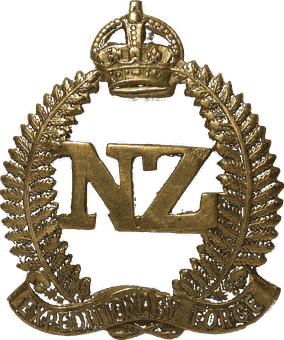
The rank he held, and the badge a soldier of that rank wore. These are simplified illustrations.
His medals
“Documented” means a source we name says he received it. “Listed on the Online Cenotaph” means the museum’s record lists the medal but we could not confirm it elsewhere. “Entitled” means his service dates qualified him, but we have not seen a record of the medal itself. The drawings are simplified illustrations.
His ships
Afterwards
After the war Batchelar returned to Palmerston North and retired from the New Zealand Military Forces in July 1927. He died on 13 November 1964, aged 88, and is buried at Kelvin Grove Cemetery. His widow Cordelia deposited his papers with Palmerston North's library and Te Manawa museum in 1971, and the family farm site now bears his family's name as the Batchelar Research Centre.
His sign
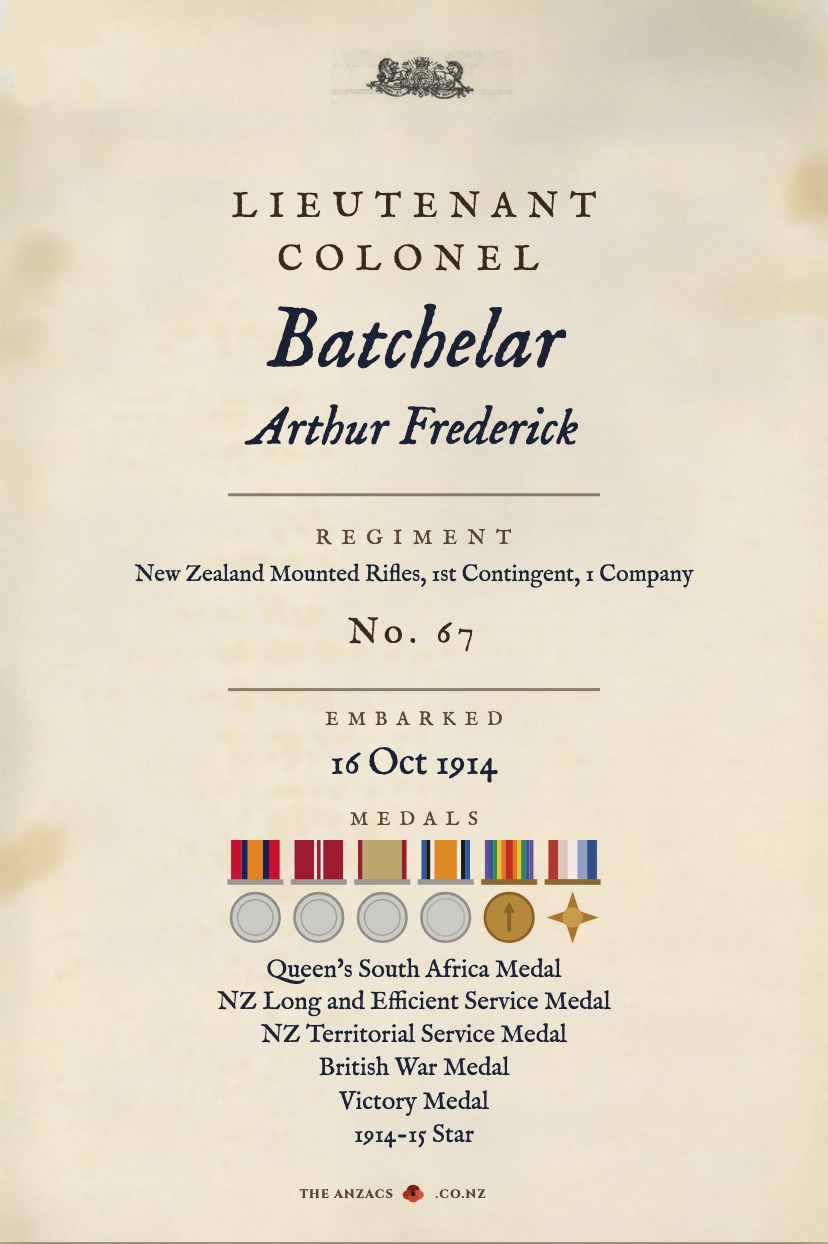
This is the Service Record sign as we would make it from his record: his rank, name, regiment, number and date of embarkation. The medals on the sign are worked out automatically from the embarkation date, so the medals listed above are the ones to rely on.
Photograph
We haven’t hosted a photograph here
Rather than copy someone else’s image onto our own site, we’d rather send you to see it where it’s properly held: his full record at the Auckland War Memorial Museum’s Online Cenotaph.
Sources
- Arthur Frederick Batchelar, Online Cenotaph, Auckland War Memorial Museum.
- NZHistory soldier record, Arthur Frederick Batchelar
- Papers Past, Manawatu Times, 3 Sep 1915, Died for His Country
- Papers Past, Manawatu Times, 10 Sep 1915, Personal
- Papers Past, Feilding Star, 12 Nov 1915, Personal
- Papers Past, Hawke's Bay Tribune, 14 Aug 1916, Personal
- Papers Past, Manawatu Times, 9 May 1917, Medals Presented
- Papers Past, Manawatu Times, 1 Oct 1919, Complimentary Dinner
- Manawatu Heritage, letter on retirement of Lieutenant Colonel Arthur Batchelar
What we could not confirm
Birth year: Cenotaph gives 1 January 1876 (a placeholder date) and age 88 at death, which fits 1876; the Manawatu Heritage item gives 1877. Exact birth date not found.
Surname is spelled Batchelor/Bachelor in several official records; the family and NZHistory confirm Batchelar.
Wartime movements are not fully reconciled: the Cenotaph shows a 13 November 1917 departure on the Tofua as Officer Commanding Troops, but a May 1917 newspaper already listed him as 'away on active service'. He was wounded in France by August 1916. His 1916-17 recovery and return to NZ, and the date and ship home in 1919, were not found.
The Manawatu Times says he commanded a squadron of the 'Hawke's Bay' regiment in the Wellington Mounted Rifles; Cenotaph says Wellington Mounted Rifles, 2nd Reinforcements (with the note 'Ex Main Body'). Treated as Main Body, 16 Oct 1914, per the newspaper. The Cenotaph's transport (Orari or Arawa) is not resolved.
Date and place of his Gallipoli wound given only as late August 1915 (the 29th was the date of the mistaken death report). Nature of the 1916 wound unknown.
No gallantry awards or mentions in despatches were found.
Marriage: widow named Cordelia (from a search-result description of his papers); date of marriage and children not found. Cenotaph shows him 'single' on 16 Oct 1914.
'Harleck Castle' is as spelled on the Cenotaph (probably the Union-Castle liner Harlech Castle).