Most decorated · 14 medals and honours, 0 for gallantry
Lieutenant Colonel George Bertrand
George Bertrand was a Ngati Mutunga schoolteacher from Urenui who sailed with the Main Body in 1914, served as a private on Gallipoli, was commissioned and wounded three times on the Western Front, then returned to arms in 1939 as second-in-command of the 28th (Maori) Battalion. He is on the list for the sheer length of his ribbon bar: fourteen medals and honours, led by an OBE, across two wars and nearly two decades of Territorial command. He won no gallantry award.
14medals and honours
0of them for gallantry
His medals and honours
Every other medal and honour (14)
His story
Sails with the Main Body
A Te Aute-educated teacher from Urenui, he enlisted as a private in the Wellington Infantry Battalion and embarked on 16 October 1914, reaching Egypt on 3 December.
Source: Auckland Museum Online Cenotaph record C38446 (award list and embarkation data, read via api.aucklandmuseum.com)Gallipoli
He served with the Wellington Battalion on Gallipoli (Wikipedia and the 1943 Taranaki Daily News profile both say he served in the last war; the Official History records three wounds across his service).
Source: Wikipedia, George Bertrand; Official History of NZ in the Second World War: 28 (Maori) Battalion, ch.1 and footnote 2 (NZETC, read via National Library web archive)Commissioned and back overseas
Embarked again on 20 August 1916 as a Second Lieutenant with J Company, 16th Reinforcements, arriving in England on 24 October 1916.
Source: Auckland Museum Online Cenotaph record C38446 (award list and embarkation data, read via api.aucklandmuseum.com)Wounded in France
A Taranaki paper reported in September 1917 that Lieutenant Bertrand, wounded on 20 August, was back in the firing line. This is probably him, though the report does not give a first name.
Source: Taranaki Herald, 12 September 1917 (Papers Past TH19170912.2.7)Education officer, then home
Reported in March 1919 as regimental education officer at Sling Camp; discharged on 23 November 1919 as a Lieutenant, and returned to teach at New Plymouth Boys' High School.
Source: Taranaki Daily News, 18 March 1919 (Papers Past TDN19190318.2.25); Auckland Museum Online Cenotaph record C38446 (award list and embarkation data, read via api.aucklandmuseum.com)Commands the Taranaki Regiment
Commanded the 1st Battalion, Taranaki Regiment, from 1930 until his term expired on 2 June 1935, and received the Jubilee Medal in May 1935.
Source: Taranaki Daily News, 5 June 1935 (TDN19350605.2.93) and 11 May 1935Second-in-command, 28 (Maori) Battalion
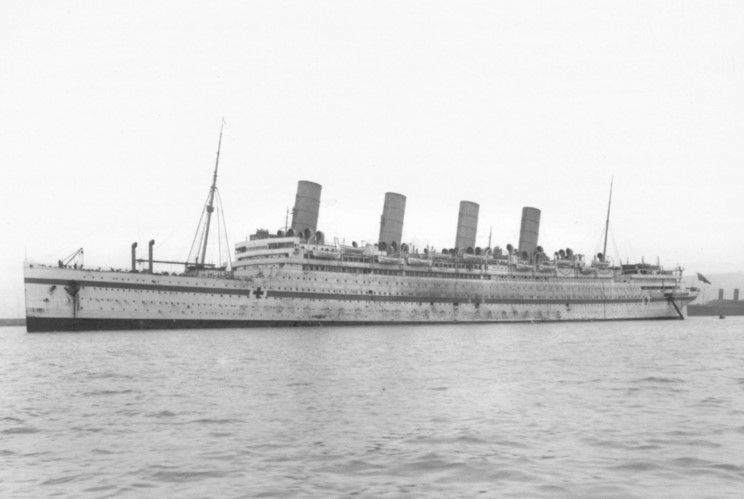
Appointed Major and second-in-command in November 1939; embarked on the Aquitania in May 1940 (he was briefly commanding the battalion while its CO was OC Troops), and served in Egypt, Greece and Crete until October 1941. He was in hospital on Crete when the Germans took the island and was invalided home.
Source: Official History of NZ in the Second World War: 28 (Maori) Battalion, ch.1 and footnote 2 (NZETC, read via National Library web archive); Taranaki Daily News, 4 January 1943Commands 2nd Maori Battalion and the Maori Training Unit
Back in New Zealand he commanded the 2nd Maori Battalion and the Maori Training Unit; the OBE followed in the 1943 New Year Honours.
Source: Official History of NZ in the Second World War: 28 (Maori) Battalion, ch.1 and footnote 2 (NZETC, read via National Library web archive); London Gazette issue 35841, supplement, 1 January 1943, p.9 (thegazette.co.uk)
Rank and insignia
The ranks he held, and the badge a soldier of that rank wore. These are simplified illustrations.
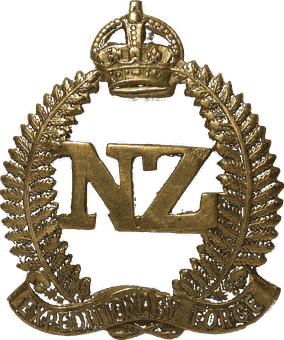
His ships
Afterwards
Bertrand went back to the classroom at New Plymouth Boys' High School after both wars, was a keen Rugby man (Taranaki representative in 1912-13) and sat on the Ngarimu Scholarship Fund Board. He died in Palmerston North on 25 July 1957 from injuries in a car crash and was buried at Te Henui Cemetery, New Plymouth. His grandchild, Georgina Beyer, was named after him.
Later awards, not counted here: OBE (1 January 1943); 1939-1945 Star; Africa Star; Defence Medal; War Medal 1939-1945; New Zealand War Service Medal.
His sign
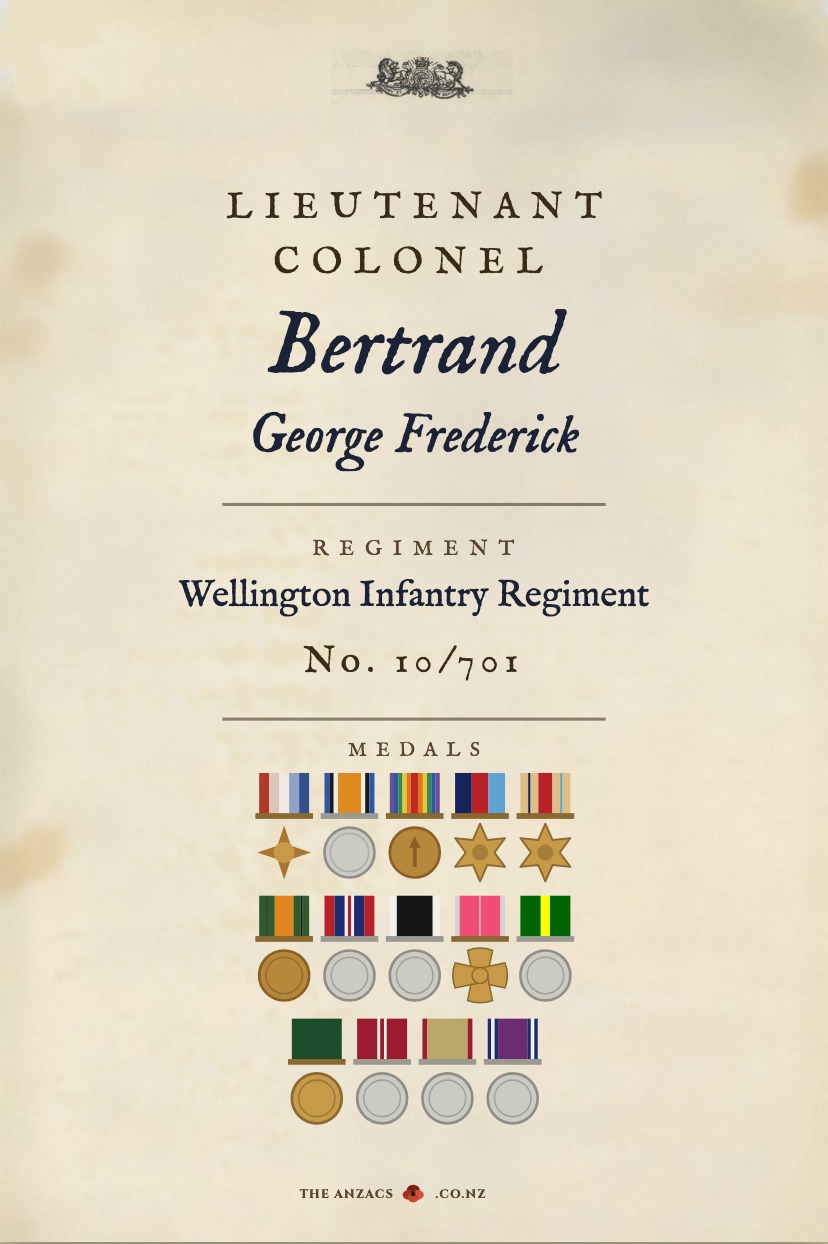
This is the Service Record sign as we would make it from his record: his rank, name, regiment, number and date of embarkation. The medals on the sign are worked out automatically, so the medals listed above are the ones to rely on.
Photograph
We haven’t hosted a photograph here
Rather than copy someone else’s image onto our own site, we’d rather send you to see it where it’s properly held: his full record at the Auckland War Memorial Museum’s Online Cenotaph.
Sources
- George Frederick Bertrand, Online Cenotaph, Auckland War Memorial Museum.
- Online Cenotaph record C38446 (George Frederick Bertrand)
- London Gazette 35841, supplement, 1 January 1943, p.9 (OBE)
- Official History of NZ in WW2: 28 (Maori) Battalion, ch.1 (footnote 2)
- Wikipedia: George Bertrand
- 28 Maori Battalion website: George Frederick Bertrand (Te Ao Hou obituary)
- Taranaki Daily News, 4 January 1943: Wide Military Experience Of Lt.-Col. G. F. Bertrand
- Taranaki Daily News, 5 June 1935: Change in Command
- Taranaki Herald, 12 September 1917: Personal
What we could not confirm
SERVED WW1: yes, as a New Zealander (born Urenui; Main Body private 1914; Wellington Infantry; three times wounded). Nothing argues against listing him as a New Zealander of that war.
No gallantry award found: the Official History footnote (which lists decorations and m.i.d.) gives only OBE, ED; Victory Medal is plain on the Cenotaph, so no Mention in Despatches is counted. The OBE is a service honour, not a gallantry award.
Total of 14 follows the Cenotaph award list exactly (the Wikipedia ribbon bar shows the same 14). Only OBE (London Gazette), ED (Official History/obituary) and the Jubilee Medal (Papers Past photo caption) were corroborated; the campaign medals follow from his documented service; the other three long-service items are Cenotaph/Wikipedia only.
Doubt: 'Colonial Auxiliary Forces Decoration' sits oddly beside the ED, which replaced it in 1931 (he was commissioned only in 1916). If it is a duplicate of the ED the total is 13; if the NZ Long and Efficient Service Medal and Territorial Service Medal are also unreliable, the corroborated-only floor is 10.
The 1 January 1943 gazette entry shows no ED after his name, so the ED may date from after that; its date was not found.
Cenotaph shows a puzzling 'third embarkation' (April 1942, Prestwick) and a Maori Battalion 'Serial No 10' on the 28 Maori Battalion site; ignored as record noise.
Wounded Aug 1917 item (Taranaki Herald) names only 'Lieutenant Bertrand'; assumed to be George, not his brothers.
Noonans/other medal-group records, Puke Ariki and the NZ Gazette were not reachable (access blocked), so no actual medal-group record was seen.