First Contingent 1899 · Queen's Scarf · Seventh Contingent · First World War 1914-1918
Captain Henry Coutts
Henry Donald Coutts was a Taranaki farmer and land valuer who sailed with the First Contingent as a trooper and came home a corporal wearing one of the rarest honours of the Boer War: a scarf crocheted by Queen Victoria herself, awarded for carrying a wounded soldier out of danger under fire at Koornspruit on 31 March 1900.
He went back to South Africa in 1902 as a captain and quartermaster of the Seventh Contingent, and when the First World War came he enlisted again as a corporal in the Auckland Infantry Battalion, at an age when most men had long since stopped being soldiers.
His story
From Canterbury to Taranaki
Henry Donald Coutts was born in November 1866 at Coutts Island, Canterbury. His family moved to Patea in 1874. He took up farming and land valuing in Taranaki, working land at Ngāere, and as a young man played three first-class cricket matches for Taranaki between 1882 and 1892.
Source: Taranaki Daily News obituary, 3 May 1944 (Papers Past TDN19440503.2.99.4); Wikipedia, Henry Coutts; Hawera & Normanby Star 18 Oct 1900; Online Cenotaph record C34714Sailing with the First Contingent
Coutts, then 32 and listed as a farmer, enlisted as a private (regimental number 96) in the First Contingent of New Zealand Mounted Rifles and sailed from Wellington on the Waiwera on 21 October 1899.
Source: Online Cenotaph record C34714; Papers Past, Taranaki Daily News 3 May 1944Koornspruit: the rescue
At Koornspruit (Sanna's Post) the British column was ambushed, and the New Zealanders covered the retirement in sections, each firing, remounting and riding back in turn. Coutts found a wounded non-commissioned officer of the Burma Mounted Infantry, named Edgar, lying on the veldt. With the help of a fellow New Zealander he got the man in front of him on his horse and carried him, holding him in the saddle as he lost consciousness, to an ambulance near Bushman's Kop. Edgar later died in hospital, but he had said that without the New Zealander he would not have survived the veldt.
Source: Poverty Bay Herald 23 Aug 1900 (as transcribed on Online Cenotaph C34714); Manawatu Standard 17 Dec 1900 (Papers Past MS19001217.2.11.4, interview with Coutts); Army Museum page 'Trooper Coutts and The Queen's Scarf'The Queen's Scarf
Queen Victoria crocheted a small number of scarves for the most gallant colonial soldiers of the campaign, and Lord Roberts chose Coutts for one of the four sent to colonial troops. The covering letter, dated Pretoria 10 July 1900, asked that it be presented to Private Henry Donald Coutts for conspicuous gallantry. The award was reported in New Zealand in August 1900. Press reports at the time said the scarf was regarded as an honour equal to the Victoria Cross, and a souvenir album later claimed that the King had approved a gold star and clasp to go with it.
Source: Hawera & Normanby Star 18 Oct 1900 (Papers Past HNS19001018.2.13.3); Daily Telegraph (Napier) 11 Dec 1900 (DTN19001211.2.24.4); St Clair Inglis, Souvenir Album (cited on Online Cenotaph C34714); Wikipedia, Henry CouttsHome as a corporal
Coutts returned to New Zealand on the Westralia, arriving in the south in December 1900 with the rank of corporal. He had served with General French's column right up to Komati Poort, spoke well of the Orange River Colony as farming country, and said he meant to go back there. He passed through Palmerston North on the way to Taranaki and, by every account, said little about his own deed.
Source: Daily Telegraph (Napier) 11 Dec 1900 (Papers Past DTN19001211.2.24.4); Manawatu Standard 17 Dec 1900 (MS19001217.2.11.4); Online Cenotaph C34714Back to South Africa with the Seventh Contingent
In early 1902 Coutts was gazetted Captain and Quartermaster on the regimental staff of the Seventh Contingent under Lieutenant-Colonel Porter. After the war he served as a captain in the New Zealand Militia and worked as a government valuer.
Source: Auckland Star 28 Feb 1902 (Papers Past AS19020228.2.58.5); Press 1 Mar 1902 (CHP19020301.2.35.3); Wikipedia, Henry Coutts; Army Museum pageGiving the scarf to the nation
In 1913 Captain Coutts, then living in Auckland and about to leave New Zealand, sent the Queen's Scarf to the Minister of Defence together with his Queen's and King's South Africa medals, suggesting they be displayed at Parliament. The scarf hung for many years in the General Assembly Library and was later passed to the National Army Museum at Waiouru.
Source: Taranaki Herald 29 Apr 1913 (Papers Past TH19130429.2.55); Army Museum page; Wikipedia, Henry CouttsEnlisting again at fifty
Coutts enlisted again in 1916, giving his trade as carpenter, and embarked with A Company of the Auckland Infantry Battalion, 19th Reinforcements, as a corporal (regimental number 33022) on 15 November 1916. The Army Museum records that he understated his age to be accepted, being about 50. He served in England and was medically discharged in 1918.
Source: Online Cenotaph record C34714; Army Museum page 'Trooper Coutts and The Queen's Scarf'; Taranaki Daily News 3 May 1944 ('served in England')Later life
After the war he farmed near Kāwhia and in Taranaki and worked in sawmilling. He had married Margaret Brown of Ngāere; she and their only son had died before him. He died in Auckland on Sunday 30 April 1944, aged 77, and was buried at Waikumete Cemetery.
Source: Taranaki Daily News 3 May 1944 (Papers Past TDN19440503.2.99.4); Army Museum page; Online Cenotaph C34714 (burial)
Rank and insignia
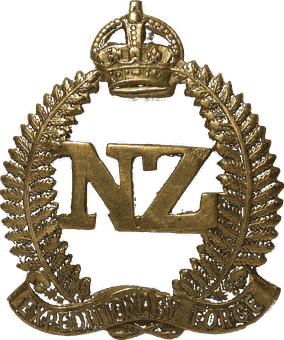
The rank he held, and the badge a soldier of that rank wore. These are simplified illustrations.
His medals
“Documented” means a source we name says he received it. “Listed on the Online Cenotaph” means the museum’s record lists the medal but we could not confirm it elsewhere. “Entitled” means his service dates qualified him, but we have not seen a record of the medal itself. The drawings are simplified illustrations.
His ships
Afterwards
Coutts spent his later years in Taranaki and Auckland. His wife Margaret (née Brown, of Ngāere) and their one son died before him. He died in Auckland on 30 April 1944 and is buried at Waikumete Cemetery, Glen Eden. His Queen's Scarf is held by the National Army Museum at Waiouru, and he is remembered as one of only a handful of colonial soldiers, and one of four in the contingents of 1900, to receive it.
His sign
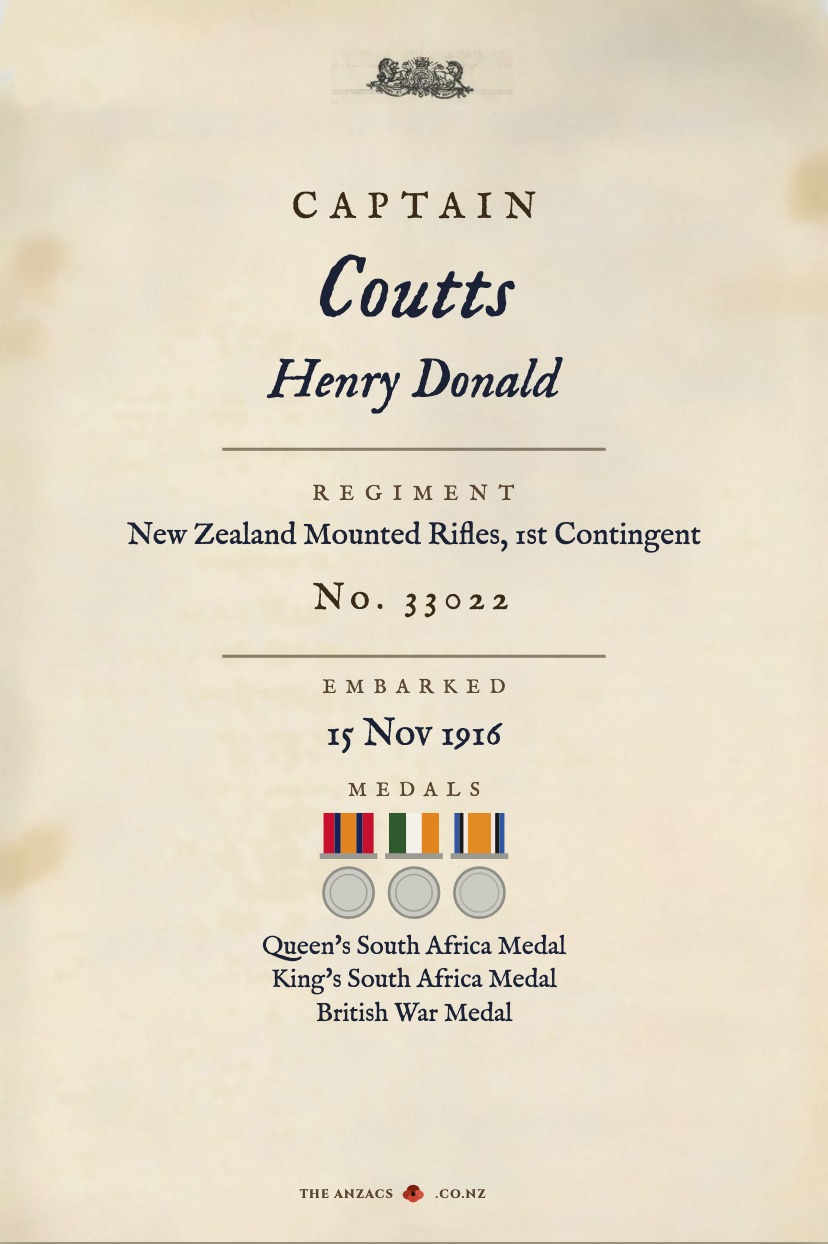
This is the Service Record sign as we would make it from his record: his rank, name, regiment, number and date of embarkation. The medals on the sign are worked out automatically from the embarkation date, so the medals listed above are the ones to rely on.
Photograph
We haven’t hosted a photograph here
Rather than copy someone else’s image onto our own site, we’d rather send you to see it where it’s properly held: his full record at the Auckland War Memorial Museum’s Online Cenotaph.
Sources
- Henry Donald Coutts, Online Cenotaph, Auckland War Memorial Museum.
- Papers Past, Hawera & Normanby Star, 18 Oct 1900, Trooper H. D. Coutts
- Papers Past, Daily Telegraph (Napier), 11 Dec 1900, A Queen's Scarf Winner
- Papers Past, Manawatu Standard, 17 Dec 1900, A Queen's Scarf Wearer
- Papers Past, Auckland Star, 28 Feb 1902, Seventh Contingent Roll
- Papers Past, Taranaki Herald, 29 Apr 1913, A Queen's Scarf
- Papers Past, Taranaki Daily News, 3 May 1944, Death of Mr H. D. Coutts
- National Army Museum, Trooper Coutts and The Queen's Scarf
- Wikipedia, Henry Coutts
What we could not confirm
Death date conflict: Online Cenotaph says 3 April 1944 aged 78; the Taranaki Daily News of Wednesday 3 May 1944 says he died at Auckland 'on Sunday' (30 April 1944), which matches the Army Museum page (30 April). Cenotaph's date looks like the newspaper date misread. Place: Cenotaph/Wikipedia/obituary say Auckland; the Army Museum page says Wellington. Use Auckland, 30 April 1944.
Birth date: obituary gives 13 November 1866, NZHistory/Wikipedia say 14 November 1866. Age at death is therefore 77 (Cenotaph says 78).
The 'gold star and clasp equal to the VC' wording comes from the 1902 Souvenir Album (via Cenotaph) and Wikipedia; I did not find an official source for a separate decoration. Present as a claim, not a documented medal.
Cenotaph shows his final rank as Captain (South African War); his WWI rank on embarkation was Corporal. No later WWI promotion found.
WWI details (understated age, medical discharge 1918, farming near Kāwhia, sawmilling) come only from the Army Museum page; his full Archives NZ file (R20524588) was not viewed. Exact WWI discharge date, hospital stays and ship home are unknown.
Outward ship 15 Nov 1916 is 'Tahiti or Maunganui' per Cenotaph; not resolved.
I did not find which company of the First Contingent he served in, or his Queen's South Africa Medal clasps.
Returning ship Westralia (Dec 1900) and 'with General French to Komati Poort' come from a single Press Association item.