First Contingent 1899 · Hāwera Mounted Rifles · Boer War · British Army 1914-1918
Major-General Richard Davies
Richard Hutton Davies was an Inglewood surveyor who commanded the Hāwera Mounted Rifles and sailed on the Waiwera in 1899 as captain of No. 1 Company. He went on to lead the Fourth and Eighth New Zealand Contingents in South Africa, and became the first New Zealand officer to command an independent force on active service overseas.
In 1914 he took a British infantry brigade to France with the original Expeditionary Force, and then commanded the 20th (Light) Division, the first New Zealander to command a division in the First World War. His health gave way under the strain, and he died in London in May 1918.
His story
London to Taranaki
Richard Hutton Davies was born in London on 14 August 1861, the son of a journalist, Theophilus Davies, and his wife Mary. He was educated at St John's College, Hurstpierpoint, in Sussex, then emigrated to New Zealand. After two years on an uncle's sheep station in Canterbury he settled in Taranaki, farming and working as a surveyor at Inglewood. He qualified as a civil engineer and surveyor in 1884 and married Ida Mary Cornwall at Bell Block on 24 February 1886.
Source: Te Ara, Dictionary of NZ Biography (Garry Clayton), 'Davies, Richard Hutton'; Wikipedia, 'Richard Hutton Davies'The Hāwera Mounted Rifles
Davies joined the Hāwera Mounted Rifle Volunteers on 10 April 1893, was commissioned a lieutenant in May 1895 and within about six weeks was captain and commander of the unit. He was also active in local government, serving as surveyor to a road board and, from 1897, on the New Plymouth Harbour Board.
Source: Te Ara DNZB; Wikipedia, 'Richard Hutton Davies' (citing Taranaki Herald, Hāwera & Normanby Star)Captain of No. 1 Company
On 3 October 1899 Davies moved to the New Zealand Militia as a temporary major, instructing mounted volunteers in the North Island. Within three weeks he was seconded in his rank of captain to command No. 1 Company of the First Contingent. The contingent sailed from Wellington on the Waiwera on 21 October 1899 and reached South Africa on 23 November. A Hāwera newspaper of 16 October 1899, listing the officers appointed so far, named him as captain of the first company.
Source: Online Cenotaph record C34773; Te Ara DNZB; Papers Past, Hāwera & Normanby Star 16 Oct 1899With French's cavalry
Within a week of landing the New Zealanders were on active service with General French's cavalry division. The Army List entry quoted at his death records Davies at Colesberg, the Relief of Kimberley, and in the Orange Free State at Houtnek, Vet River (5-6 May 1900) and Zand River, then at Johannesburg, Pretoria and Diamond Hill (June 1900). He was promoted major in May 1900 and commanded the Third Contingent for about four weeks (26 May to 29 June 1900).
Source: Papers Past, Evening Post 14 May 1918 (Army List extract); Te Ara DNZB; Online Cenotaph C34773Commanding the Fourth Contingent
Transferred to the Rhodesian Field Force, Davies took over the Fourth Contingent (Rough Riders) in July-August 1900 and kept it until the middle of 1901. His handling of set battles and the mobile veld operations built his reputation, and men who served under him spoke warmly of him. He was promoted lieutenant-colonel and made a Companion of the Order of the Bath in 1901. After about eighteen months of continuous service he embarked for home on 12 June 1901; the Tagus reached Wellington in mid-July 1901, where the Premier told him he had seen the longest service of any officer the colony had sent.
Source: Te Ara DNZB; Wikipedia 'Richard Hutton Davies'; Papers Past, Evening Post 15 Jul 1901 and Evening Star 12 Jul 1901; Online Cenotaph C34773 (Tagus)The Eighth Contingent
Davies commanded the Auckland military district from October 1901, was made brevet colonel in January 1902, and then led the Eighth Contingent, which left Auckland on 1 February 1902 (the Cenotaph gives the ship as the Surrey). It served as a single unit, making Davies the first New Zealand officer to command an independent force on active service overseas. After the peace he came home on the troopship Britannic, which reached Wellington on 1 August 1902. He was mentioned in Lord Kitchener's final despatch.
Source: Te Ara DNZB; Online Cenotaph C34773; Papers Past, Auckland Star 2 Aug 1902Reforming the New Zealand forces
Davies commanded the Auckland district until December 1906, when he became Inspector-General of the New Zealand Defence Forces and a member of the Council of Defence as a substantive colonel. He criticised weaknesses in the volunteer system and argued for universal part-time military training. His first wife Ida died in December 1906, and on 7 May 1908 he married her younger sister, Eileen Kathleen Cornwall, at New Plymouth.
Source: Te Ara DNZB; Wikipedia 'Richard Hutton Davies'Across to the British Army
In 1909 Davies went to England to gain staff experience and was attached to the 2nd Cavalry Brigade for a year. The British Army was so impressed that in October 1910 it offered him command of the 6th Infantry Brigade at Aldershot as a temporary brigadier-general, with the approval of the New Zealand Government. He was the first overseas officer to command a regular British brigade.
Source: Te Ara DNZB; Wikipedia 'Richard Hutton Davies'Mons and the Aisne
When war came in August 1914 Davies took the 6th Brigade, with the 1st Liverpool, 1st South Staffordshire, 1st Royal Berkshire and 1st King's Royal Rifle Corps battalions, to France with the original British Expeditionary Force. He was in the retreat from Mons and was mentioned in despatches. The strain of leading from the front, and the effects of pneumonia earlier in the year, wore him down, and he was sent home after the First Battle of the Aisne; Colonel Robert Fanshawe took over the brigade on 20 September.
Source: Papers Past, Evening Post 14 May 1918; Wikipedia 'Richard Hutton Davies'; Te Ara DNZBThe 20th (Light) Division
Davies was appointed to command the newly raised 20th (Light) Division as a temporary major-general on 19 October 1914, the first New Zealand officer to command a division in the war. On 18 February 1915 he was formally transferred to the British Army with permanent rank. The division moved to France in July 1915. He was mentioned in despatches again (January 1916 according to Te Ara) but handed over command on 8 March 1916 because of ill health.
Source: Wikipedia 'Richard Hutton Davies' (citing London Gazette 23 and 30 Oct 1914, 16 Feb 1915); Te Ara DNZBCannock Chase and his death
He was given command of a reserve centre at Cannock Chase, Staffordshire, where in September 1917 the New Zealand Rifle Brigade's reinforcements came under him, and he again had the chance to command his own countrymen. He was relieved in March 1918. After a long period of physical and mental ill health he took his own life on 9 May 1918 at the Special Neurological Hospital for Officers, Kensington. The funeral service was held on 14 May in the Guards Chapel, Queen Alexandra's Military Hospital, Millbank, with a firing party of New Zealanders and British soldiers, and he was buried at Brompton Cemetery.
Source: Wikipedia 'Richard Hutton Davies'; Te Ara DNZB; Online Cenotaph C34773 (funeral and burial, quoting a 1918 report)
Rank and insignia
The rank he held, and the badge a soldier of that rank wore. These are simplified illustrations.
His medals
“Documented” means a source we name says he received it. “Listed on the Online Cenotaph” means the museum’s record lists the medal but we could not confirm it elsewhere. “Entitled” means his service dates qualified him, but we have not seen a record of the medal itself. The drawings are simplified illustrations.
His ships
Afterwards
Davies died in Kensington on 9 May 1918, aged 56, after two years of poor health, and was buried at Brompton Cemetery, London (reference W.6. 174725 on Online Cenotaph) with full military honours. His widow Eileen died in 1971. One of his sons, Henry Cornwall Davies, served with the NZEF and then transferred to the Royal Engineers in 1915. He is remembered on a memorial plaque at the Auckland Garrison Officers' Club, St Mary's Church, Parnell Road, Auckland. A tribute in the Chronicles of the NZEF described him as a surveyor-soldier who knew open country and earned a reputation as a tactician.
His sign
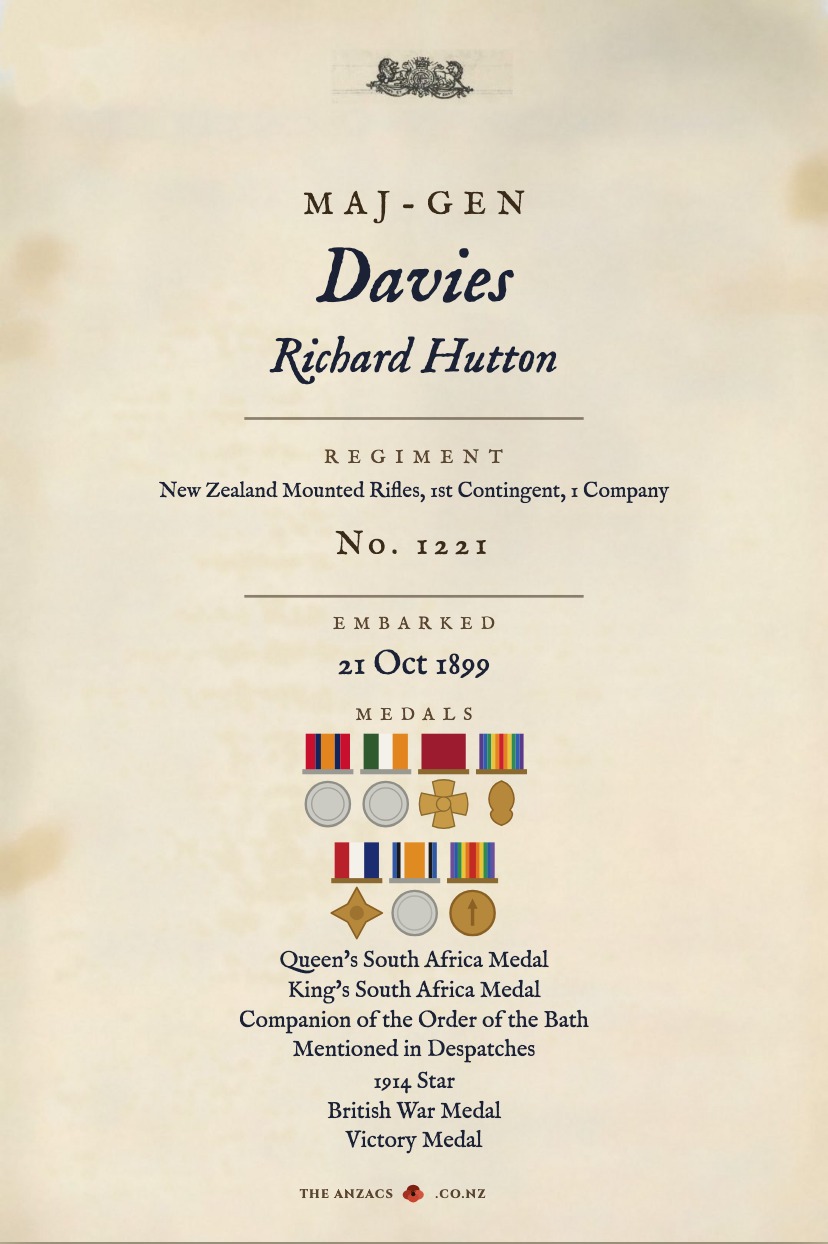
This is the Service Record sign as we would make it from his record: his rank, name, regiment, number and date of embarkation. The medals on the sign are worked out automatically from the embarkation date, so the medals listed above are the ones to rely on.
Photograph
We haven’t hosted a photograph here
Rather than copy someone else’s image onto our own site, we’d rather send you to see it where it’s properly held: his full record at the Auckland War Memorial Museum’s Online Cenotaph.
Sources
- Richard Hutton Davies, Online Cenotaph, Auckland War Memorial Museum.
- Te Ara, Dictionary of New Zealand Biography: Davies, Richard Hutton
- Wikipedia: Richard Hutton Davies
- Papers Past, Evening Post 14 May 1918, 'General R. H. Davies'
- Papers Past, Evening Post 15 July 1901, 'Back from South Africa'
- Papers Past, Auckland Star 2 August 1902, 'Back from the war'
- Papers Past, Hāwera & Normanby Star 16 October 1899, 'The War'
What we could not confirm
Online Cenotaph shows 'Married, 21 Oct 1899' (status on the sailing date, not a wedding date), next of kin 'Mrs Ida Mary Davies (wife), Inglewood' and later 'husband of Eileen Kathleen Davies'. Te Ara gives the marriages: Ida Mary Cornwall 24 Feb 1886 and Eileen Kathleen Cornwall 7 May 1908. Consistent; followed Te Ara.
Cenotaph says his daughter Eileen worked at Walton Hospital; Te Ara says he had two sons and a daughter by his first marriage. Not used on the page.
Mentions in despatches: Cenotaph four, Wikipedia three. QSA clasps: Cenotaph six vs five elsewhere.
Dates of handing over the 20th Division differ: Wikipedia says 8 March 1916; Te Ara says he was evacuated to Britain in late 1916 (Wikipedia calls Te Ara's date an error).
Regimental number 1221 appears on Online Cenotaph only; not confirmed.
WWI outward ship not found; he crossed with the 6th Brigade BEF in August 1914. The Cenotaph 'embarkation 2nd Embarkation' entry is probably a data-entry artefact.
Cause of death (suicide) is stated by Wikipedia, Te Ara and Online Cenotaph; the Evening Post of 14 May 1918 reported only that he 'died suddenly'. Handle tactfully on the page.
Burial reference W.6. 174725 comes from Online Cenotaph only; not checked against Brompton Cemetery records.