First Contingent 1899 · Trumpeter · Bandmaster, Trentham Camp 1914-1919
Regimental Sergeant Major Frederick Fox
Fred Fox was a Christchurch professional musician who sailed with the First Contingent in 1899 as its bugler, and was promoted to sergeant in the field. In the First World War he went into camp at Trentham in December 1914 and spent the war leading the military band there, with the rank of Regimental Sergeant Major.
He was a celebrated cornet player, described in 1918 as New Zealand's champion cornetist, and after the war he conducted bands in Napier, Stratford and, from 1920, in New South Wales.
His story
A Christchurch musician
Frederick Alfred Fox was born in 1878 and grew up in Christchurch, where his father John Fox was at the Zetland Arms in Cashel Street. He was a professional musician when he enlisted.
Source: Online Cenotaph record C34759; NZHistory soldier record (Fox, reg. no. 111, occupation musician)Bugler on the Waiwera
Fox enlisted in No. 2 Company of the First Contingent as bugler (regimental number 111) and sailed on the Waiwera on 21 October 1899.
Source: Online Cenotaph C34759; NZHistory soldier recordPromoted sergeant
A Press Association item of 18 January 1900, about a bugler in a later contingent who refused to sail unless he was made sergeant, notes that Trumpeter Fox of the First Contingent had been made a sergeant. Fox's later movements in South Africa, and his return to New Zealand, were not found.
Source: Press 19 Jan 1900 (Papers Past CHP19000119.2.35)Enlisting again
Fox enlisted on 7 December 1914 as a musician and was given number 24603. In January 1915 the Christchurch Star's band column reported that Mr Fred Fox had been appointed bandmaster of the Expeditionary Force Reinforcement Band at Trentham, and was asking bands around the Dominion for spare music.
Source: Online Cenotaph C34759; Star (Christchurch) 15 Jan 1915 (Papers Past TS19150115.2.13)Trentham Camp Band
In February 1916 Sergeant-Major Fox led the Trentham Camp Band when it took possession of a new set of 26 silver-plated Besson instruments bought by public subscription. In December 1917 Regimental Sergeant-Major F. Fox was publicly complimented by the Commandant, General Sir Alfred Robin, on the band's progress; in June 1918 a reviewer called the conductor, Mr F. A. Fox, New Zealand's champion cornetist.
Source: Evening Post 25 Feb 1916 (EP19160225.2.7); Star (Christchurch) 21 Dec 1917 (TS19171221.2.13); Colonist 27 Jun 1918 (TC19180627.2.14)After the war
In March 1919 Mr F. A. Fox, formerly conductor of the Trentham Military Camp Band, was appointed conductor of the Napier City Band. By July 1920 he had also conducted the Stratford Municipal Band and had been appointed conductor of the Kurri Kurri Band in Newcastle, New South Wales.
Source: Press 5 Mar 1919 (CHP19190305.2.51); Daily Telegraph (Napier) 23 Jul 1920 (DTN19200723.2.28)
Rank and insignia
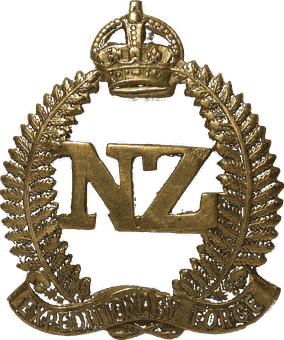
The rank he held, and the badge a soldier of that rank wore. These are simplified illustrations.
His medals
“Documented” means a source we name says he received it. “Listed on the Online Cenotaph” means the museum’s record lists the medal but we could not confirm it elsewhere. “Entitled” means his service dates qualified him, but we have not seen a record of the medal itself. The drawings are simplified illustrations.
His ships
Afterwards
Fox's life after July 1920 has not been traced. He appears to have emigrated to New South Wales to lead the Kurri Kurri Band. No death, burial or family record was found, and the Online Cenotaph carries no death details. A 1923 reference to a 'Lieut. Fox' of the Hastings Citizens' Band may or may not be him.
His sign
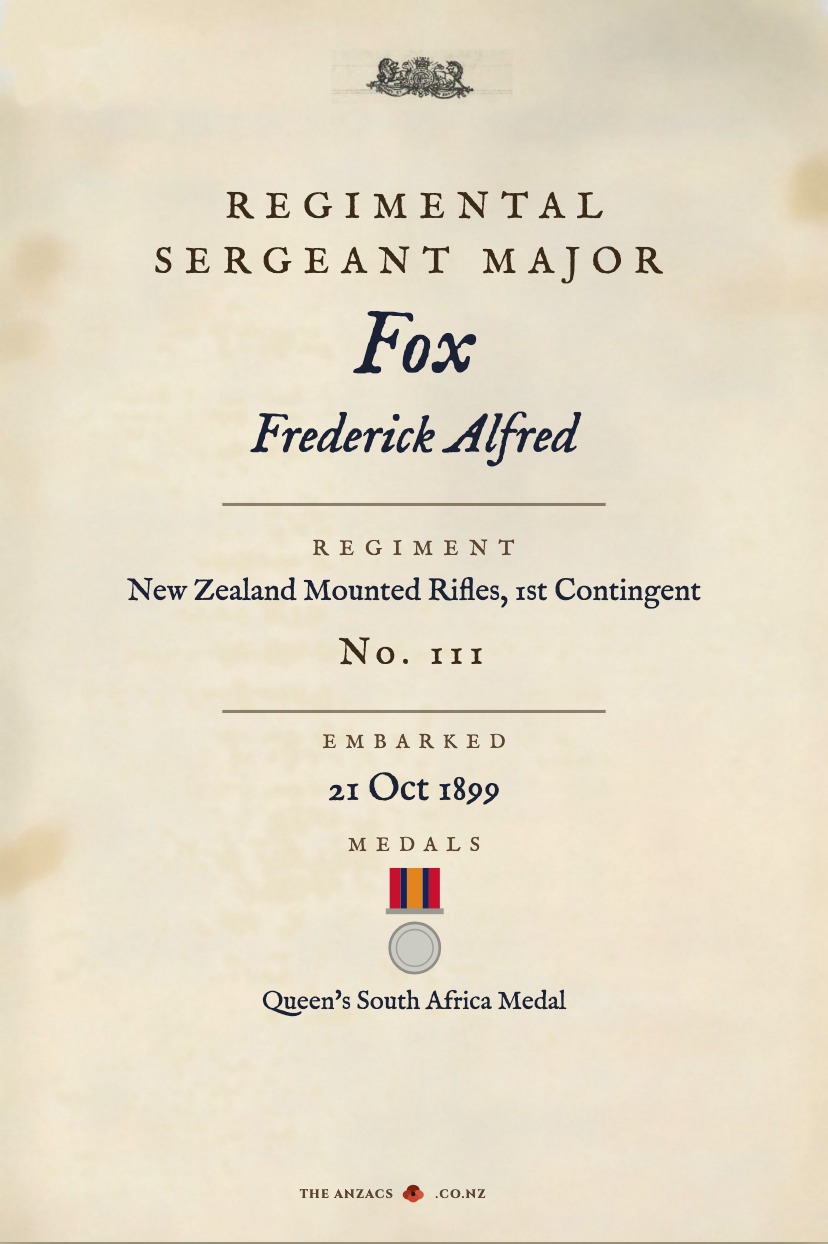
This is the Service Record sign as we would make it from his record: his rank, name, regiment, number and date of embarkation. The medals on the sign are worked out automatically from the embarkation date, so the medals listed above are the ones to rely on.
Photograph
We haven’t hosted a photograph here
Rather than copy someone else’s image onto our own site, we’d rather send you to see it where it’s properly held: his full record at the Auckland War Memorial Museum’s Online Cenotaph.
Sources
- Frederick Alfred Fox, Online Cenotaph, Auckland War Memorial Museum.
- NZHistory soldier record, Frederick Alfred Fox
- Papers Past, Press, 19 Jan 1900, A Bugler's Grievance
- Papers Past, Star (Christchurch), 15 Jan 1915, Our Bandsmen
- Papers Past, Evening Post, 25 Feb 1916, Instruments for Trentham Camp Band
- Papers Past, Star (Christchurch), 21 Dec 1917, Our Bandsmen
- Papers Past, Colonist, 27 Jun 1918, Band Concert at Trentham
- Papers Past, Press, 5 Mar 1919, Personal Items
- Papers Past, Daily Telegraph (Napier), 23 Jul 1920, Personal
What we could not confirm
Identity: the 1899 bugler and the 1914-19 Trentham bandmaster are linked by the Cenotaph (one record, numbers 111 and 24603, 'Musician') and by the newspaper name F. A. Fox / Fred Fox, musician. No article was found that says in one sentence that the bandmaster had been in the First Contingent. Treat as probable.
No evidence he served overseas in the First World War: every report from 1915 to 1919 places him at Trentham Camp. The Cenotaph's '2nd Embarkation' and 'Private' entry is unexplained. Do not state that he sailed overseas or give WWI ship or medals (BWM/Victory) until confirmed from his Archives NZ file (R20520158).
Rank: Cenotaph's last rank is Regimental Sergeant Major (Headquarters Staff). A 1923 'Lieut. Fox' of the Hastings Citizens' Band might be him or a different Fox.
Birth 1 January 1878 is a placeholder date.
His Boer War service in South Africa (battles, wounds, return date) is not documented in the sources reached; only his bugler role and the sergeant's promotion by January 1900.
Later life: Kurri Kurri (NSW) appointment 1920 only. Other Foxes in the papers (H. Fox of the Oamaru Tenth Regimental Band, 1916; a Palmerston North cornetist H. Fox, 1906) were not assumed to be him.
No death, burial or family details found.