Most decorated · 16 medals and honours, 3 for gallantry
Brigadier Frederick Hanson
Frederick Hanson, born in Levin in 1895, won the Military Medal as a young infantry soldier on the Western Front in September 1918 and returned to war in 1940 as an engineer, earning the Distinguished Service Order and a bar as chief engineer of the 2nd New Zealand Division and the 2NZEF. He ended the war a brigadier and later ran the Ministry of Works. Counting the CMG, OBE and campaign medals he holds 16 items across both wars, including the rare combination of MM, DSO and bar.
16medals and honours
3of them for gallantry
His medals and honours
Won for gallantry
Gallantry award
Military Medal
c. 14 September 1918 · Exposed flank near Havrincourt Wood, France · Corporal (gazette); later Sergeant, 1st Battalion, Wellington Infantry Regiment, NZEF
Gazetted: London Gazette supplement 31173, 11 February 1919 (Gazette index date 7 February), page 2144: 70738 Cpl. Hanson, F. M. H., 1st Bn., Wellington R.
Hanson was a young reinforcement who had left the Australian military college at Duntroon in late 1917 and enlisted in the NZEF as a private. In mid-September 1918 the New Zealand Division was fighting its way forward in the Havrincourt Wood area, on the approaches to the Hindenburg Line. Hanson's award records that he handled a Lewis gun and, by his fire, kept off a succession of enemy attacks on an exposed flank. A light machine gun drew counter-attacks, so the man behind it was in constant danger. The Online Cenotaph gives the citation wording as 'gallantry in handling a Lewis gun and keeping off repeated enemy attacks' on the exposed flank 'about 14 September 1918'. The medal was the only gallantry award he won as a private soldier, and it was gazetted in the February 1919 list of Military Medals to Dominion troops, where he appears as a corporal with the service number 70738. He later reached the rank of sergeant and was discharged in June 1919.
Cenotaph and Wikipedia say 'sergeant'; the 1919 Gazette entry says Cpl. Cenotaph dates the Gazette 11 Feb 1919 (the supplement's own date); the Gazette website indexes it as 7 Feb 1919. Exact citation date given only as 'about 14 September 1918'.
Counted in his gallantry totalSource: Online Cenotaph record C36296 (Auckland War Memorial Museum), https://www.aucklandmuseum.com/war-memorial/online-cenotaph/record/C36296; London Gazette supplement 31173 p.2144 (read); Poppy Places, Hanson Road, Linton Camp (summarises the DNZB), https://www.poppyplaces.nz/explore-poppy-places/325-hanson-road-linton-camp/
Gallantry award
Distinguished Service Order (DSO)
6 April 1943 · Wadi Akarit, Tunisia · Lieutenant-Colonel, CRE, 2nd New Zealand Division
Gazetted: London Gazette supplement 36102, 22 July 1943, page 3313 ('gallant and distinguished services in the Middle East'); the Cenotaph cites the NZ Gazette of 21 September 1944
At Wadi Akarit the 2nd New Zealand Division had to break through a strong enemy line anchored on a deep minefield, with armour waiting behind to exploit any breach. Hanson, as the Division's chief engineer, was responsible for getting gaps cleared and marked so that the tanks and infantry could pass. According to the citation as quoted by the Online Cenotaph and by the Poppy Places summary of his DNZB entry, he organised tanks, infantry and engineers to clear the enemy minefield 'under considerable fire', and personally led the tanks forward to the edge of the minefield. His coolness and leadership under fire allowed an enemy position to be taken, and the breakthrough was a step in the 8th Army's advance out of southern Tunisia. He had been mentioned in despatches earlier in the same year (Gazette of 24 June 1943), and the DSO was gazetted only a month later.
Gazette date conflict: London Gazette 22 July 1943 (read, p.3313, 'Lt.-Col. Frederick Melrose Horowhenua Hanson, O.B.E., M.M. (20034)') versus Cenotaph's 'NZ Gazette 21 September 1944', probably the later NZ republication.
Counted in his gallantry totalSource: Online Cenotaph record C36296 (Auckland War Memorial Museum), https://www.aucklandmuseum.com/war-memorial/online-cenotaph/record/C36296; London Gazette supplement 36102 p.3313 (read); Poppy Places, Hanson Road, Linton Camp (summarises the DNZB), https://www.poppyplaces.nz/explore-poppy-places/325-hanson-road-linton-camp/; Wikipedia, Frederick Hanson (engineer), https://en.wikipedia.org/wiki/Frederick_Hanson_(engineer)
Bar: a second award
Bar to the Distinguished Service Order
Late 1944 to May 1945 (Senio to Trieste) · Italy: Senio, Santerno, Sillaro, Idice, Gaiana, Po, Adige, Piave rivers to Trieste · Colonel (temporary Brigadier), CRE 2 NZ Division and later CRE IV Corps / 2NZEF chief engineer
Gazetted: London Gazette supplement 37310, 16 October 1945 (page header 18 October 1945), page 5102: 'Bar to the Distinguished Service Order... Colonel Frederick Melrose Horowhenua Hanson, D.S.O., O.B.E., M.M. (20034)', for services in Italy; Cenotaph cites the NZ Gazette of 30 April 1946
By the Italian campaign Hanson was the senior engineer of the whole New Zealand force. The award recognised a long series of bridging operations as the New Zealand Division and IV Corps followed the Germans across the rivers of northern Italy in the final offensive, from the Senio crossing in April 1945 to the entry into Trieste in early May. According to the citation as given by the Online Cenotaph and the DNZB summary, he showed 'skill of the highest order' in planning and carrying out the bridges, often 'under heavy fire'. The Cenotaph counts nine rivers, from the Senio through the Piave. The Poppy Places summary of his DNZB entry credits him with developing the bridging techniques, including Bailey bridges and mechanical plant, that kept the engineers working right forward in the attack. His first DSO had come for a single action; the bar rewarded a whole campaign of engineering under fire.
The London Gazette date (Oct 1945) differs from the Cenotaph's NZ Gazette date (30 April 1946). Poppy Places says 'bar 1946'. Wikipedia cites LG 37310 p.5102, 16 Oct 1945. The page itself carries a 18 Oct 1945 header; the Gazette index lists 16 Oct.
Counted in his gallantry totalSource: Online Cenotaph record C36296 (Auckland War Memorial Museum), https://www.aucklandmuseum.com/war-memorial/online-cenotaph/record/C36296; London Gazette supplement 37310 p.5102 (read); Poppy Places, Hanson Road, Linton Camp (summarises the DNZB), https://www.poppyplaces.nz/explore-poppy-places/325-hanson-road-linton-camp/; Wikipedia, Frederick Hanson (engineer), https://en.wikipedia.org/wiki/Frederick_Hanson_(engineer)
Every other medal and honour (13)
British War Medal 1914-19201914-1920 (issued after the war)Qualified by his overseas service with the New Zealand Expeditionary Force on the Western Front, Nov 1917 embarkation to 1919.Victory Medal1914-1919 (issued after the war)Qualified by service in a theatre of war in the First World War (Western Front, 1918).Officer of the Order of the British Empire (OBE, Military)Service Nov 1941 to Apr 1942; gazetted 9 September 1942 · Middle East (Libya/Egypt)Hanson's first Second World War honour recognised his work as the New Zealand Division's chief engineer in the Libyan desert fighting of Operation Crusader and its aftermath. The Gazette says the awards in that list…1939-1945 Star1939-1945Qualified by operational service in the Second World War (Greece, Crete and the Western Desert).Africa Star (8th Army clasp)1940-1943 · North AfricaAwarded for service in North Africa; the 8th Army clasp does not count separately.Italy Star1943-1945 · ItalyAwarded for service in the Italian campaign.Defence Medal1940-1945 · EnglandProbably earned by the 2nd Echelon's service in England in 1940-41, where his company trained and guarded the Dover coast.War Medal 1939-19451939-1945Standard medal for full-time service in the Second World War; worn with the oak leaf for the mention in despatches (counted once above).New Zealand War Service Medal1939-1945Awarded to New Zealanders for Second World War service.Efficiency Decoration (ED)Date not found (held by 1961)Long-service decoration for officers of the Territorial Force; he held it by the time of the 1961 Birthday Honours.Coronation Medal 19531953Issued to him as a senior public servant for the coronation of Elizabeth II (Wikipedia citing Taylor and Coddington, Honoured by the Queen, 1994).Companion of the Order of St Michael and St George (CMG)2 June 1961 (Queen's Birthday Honours) · New ZealandHanson's CMG came not for war service but for his public career, in the 1961 Birthday Honours, shortly before his retirement in December 1961. As Commissioner of Works from 1955 he led a department of about 4,500…Mentioned in DespatchesMiddle East, May to October 1942; gazetted 24 June 1943 · Middle EastOne mention in despatches in the Gazette of 24 June 1943, in the same New Zealand list that names General Freyberg and other senior officers. It is worn as a bronze oak leaf on the War Medal 1939-45, which is why the…
His story
Born in Levin
Son of a farmer; scholarship to Wellington College; Territorial Force second lieutenant in 1914.
Source: Wikipedia, Frederick Hanson (engineer), https://en.wikipedia.org/wiki/Frederick_Hanson_(engineer)
Duntroon
Entered the Royal Military College, Duntroon, having misled the authorities about his age, and was expelled for misconduct in October 1917; he resigned or was expelled and then enlisted in the NZEF as a private.
Source: Wikipedia, Frederick Hanson (engineer), https://en.wikipedia.org/wiki/Frederick_Hanson_(engineer); Online Cenotaph record C36296 (Auckland War Memorial Museum), https://www.aucklandmuseum.com/war-memorial/online-cenotaph/record/C36296
Western Front with Wellington Regiment
Embarked on Tahiti (HMNZT 97) with the 31st Reinforcements, reached the 1st Battalion, Wellington Infantry Regiment, and rose to corporal and sergeant.
Source: Online Cenotaph record C36296 (Auckland War Memorial Museum), https://www.aucklandmuseum.com/war-memorial/online-cenotaph/record/C36296
Havrincourt Wood: Military Medal
Held an exposed flank with a Lewis gun against repeated enemy attacks; gazetted 11 Feb 1919.
Source: London Gazette supplement 31173 p.2144; Online Cenotaph record C36296 (Auckland War Memorial Museum), https://www.aucklandmuseum.com/war-memorial/online-cenotaph/record/C36296
Surveyor and roading engineer
Rugby tour with the NZEF team in 1919, home in September 1919; Public Works Department engineer; developed chipseal design principles in 1935.
Source: Wikipedia, Frederick Hanson (engineer), https://en.wikipedia.org/wiki/Frederick_Hanson_(engineer); Poppy Places, Hanson Road, Linton Camp (summarises the DNZB), https://www.poppyplaces.nz/explore-poppy-places/325-hanson-road-linton-camp/
7th Field Company: England, Greece, Crete
Commissioned major commanding 7th Field Company, NZ Engineers; trained in England in 1940, then Greece (Aliakmon Line demolitions) and Crete, acting CRE.
Source: Wikipedia, Frederick Hanson (engineer), https://en.wikipedia.org/wiki/Frederick_Hanson_(engineer)
CRE 2 NZ Division in the desert: OBE, MiD, DSO
Lieutenant-colonel and permanent CRE; OBE for Nov 1941 to Apr 1942; mention in despatches; DSO for Wadi Akarit on 6 April 1943.
Source: London Gazette supplements 35697, 36065, 36102
Italy: chief engineer and bar to DSO
Colonel and chief engineer of the 2NZEF; CRE IV Corps 1944-45; bridged the rivers from the Senio to the Piave and into Trieste; bar to DSO gazetted Oct 1945.
Source: London Gazette supplement 37310 p.5102; Online Cenotaph record C36296 (Auckland War Memorial Museum), https://www.aucklandmuseum.com/war-memorial/online-cenotaph/record/C36296
Roads and Works
Chief engineer of the Main Highways Board, first chairman of the National Roads Board, Commissioner of Works 1955-61; CMG in 1961.
Source: Wikipedia, Frederick Hanson (engineer), https://en.wikipedia.org/wiki/Frederick_Hanson_(engineer)
Rank and insignia
The ranks he held, and the badge a soldier of that rank wore. These are simplified illustrations.
Private1917 · Wellington Infantry Regiment (NZEFNo rank badge: a private soldier wore noneCorporal / Sergeant1918-1919 (Sergeant at discharge 12 June 1919)Two chevronsSecond lieutenant1914 · Territorial ForceShoulder strap: one pipLieutenant1919; reserve 1922; retired list 1930 · Territorial ForceShoulder strap: two pipsMajor1940Shoulder strap: crownLieutenant-colonelOctober 1941Shoulder strap: crown and one pipColonel1943-1945 · temporary Brigadier on several occasionsShoulder strap: crown and three pipsBrigadierdischarged early 1946Shoulder strap: crown and three pips
His ships
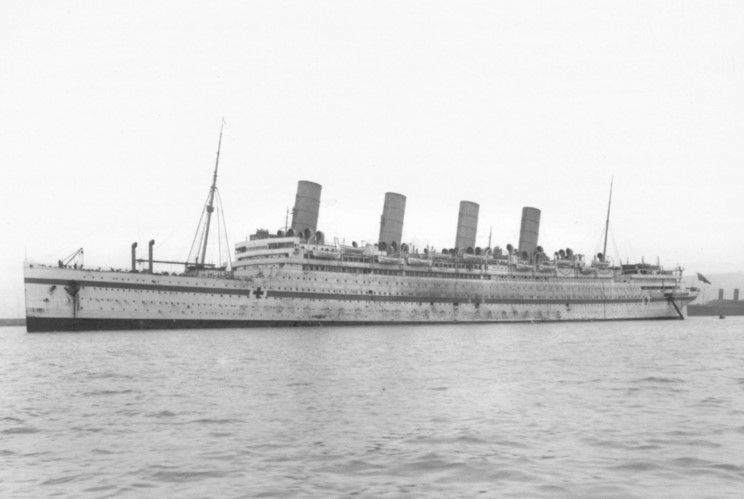
RMS Tahiti (HMNZT 97)WW1 troopship31st Reinforcements embarked 16 Nov 1917 (Cenotaph, date range 16 Nov 1917 to 7 Jan 1918).RMS AquitaniaWW2 troopship7th Field Company left New Zealand in April 1940 aboard Aquitania (diverted to England).Hospital Ship Aquitania · Ernest Brooks · Public domain · Wikimedia Commons
Afterwards
After the war Hanson returned to the Main Highways Board as chief engineer in 1946. He drove the reorganisation that created the National Roads Board in 1953 and became its first chairman, served on the Army Board (1952-55) and became deputy commissioner of works in 1951 and Commissioner of Works in 1955, running the Ministry of Works until December 1961. He was president of the New Zealand Institution of Engineers and was made a CMG in 1961.
He was a rugby player and head prefect in his youth, married Margaret Constance Grindley in 1924 (no children), and is remembered for the chipseal design principles he published in 1935. He died in Wellington on 15 July 1979; Hanson Road at Linton Camp is named after him.
Later awards, not counted here: Officer of the Order of the British Empire (1942); Mention in Despatches (1943); Distinguished Service Order (1943); Bar to the DSO (1945); 1939-1945 Star; Africa Star (8th Army clasp); Italy Star; Defence Medal; War Medal 1939-1945; New Zealand War Service Medal.
This is the Service Record sign as we would make it from his record: his rank, name, regiment, number and date of embarkation. The medals on the sign are worked out automatically, so the medals listed above are the ones to rely on.
The Service Record
Photograph
We haven’t hosted a photograph here
Rather than copy someone else’s image onto our own site, we’d rather send you to see it where it’s properly held: his full record at the Auckland War Memorial Museum’s Online Cenotaph.
Online Cenotaph omits the CMG (1961) and the Mention in Despatches (shown only as the oak leaf on the War Medal); both added from the Gazette.
Cenotaph lists 'DSO and bar' as one entry: reconciled to DSO (1) plus bar (1). The OBE, MiD and CMG are separate items.
Gazette dates conflict with the Cenotaph: DSO London Gazette 22 July 1943 versus 'NZ Gazette 21 September 1944'; bar London Gazette Oct 1945 versus 'NZ Gazette 30 April 1946'. I used the London Gazette (read) and noted the others.
The OBE entry prints his name as 'Hansen' and number 20634 (evident misprints). The 1961 CMG entry reverses his middle names.
MM Gazette entry shows Cpl., but Cenotaph and Wikipedia say he reached Sergeant (discharged 12 June 1919).
Only one mention in despatches confirmed (LG 36065, 24 June 1943); a second for Italy is possible but not found.
Efficiency Decoration: date of award not found; it is shown in his post-nominals in the 1961 Gazette.
Defence Medal is on the Cenotaph list; qualification inferred from 1940-41 England service.
Te Ara (DNZB) returned 403 (Cloudflare), so its content was taken from Wikipedia and Poppy Places, which paraphrase it.
Birth-year conflict: Cenotaph says 9 July 1896; Wikipedia and Poppy Places (DNZB) say 9 July 1895. I used 1895. The sources say he misled Duntroon about his age, which may explain a 1896 date.
No foreign awards found. WWII wounds: wounded three times (Cenotaph) but no wound stripes or other medal to count.
Poppy Places lists the bar as 1946 and mislabels the CMG; ignored.