First Contingent 1899 · Boer War · Auckland Infantry Battalion, First World War
Major Edwin Harrowell
Edwin Harrowell was an English-born farmer from Papatoetoe who sailed with the First Contingent as a sergeant in October 1899 and came home from the Boer War a captain. He went back to South Africa with the Seventh Contingent in 1901, then spent years in the Pacific as a police commander and colonial official.
In 1914 he was home on furlough from the New Hebrides and rejoined at once, sailing with the Main Body as a major and second-in-command of the Auckland Infantry Battalion. He was wounded at Gallipoli, later served in Samoa, and died in Auckland in 1941, aged 74.
His story
An Epsom childhood
Edwin was born at Epsom in Surrey on 28 March 1867. A detailed local-history essay says his father, a butler, died the same year and that Edwin spent part of his childhood in an orphan asylum at Wanstead, then attended Kendrick School in Reading, where he played football as a goalkeeper and worked as a clerk. In September 1895 he sailed for Wellington aboard the Tokomaru.
Source: Online Cenotaph record C34778; NZ War Graves Project (Cenotaph extract, node 67507); Jackson, 'Edwin Harrowell - the orphan of the South Seas', Epsom and Ewell History Explorer (2011)Farming at Papatoetoe
In New Zealand he farmed at Papatoetoe, south of Auckland, and was active in the volunteers. His 1941 obituary says he helped form the country division of the Auckland Mounted Rifles, and the New Zealand Herald of March 1900 remembered him as one of the men his local volunteer corps lost when the First Contingent left.
Source: Online Cenotaph record C34778; Papers Past, Auckland Star 9 Aug 1941 (obituary); New Zealand Herald 26 Mar 1900Off with the First Contingent
Harrowell was one of the Auckland volunteers chosen for the First Contingent. The Auckland Star reported him in charge of the Auckland party on its journey down to the Wellington camp, and listed him in the Auckland Mounted Rifles section as a sergeant aged 32 and a first-class shot. He embarked on the Waiwera at Wellington on 21 October 1899.
Source: Papers Past, Auckland Star 14 Oct 1899 and 26 Oct 1899; Online Cenotaph record C34778Colesberg to Pretoria
The Contingent joined General French's force in the Colesberg area. Harrowell's own letters, printed in a Berkshire newspaper, describe coming under rifle fire in late December 1899 and the fighting at Colesberg on New Year's Day 1900. The Cenotaph lists his campaigns as Colesberg, Paardeberg, Poplar Grove, Driefontein, Houtnek, Vet River (5-6 May 1900), Zand River (10 May 1900), Johannesburg, Pretoria and Diamond Hill.
Source: Online Cenotaph record C34778; Jackson essay (Epsom and Ewell History Explorer), quoting the Berkshire ChronicleTransvaal Constabulary, then home
In June 1900 he joined the Provisional Transvaal Constabulary, a force raised after the capture of Pretoria; the Jackson essay says he held a captain's commission in it. He came home to New Zealand and was welcomed by the Auckland Mounted Rifles in February 1901.
Source: Online Cenotaph record C34778; Jackson essay; Papers Past, New Zealand Herald 15 Feb 1901Back to South Africa as a captain
In March 1901 the Evening Post noted that Captains Coutts and Harrowell had gone into the Seventh Contingent's camp at Newtown, Wellington, adding that Harrowell had been a sergeant in the First Contingent. The Contingent embarked on the Gulf of Taranto at Wellington on 6 April 1901. He served until the war ended in May 1902.
Source: Papers Past, Evening Post 11 Mar 1901; Greymouth Evening Star 9 Apr 1901; Online Cenotaph record C34778; Jackson essayVolunteers, Fiji and the New Hebrides
After the war he was adjutant of the Auckland Mounted Rifles (later the 3rd Regiment) and then of the Auckland Infantry Regiment. A 1915 profile says the Imperial Government asked him to take charge of rifle associations in Fiji. From about 1907 he was police commissioner in the New Hebrides, building the first native police force there. The Jackson essay places a failed 1911 operation against a rebel chief on Santo in this period.
Source: Papers Past, Press 14 May 1915 ('Personal Notes'); Jackson essay (citing Journal of Pacific History, 1998)Second-in-command, Auckland Infantry Battalion
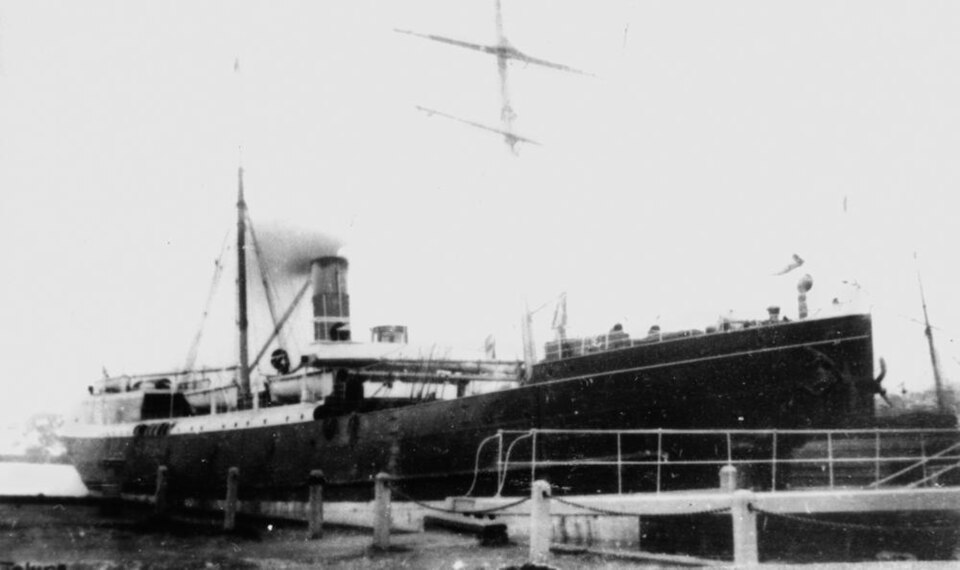
Harrowell was in Auckland on furlough in August 1914. He rejoined the 3rd (Auckland) Regiment and was made second-in-command of the Auckland Infantry Battalion in the Main Body, with the rank of major. The Cenotaph shows him in battalion headquarters, sailing in the convoy that left Wellington on 16 October 1914 aboard either the Star of India (HMNZT 8) or the Waimana (HMNZT 12).
Source: Papers Past, Press 14 May 1915; Online Cenotaph record C34778Wounded at Gallipoli
Major Harrowell was wounded on Gallipoli; the Press listed him among the Auckland Battalion wounded on 14 May 1915. His obituary says he was invalided to England and later to New Zealand, and the Cenotaph notes he was struck off strength as fit for home service only.
Source: Papers Past, Press 14 May 1915; Auckland Star 9 Aug 1941; Online Cenotaph record C34778Samoa and marriage
He sailed on the Talune on 5 March 1917 with the Samoan relief reinforcements and served as Assistant Military Secretary to the Commissioner of the Samoa Garrison. He married nursing sister Florence Camilla Steele about 1917; a marriage notice appeared in Kai Tiaki in July 1917. Their son Dudley was born in Auckland in October 1919.
Source: Online Cenotaph record C34778; Jackson essay; NZ War Graves Project (Dudley Harrowell record)Colonial Service and Epsom
He returned to the Colonial Service in the central Pacific, holding administrative posts at Ocean Island and Fanning Island, and retired to Auckland in the late 1930s. He died at his home, 68 Mount St John Avenue, Epsom, on 7 August 1941, aged 74, and is buried at O'Neill's Point Cemetery.
Source: Papers Past, Auckland Star 9 Aug 1941; Online Cenotaph record C34778; Jackson essay
Rank and insignia
The rank he held, and the badge a soldier of that rank wore. These are simplified illustrations.
His medals
“Documented” means a source we name says he received it. “Listed on the Online Cenotaph” means the museum’s record lists the medal but we could not confirm it elsewhere. “Entitled” means his service dates qualified him, but we have not seen a record of the medal itself. The drawings are simplified illustrations.
His ships
Afterwards
After the war Edwin Harrowell stayed in the Colonial Service in the central Pacific, with postings on Ocean Island and Fanning Island. He and his wife Camilla retired to Auckland in the late 1930s and lived in Epsom, the suburb that shares a name with his English birthplace. He died on 7 August 1941 and was buried at O'Neill's Point Cemetery, Bayswater (Row N, Plot 056). Camilla, who died in 1961, is buried beside him.
Their only son, Lieutenant Dudley Steele Harrowell, born in Auckland in 1919, served with 23 Battalion in the Second World War and died of wounds in Tunisia in late March 1943, aged 23.
His sign
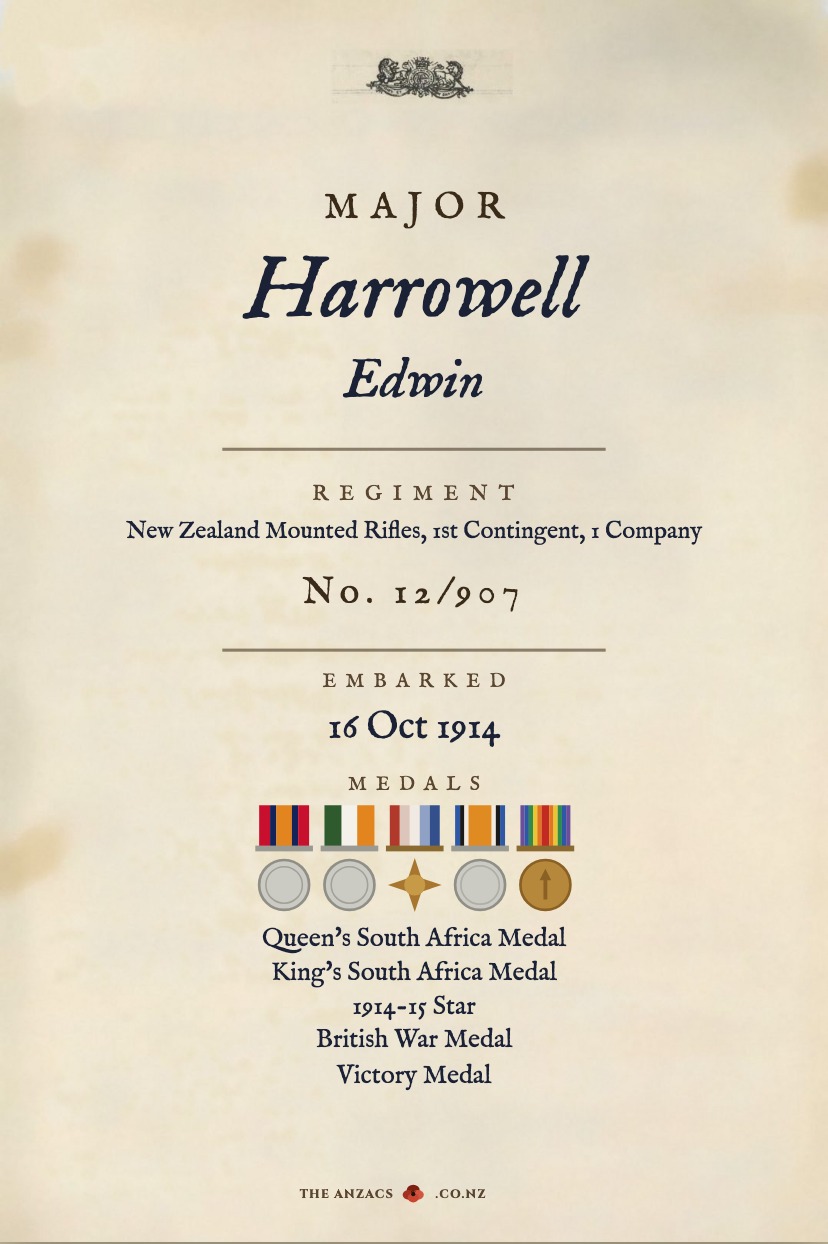
This is the Service Record sign as we would make it from his record: his rank, name, regiment, number and date of embarkation. The medals on the sign are worked out automatically from the embarkation date, so the medals listed above are the ones to rely on.
Photograph
We haven’t hosted a photograph here
Rather than copy someone else’s image onto our own site, we’d rather send you to see it where it’s properly held: his full record at the Auckland War Memorial Museum’s Online Cenotaph.
Sources
- Edwin Harrowell, Online Cenotaph, Auckland War Memorial Museum.
- NZ War Graves Project, Cenotaph extract for Edwin Harrowell
- Jackson, L. 'Edwin Harrowell - the orphan of the South Seas', Epsom and Ewell History Explorer
- Papers Past: Auckland Star, 14 Oct 1899
- Papers Past: Auckland Star, 26 Oct 1899 (Auckland section)
- Papers Past: New Zealand Herald, 26 Mar 1900
- Papers Past: New Zealand Herald, 15 Feb 1901
- Papers Past: Evening Post, 11 Mar 1901
- Papers Past: Greymouth Evening Star, 9 Apr 1901 (Departure of the Seventh)
- Papers Past: Press, 14 May 1915 (Personal Notes)
- Papers Past: Auckland Star, 9 Aug 1941 (obituary)
- NZ War Graves Project: Dudley Steele Harrowell
What we could not confirm
Birth parents: the Jackson essay gives James and Mary Harrowell; the Cenotaph next-of-kin entry names a mother 'Mrs Anne Harrowell' at Layton, Essex. Not reconciled.
Arrival in New Zealand: the Jackson essay says September 1895 (Tokomaru); the 1941 Auckland Star obituary says he came in 1900, which cannot be right as he sailed in 1899. We use 1895 but did not see a passenger list.
Cenotaph rank dates look unreliable: 'Acting Company Sergeant Major 3 April 1901' and 'Captain 8th Contingent 21 October 1903' conflict with Papers Past (Captain in the Seventh Contingent camp, March 1901). Major rank is dated 8 Dec 1917 in the Cenotaph but the Press called him Major in May 1915, so that date is probably a later confirmation.
Seventh Contingent departure: Cenotaph says June 1901; Papers Past shows the Gulf of Taranto sailed from Wellington on 6 April 1901.
The Cenotaph says he returned to New Zealand on the Harleck (Harlech) Castle before rejoining; the Harlech Castle brought First Contingent men home in December 1900, so the voyage date is approximate. His return ship from the Seventh Contingent and from the First World War is unknown.
The Cenotaph also lists 'Queensland Mounted Constabulary' and an 8th Contingent link; dates for Queensland and Fiji are not given by any source we read.
Date and place of the Gallipoli wound, hospital and length of invalidity not found. Press report is dated 14 May 1915.
The Auckland Star 26 Oct 1899 prints his initials as 'R. H.' (probably OCR); other lists give 'E. Harrowell'. Age 32 and the Auckland Mounted Rifles section match the Cenotaph.
Papers Past 1941 obituary and the Jackson essay were the only sources for the New Hebrides, Ocean Island and Fanning Island postings. Jackson's account of Dudley's death (26 March 1943, killed) differs from the NZ War Graves Project (died of wounds 27 March 1943).
Archives NZ personnel files R20520653 and R20524535 are listed on the Cenotaph but could not be opened (JavaScript catalogue).