Most decorated · 21 medals and honours, 2 for gallantry
Brigadier-General Herbert Hart
Herbert Hart was a Carterton solicitor and Territorial officer who sailed with the Main Body as second-in-command of the Wellington Battalion, won a DSO on the Gallipoli landing days, and by 1918 commanded three different NZ brigades, ending with the Rifle Brigade at Le Quesnoy. His awards are mostly orders rather than gallantry: DSO and Croix de Guerre, then CMG, CB, five mentions in despatches and, in 1935, a KBE as Administrator of Western Samoa. He is among the most decorated because honours kept coming across thirty years, from the Boer War contingent of 1902 to the 1935 Jubilee Medal.
21medals and honours
2of them for gallantry
His medals and honours
Won for gallantry
Gallantry award
Distinguished Service Order
26/27 April 1915 · Gaba Tepe / Walker's Ridge, Anzac, Gallipoli · Major (second-in-command), Wellington Infantry Battalion
Gazetted: London Gazette supplement 29180, 3 June 1915, p5331 (Major H. Hart, Wellington Battalion, 17th (Ruahine) Regiment, New Zealand Forces)
Hart landed at Anzac on the afternoon of 25 April 1915 as second-in-command of the Wellington Battalion under Lieutenant-Colonel Malone, and the battalion was soon pushed up towards Plugge's Plateau and Walker's Ridge in broken, scrub-covered country nobody had scouted. On 27 April the Turks attacked the ridge line hard. Te Ara says Hart played an important part in halting the attack, and Wikipedia says he was supervising the siting of defensive positions when a bullet hit his thigh at close range that evening. He was taken off to Alexandria the next day and spent months recovering in England. The published citation for the DSO praises his distinguished service in rallying men and digging in on an important forward position under extremely severe fire, in difficult wooded ground, while his force was subject to constant surprise attacks. It was the first of his Gallipoli honours; he was also mentioned in General Hamilton's despatch of May 1915 for the same fighting.
Date conflict: the citation text (Cenotaph/ADFA) says 26 April near Gaba Tepe; Te Ara and Wikipedia place his wounding and the key action on 27 April at Walker's Ridge. ADFA prints the Gazette date as 3 July 1915 but the Gazette page itself is 3 June 1915.
Counted in his gallantry totalSource: https://www.thegazette.co.uk/London/issue/29180/supplement/5331/data.pdf (3 June 1915); https://www.aucklandmuseum.com/war-memorial/online-cenotaph/record/C34731; https://nzef.adfa.edu.au/showPerson?pid=108722; https://teara.govt.nz/en/biographies/3h9/hart-herbert-ernest; https://en.wikipedia.org/wiki/Herbert_Hart_(general)
Foreign gallantry award
Croix de Guerre 1914-1918 (France)
Campaign service to 1919 · Western Front · Brigadier-General (temporary), New Zealand Forces (Rifle Brigade commander at the end of the war)
Gazetted: London Gazette third supplement 31688, 15 December 1919, p15579 (Lt.-Col. (T./Brig.-Gen.) Herbert Hart, C.B., C.M.G., D.S.O., New Zealand Forces)
The War Office list of 15 December 1919 reported decorations conferred by the President of the French Republic on British Empire officers 'for distinguished services rendered during the course of the campaign'. Hart appears in the plain Croix de Guerre list. The notice gives no separate act, so it is a French recognition of his brigade commands, most plausibly the Rifle Brigade's part in the November 1918 liberation of Le Quesnoy, though that link is inference. Te Ara and Wikipedia both note the award without detail.
The Online Cenotaph says 'with Palm'. The Gazette entry shows no palm for Hart (I found no 'avec Palme' heading on the page). I treat the palm as unconfirmed; it does not change the count. Date of award is the Gazette date, not the act.
Counted in his gallantry totalSource: https://www.thegazette.co.uk/London/issue/31688/data.pdf (15 Dec 1919, p15579); https://nzef.adfa.edu.au/showPerson?pid=108722; https://www.aucklandmuseum.com/war-memorial/online-cenotaph/record/C34731
Every other medal and honour (19)
Queen's South Africa Medal1902 · South AfricaQualifying service: he enlisted in the Ninth New Zealand Contingent in early 1902, reached South Africa in April and served until the contingent went home in August, though the war ended on 31 May without his unit…1914-15 Star1914 to 1915 · Egypt and GallipoliQualified by sailing with the Main Body on 16 October 1914 and serving at Gallipoli from the landing in April 1915 until the evacuation in December 1915.Companion of the Order of St Michael and St George (CMG)3 June 1918 · Ypres sector / EnglandHart was given command of the newly raised 4th Brigade in March 1917, trained it from reinforcements in England and led it through Messines and, on 4 October 1917, the attack on Gravenstafel Spur (Broodseinde). The…Companion of the Order of the Bath (CB)3 June 1919 · Gallipoli to GermanyThe CB capped his war service and is tied to Le Quesnoy: from late July 1918 he led the Rifle Brigade through Bapaume and the Hundred Days, and on 4 November 1918 it took the walled town of Le Quesnoy, after which…British War Medal 1914-201914 to 1919 · Egypt, Gallipoli, France, GermanyQualified by service overseas with the NZEF, 1914 to 1919.Victory Medal 1914-191914 to 1919 · Egypt, Gallipoli, France, GermanyQualified by the same overseas service; a bronze oak leaf for his mentions would have been worn on its ribbon (not a separate item).Volunteer Officers' Decoration / Colonial Auxiliary Forces Officers' Decoration (VD)By 1930 (after leaving active list 1925) · New ZealandLong service as a commissioned officer in the Volunteers and Territorials (commissioned 1907, retired 1930).King George V Silver Jubilee Medal 19356 May 1935 · Western SamoaIssued to him as Administrator of Western Samoa.Knight Commander of the Order of the British Empire (KBE)3 June 1935 · Western SamoaHart was appointed Administrator of the League of Nations mandate of Western Samoa in 1931 at a time of Mau agitation and Depression-era budget trouble. He imposed tight spending controls and put the territory's…1939-1945 Star1940 to 1942 · Middle EastListed on the Online Cenotaph; plausible from his British Army service in the Middle East from July 1940, but no issue record or roll seen.Listed on the Online Cenotaph, not yet confirmedAfrica Star1940 to 1943 · Egypt / Middle East and East AfricaListed on the Online Cenotaph; he ran the British Army graves registration service in East Africa and the Middle East between mid-1940 and late 1942.Listed on the Online Cenotaph, not yet confirmedDefence Medal1940 to 1943 · Middle EastListed on the Online Cenotaph; not independently confirmed.Listed on the Online Cenotaph, not yet confirmedWar Medal 1939-1945 (listed with oak leaf)1939 to 1945 · Middle EastListed on the Online Cenotaph 'with oak leaf'.Listed on the Online Cenotaph, not yet confirmedColonial Auxiliary Forces Long Service MedalNew ZealandListed by the Online Cenotaph.Listed on the Online Cenotaph, not yet confirmedNew Zealand Long and Efficient Service MedalNew ZealandListed by the Online Cenotaph.Listed on the Online Cenotaph, not yet confirmedNew Zealand Territorial Service MedalNew ZealandListed by the Online Cenotaph.Listed on the Online Cenotaph, not yet confirmedNew Zealand War Service MedalListed on the Online Cenotaph; no supporting source found.Listed on the Online Cenotaph, not yet confirmedCoronation Medal 19371937Listed on the Online Cenotaph.Listed on the Online Cenotaph, not yet confirmedMentioned in Despatches20 May 1915, Sept 1916, 25 Sept 1917 to 24/25 Feb 1918, 25 Feb to 16/17 Sept 1918, 16 Sept 1918 to 15 March 1919 · GallipoliNamed among Wellington Battalion officers in the Mediterranean Expeditionary Force despatch (listed as Major H. Hart, D.S.O.). Mention 1 of 5; this entry stands for the single counted MiD item covering all five…
His story
Boer War contingent
Hart (then 19, having overstated his age) enlisted as a private in the Ninth Contingent. It reached South Africa in April 1902, saw no fighting before the war ended on 31 May, and he came home a lance sergeant.
Qualified as a barrister and solicitor in 1907, practised in Carterton, and was commissioned in the Volunteers in 1907, rising to captain (1911) and major (1912) in the 9th and then the 17th (Ruahine) Regiment.
Landed with the battalion on 25 April, helped hold Walker's Ridge against Turkish attacks on 27 April and was shot in the thigh that evening. DSO and a first mention followed.
Promoted lieutenant-colonel in August, he returned in September to command the battalion after Malone's death, and left Gallipoli among the last on 19 December.
Made temporary brigadier-general in March 1917, raised and trained the 4th Brigade, which took Abraham Heights on Gravenstafel Spur on 4 October 1917. It was disbanded in January 1918.
Gassed and temporarily blinded on 18 February two weeks into command of the 2nd Brigade. After Sling Camp he took the Rifle Brigade in late July 1918, fought at Bapaume, and on 4 November 1918 the brigade captured Le Quesnoy.
Discharged May 1919; led the 2nd (Wellington) Infantry Brigade 1920 to 1925; Administrator of Western Samoa 1931 to 1935 (KBE); from 1936 deputy controller of the Imperial War Graves Commission in Jerusalem, and from July 1940 an acting brigadier in the British Army running graves registration for the Middle East until retiring in 1943.
The ranks he held, and the badge a soldier of that rank wore. These are simplified illustrations.
Private1902 · later lance sergeant), 9th ContingentThree chevronsLieutenant29 October 1907 (Cenotaph) · VolunteersShoulder strap: two pipsCaptain1911 · Territorial ForceShoulder strap: three pipsMajor1912; NZEF 5/12 August 1914Shoulder strap: crownLieutenant-ColonelAugust 1915Shoulder strap: crown and one pipTemporary Brigadier-GeneralMarch 1917Shoulder strap: crown and three pipsBrigadier-GeneralDecember 1930 · retired listShoulder strap: crown and three pipsLieutenantJuly 1940 · British Army, with unpaid acting rank of BrigadierShoulder strap: crown and three pips
His ships
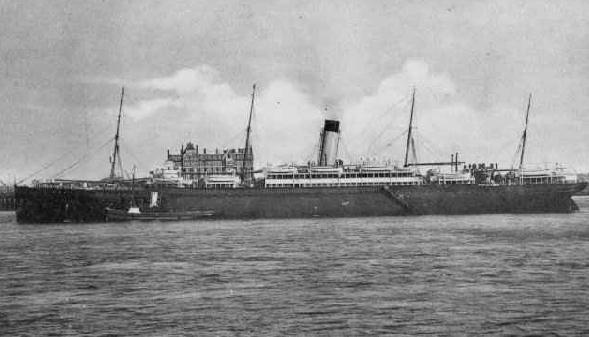
Devontroopship to South Africa9th Contingent, 1902 (Cenotaph)HMNZT 7 Arawa or HMNZT 10 LimerickMain Body transportCenotaph is unsure which of the two; sailed 16 October 1914Corinthicreturn to New ZealandCommenced return 12 March 1919 (ADFA)Corinthic · White Star Line · Public domain · Wikimedia Commons
Afterwards
Hart returned to Carterton to a heroes' welcome on 25 April 1919, five years to the day after the Gallipoli landing, then built a new law practice in Masterton. He founded the Masterton Rotary Club, received the RSA Gold Badge, commanded the 2nd (Wellington) Infantry Brigade (1920 to 1925) and retired in 1930. He then served as Administrator of Western Samoa (1931 to 1935), where he balanced the books and tried to ease relations with the Mau, and was knighted in 1935.
From 1936 he was deputy controller of the Imperial War Graves Commission, based in Jerusalem. In July 1940 he became a lieutenant in the British Army with the acting rank of brigadier, running the graves registration service for East Africa and the Middle East until late 1942, and retired from the Commission in 1943. Back in the Wairarapa he returned to Rotary, took part in unit reunions and in 1955 presented the Le Quesnoy flag to Wellington Cathedral. He died at home in Masterton on 5 March 1968, said to be the last surviving senior NZEF officer.
Later awards, not counted here: Cenotaph lists 1939-1945 Star, Africa Star, Defence Medal and War Medal with oak leaf; none confirmed (see flags)..
This is the Service Record sign as we would make it from his record: his rank, name, regiment, number and date of embarkation. The medals on the sign are worked out automatically, so the medals listed above are the ones to rely on.
The Service Record
Photograph
We haven’t hosted a photograph here
Rather than copy someone else’s image onto our own site, we’d rather send you to see it where it’s properly held: his full record at the Auckland War Memorial Museum’s Online Cenotaph.
The Online Cenotaph lists 21 items for him (counting its separate VD and Colonial Auxiliary Forces Decoration entries once). Nine of them (the three Second World War stars and medals, the 1937 Coronation Medal, the New Zealand War Service Medal and three long-service medals) could not be confirmed elsewhere and are marked on this page.
SERVED IN WW1: yes. Enlisted NZEF 12 August 1914 (5 August per Cenotaph), embarked 16 October 1914 as Major, no. 10/133, Main Body; served Gallipoli, France and Germany to 1919 (Cenotaph, ADFA, DNZB). Born in New Zealand; nothing argues against listing him as a New Zealander of the war.
Total: strict count is 12 (QSA, DSO, 1914-15 Star, CMG, MiD x5 as one, CB, BWM, Victory, Croix de Guerre, VD, Silver Jubilee 1935, KBE). The Cenotaph face-value list, after merging its duplicate CAF Decoration with VD, comes to 21. The nine extras are 1939-45 Star, Africa Star, Defence Medal, War Medal (oak leaf), NZ War Service Medal, Coronation 1937, CAF Long Service Medal, NZ Long and Efficient Service Medal and NZ Territorial Service Medal, none of which I could source. If only the four WW2 campaign medals are accepted the total would be 16.
Duplicate reconciled: Cenotaph lists 'Colonial Auxiliary Forces Decoration' and 'Volunteer Officer's Decoration (VD)'; one award, counted once.
Gallantry count 2: DSO and Croix de Guerre. CMG, CB, KBE are honours, not gallantry. MiD is not counted as gallantry.
Mentions in Despatches: five, all found in the London Gazette: 5 Aug 1915, 4 Jan 1917, 28 May 1918, 31 Dec 1918, 11 July 1919 (matches Cenotaph and ADFA; DNZB's 'four times' is the later ones). Counted as one item.
Croix de Guerre: Cenotaph says 'with Palm'; the 15 Dec 1919 Gazette lists him under plain Croix de Guerre. Palm unconfirmed.
DSO: citation date 26 April near Gaba Tepe vs 27 April Walker's Ridge in DNZB and Wikipedia; ADFA misprints the Gazette date as 3 July 1915.
QSA: Cenotaph-only; Boer War clasps listed oddly ('South Africa 1901'); count kept on medium confidence.
No evidence found of Home Guard service or any other WW2 gallantry or honour; his WW2 service was British Army graves registration in the Middle East (July 1940 to late 1942).
RSA Gold Badge is an association honour, not a state award, so not counted.
Wikipedia says he overstated his age to join the 1902 contingent (born October 1882, so 19).