First Contingent 1899 · the youngest officer · 7th Dragoon Guards, Gallipoli and the Durham Light Infantry
Lieutenant-Colonel Michael Lindsay
Michael Egan Lindsay was a Timaru-born cavalryman, only nineteen when he sailed on the Waiwera in 1899 as a lieutenant in No. 1 Company, the youngest man in the contingent. His courage in the first months in South Africa won him a recommendation for a commission in the British cavalry, and he joined the 7th Dragoon Guards.
He stayed in the British Army, served at Gallipoli and in Egypt in 1915-16 and then commanded a battalion of the Durham Light Infantry on the Western Front, winning the DSO. He married a New Zealander, Elsie Riddiford, in 1904, and died in Scotland in 1957.
His story
Timaru boyhood
Michael Egan Lindsay was born on 26 March 1880 in Timaru. He was the eldest son of William Stewart Lindsay, a captain (later major) commanding the Canterbury Yeomanry Cavalry. He was educated at Christ's College, Christchurch, where he was the champion athlete, and joined the Yeomanry himself as a lieutenant while preparing for a commission in the Imperial Army. A newspaper of 1900 called him an accomplished horseman and a good shot.
Source: Online Cenotaph C34776; Papers Past, Thames Star 26 Feb 1900 (from the Weekly Press) and New Zealand Mail 7 Sep 1904The youngest officer
When New Zealand called for volunteers, the Timaru Herald of 7 October 1899 listed Lieutenant Lindsay among the Canterbury Yeomanry Cavalry members who had offered. He became a lieutenant in No. 1 Company of the First Contingent and sailed on the Waiwera on 21 October 1899, still a minor and the youngest man in the contingent.
Source: Papers Past, Timaru Herald 7 Oct 1899; New Zealand Mail 26 Oct 1899 (officers' list); Online Cenotaph C34776; NZHistory nominal rollBravery under fire
Lindsay distinguished himself in the early fighting with the contingent's mounted infantry, including an action at 'Jaasfontein' (Jasfontein) in the Cape Colony, and was complimented by the General Commanding for his bravery and coolness. Major Robin described him as brave and cool in action and recommended him for a commission in the British cavalry.
Source: Papers Past, Thames Star 26 Feb 1900; Online Cenotaph C34776 (quoting Stowers, Kiwi versus Boer, p.147)A commission in the 7th Dragoon Guards
While in South Africa Lindsay obtained a commission in the Imperial Army as a lieutenant in the 7th Dragoon Guards. Invalided home, he came back to New Zealand on the Papanui, which reached Port Chalmers on 22 July 1900. He reached Timaru on 1 August to a civic welcome with a mounted guard of honour, school children cheering at Winchester, and a luncheon given by the Mayor. He looked pale and weak and was on six months' leave.
Source: Papers Past, Evening Star 23 Jul 1900, Timaru Herald 2 Aug 1900; Online Cenotaph C34776Wounded and posted to India
The Cenotaph says he returned to South Africa, rejoined the 7th Dragoon Guards, was wounded in the knee in May 1901 and was invalided to England on the hospital ship Avoca. In October 1901 he left South Africa for India with a draft of 158 men for the 5th Dragoon Guards.
Source: Online Cenotaph C34776 (quoting Stowers)Marriage at the Hutt
Lindsay married Elsie Catherine Riddiford, eldest daughter of E. J. Riddiford of Lower Hutt, at the Lower Hutt church in 1904 (reported 7 September 1904), and took her back to England that December. They had three sons.
Source: Papers Past, New Zealand Mail 7 Sep 1904; Online Cenotaph C34776; Durham at War story 14368 (as summarised in a web search; page not directly viewable)Gallipoli and Egypt
According to the Durham at War biography, Lindsay arrived at Gallipoli on 7 August 1915, served there for four months, then went to Egypt until March 1916, when he was posted to Europe. He was promoted brigade major of the 22nd Mounted Brigade. Online Cenotaph lists Gallipoli, 1915-16, and the Canterbury Yeomanry Cavalry (which was his pre-1899 New Zealand unit, not his First World War one).
Source: Durham at War, 'Michael Egan Lindsay (1880-1957)' (as summarised in a web search; the page itself could not be opened); Online Cenotaph C34776Commanding the 13th Durham Light Infantry
He was transferred to the 13th Battalion, Durham Light Infantry, as temporary major in command and acted as lieutenant-colonel from August to December 1916. During this time he was awarded the DSO, which appeared in the New Year Honours of 1 January 1917 (as 'Captain Michael Egan Lindsay, Dragoon Guards'). In July 1917 he was again appointed acting lieutenant-colonel, and a month later temporary lieutenant-colonel in command.
Source: Durham at War (as above); Wikipedia, '1917 New Year Honours' (DSO list)Fife
After the war the family settled at Lathrisk, near Cupar, in Fife. He was made honorary colonel of the Fife and Forfar Yeomanry in December 1946. He died at his home in Scotland in December 1957, aged 77. The Online Cenotaph gives 1 December; the Durham at War summary gives 11 December.
Source: Durham at War (as above); Online Cenotaph C34776
Rank and insignia
The rank he held, and the badge a soldier of that rank wore. These are simplified illustrations.
His medals
“Documented” means a source we name says he received it. “Listed on the Online Cenotaph” means the museum’s record lists the medal but we could not confirm it elsewhere. “Entitled” means his service dates qualified him, but we have not seen a record of the medal itself. The drawings are simplified illustrations.
His ships
Afterwards
Lindsay stayed in the British Army and later lived at Lathrisk, near Cupar, in Fife. His three sons were born between about 1905 and 1909; one went on to be a major-general in the Royal Artillery. He returned to New Zealand several times in his life, according to the Cenotaph. In December 1946 he became honorary colonel of the Fife and Forfar Yeomanry. He died at home in Fife in December 1957, aged 77. No grave or memorial reference was found.
His sign
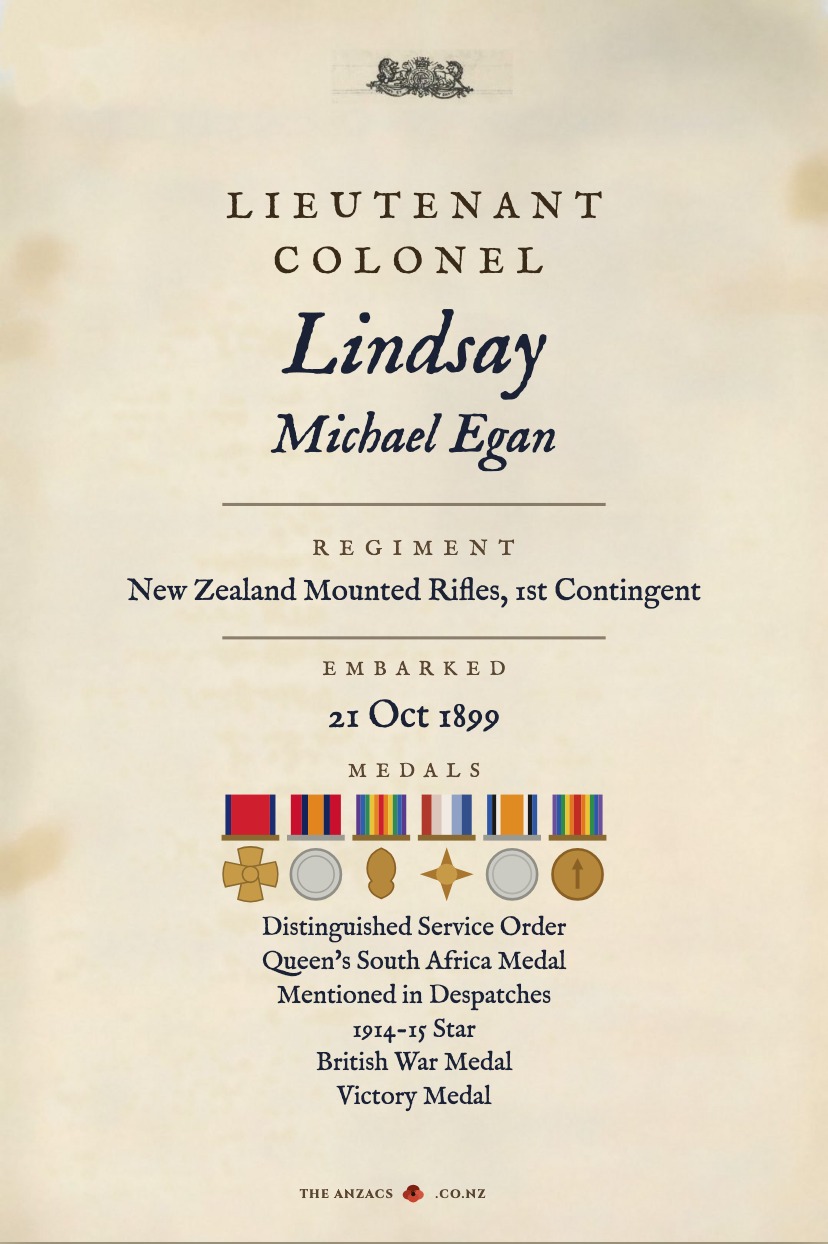
This is the Service Record sign as we would make it from his record: his rank, name, regiment, number and date of embarkation. The medals on the sign are worked out automatically from the embarkation date, so the medals listed above are the ones to rely on.
Photograph
We haven’t hosted a photograph here
Rather than copy someone else’s image onto our own site, we’d rather send you to see it where it’s properly held: his full record at the Auckland War Memorial Museum’s Online Cenotaph.
Sources
- Michael Egan Lindsay, Online Cenotaph, Auckland War Memorial Museum.
- NZHistory nominal roll: Michael Egan Lindsay
- Durham at War: Michael Egan Lindsay (1880-1957) (seen only as a web-search summary; site was unreachable)
- Wikipedia: 1917 New Year Honours (DSO list)
- Papers Past, Thames Star 26 February 1900, 'Lieutenant Lindsay'
- Papers Past, Evening Star 23 July 1900, 'Return of invalided soldiers'
- Papers Past, Timaru Herald 2 August 1900, 'Welcome to Lieutenant Lindsay'
- Papers Past, Timaru Herald 7 October 1899, 'The New Zealand Contingent'
- Papers Past, New Zealand Mail 7 September 1904, 'Wedding at Lower Hutt'
What we could not confirm
First World War details (Gallipoli from 7 Aug 1915, Egypt, 22nd Mounted Brigade, 13th DLI, acting/temporary lieutenant-colonel) come from the Durham at War biography as summarised by a web search; the page itself could not be opened (site unreachable). Treat as probable, not confirmed. The DSO in the 1 January 1917 honours is confirmed independently.
Online Cenotaph lists his WWI unit as Canterbury Yeomanry Cavalry and rank Major; that unit is his pre-1899 New Zealand volunteer corps, so the Cenotaph entry looks mixed up. The 'Lieutenant-Colonel' title used here is temporary/acting rank; his substantive rank was lower (Captain in January 1917).
Death date: Online Cenotaph 1 December 1957; the Durham at War summary says he died at home in Fife on 11 December 1957. Unresolved.
Wound: the Cenotaph says knee wound May 1901 (hospital ship Avoca) but also says he left Cape Town on the Papanui for Port Chalmers in July 1900; the 1900 return was 'invalided', reason not stated. The two episodes are probably separate; the 1900 illness/injury is not identified.
Mentions in despatches (three) and QSA clasps not dated or itemised.
Unknown: his 1914 location, which ship took him to Gallipoli, when he left the 7th Dragoon Guards, and burial place.
A web-search summary also claimed 'in 1952 served as a temporary Lord Lieutenant of the County'; I could not confirm it and left it out.
Sons are mentioned only generally; none named (some may be living).