First Contingent 1899 · the hero of New Zealand Hill · Royal Artillery, Boer War and First World War
Brigadier-General William Madocks
William Madocks was a Royal Artillery officer lent to the New Zealand Defence Forces as a staff officer, who sailed on the Waiwera in October 1899 as captain of No. 2 Company. On 15 January 1900, at Slingersfontein near Rensburg, he took charge of a hard-pressed hill position and led a bayonet charge that drove the Boers off. The hill was afterwards called New Zealand Hill.
He returned to the British Army, served in the First World War as a battery commander and then on the staff of the BEF, and finished as a brigadier-general with the CB, CMG, DSO and the French Croix de Guerre. He married the daughter of Sir Walter Buller, New Zealand's best-known ornithologist.
His story
A soldier's family
William Robarts Napier Madocks was born at Bhagalpur (then Bhaugulpore) in Bengal in 1870 and was christened in Bengal on 7 January 1871. He was a grandson of Field Marshal Lord Napier of Magdala. He trained at the Royal Military Academy, Woolwich, and served in India as an artillery officer.
Source: Online Cenotaph record C33767; Papers Past, Evening Post 30 Oct 1946 and Auckland Star 26 Mar 1931Staff officer in New Zealand
In 1896 Madocks was appointed a staff officer of the New Zealand Defence Forces on a five-year engagement.
Source: Papers Past, Ashburton Guardian 30 Oct 1946; Waikato Argus 13 Jul 1901 (five years' engagement); New Zealand Herald 28 Sep 1936Captain of No. 2 Company
When the First Contingent was formed Madocks was appointed captain of its second company. His name appears in the Hāwera newspaper's list of 16 October 1899 and in the full officers' list published on 26 October. He sailed on the Waiwera on 21 October 1899.
Source: Papers Past, Hāwera & Normanby Star 16 Oct 1899; New Zealand Mail 26 Oct 1899; Online Cenotaph C33767; NZHistory nominal roll entryNew Zealand Hill
At Slingersfontein, near Rensburg in the Cape Colony, a company of the Yorkshire Regiment and a small New Zealand picket held a hill. Under heavy fire, about 200 Boers crept up through the cover and the Yorkshire captain was badly wounded. Madocks, hearing the firing, ran up, ordered bayonets fixed and led the Yorkshiremen forward. He then rushed across to his own New Zealanders and led them down the hill in a charge. Sergeant Gourlay and Trooper Connell were killed; the Boers fled. A Papers Past account reports about 40 Boers killed (the NZHistory summary says 21 dead). A later newspaper profile told how a Boer and Madocks fired from the hip at each other and the Boer's bullet went through Madocks' hat. The position became known as New Zealand Hill.
Source: Papers Past, Manawatu Standard 16 Feb 1900 ('Gallant charge of New Zealanders'); Auckland Star 26 Mar 1931; NZHistory 'Key battles 1899-1900'; Online Cenotaph C33767Honours and staff work
Madocks was mentioned in despatches (London Gazette, 4 May 1900) and received a brevet majority in the artillery for his gallantry. According to the New Zealand Herald, he was then appointed aide-de-camp to the general commanding the Mounted Infantry. His Queen's South Africa Medal carries the clasps Relief of Kimberley, Paardeberg, Driefontein, Johannesburg and Diamond Hill. In April 1901 the New Zealand press expressed surprise that he was left out of the Bath and DSO honours given to other New Zealanders; the Otago Witness of 1 May 1901 reported he had been promoted major in the Royal Artillery from 29 November.
Source: Online Cenotaph C33767; Papers Past, Auckland Star 27 May 1901, Marlborough Express 25 Apr 1901, Otago Witness 1 May 1901, New Zealand Herald 28 Sep 1936Back in New Zealand
Major Madocks reached Auckland from Sydney on the Elingamite on Saturday 25 May 1901, and helped Colonel White with the military arrangements for the Royal visit. In interviews he said it would take at least another twelve months to end the war and that mounted men were what was needed. His five-year engagement expired and he left Wellington for England on 12 July 1901 after a series of presentations.
Source: Papers Past, Wanganui Chronicle 28 May 1901, Evening Star 27 May 1901, Waikato Argus 13 Jul 1901Ian Hamilton's staff and marriage
In November 1901 the press reported that Madocks, 'a New Zealander', had been appointed to General Sir Ian Hamilton's staff. His Online Cenotaph record lists the King's South Africa Medal with clasps for 1901 and 1902. On 7 January 1903, at St Peter's, Eaton Square, London, Major W. R. N. Madocks, R.F.A., married Laura, only daughter of Sir Walter Buller, in a quiet ceremony because of the recent death of his father.
Source: Papers Past, Auckland Star 13 Nov 1901 and Wanganui Chronicle 13 Nov 1901; New Zealand Herald 19 Feb 1903 ('A New Zealand wedding'); Online Cenotaph C33767A battery in the Great War
According to a 1936 New Zealand Herald profile, Madocks commanded a battery from the outbreak of war until February 1915, when he was wounded; he was mentioned in despatches and awarded the CMG.
Source: Papers Past, New Zealand Herald 28 Sep 1936Staff officer and brigadier-general
He was then attached to the General Staff of the British Expeditionary Force for almost two years (1915-17). His letters to General Sir Ian Hamilton, held at King's College London, include accounts of his progress as a staff officer with the 20th (Light) Division and the 35th Division on the Western Front. He became a Brigadier-General in the Royal Artillery, was again mentioned in despatches, and was awarded the DSO, the CB and the French Croix de Guerre.
Source: Papers Past, Ashburton Guardian 30 Oct 1946 and New Zealand Herald 28 Sep 1936; King's College London, Liddell Hart Centre, Hamilton papers ISM 13/69; Online Cenotaph C33767Later years
Madocks commanded the North Wales Infantry Brigade from 1920 to 1924, served on the staff at Malta, and retired in 1927, living afterwards in North Wales. In the early 1930s he acted as England-based representative of the New Zealand Football Council (soccer). In 1936 his sister, Lady Elibank, visited New Zealand and the press recalled his part in New Zealand Hill. He died on 1 October 1946, aged 75; the cable announcing his death described him as a staff officer attached to the New Zealand Defence Forces from 1896 to 1899 who served with the Mounted Rifles in South Africa.
Source: Papers Past, New Zealand Herald 28 Sep 1936; Taranaki Daily News 23 Aug 1933; Ashburton Guardian and Evening Post 30 Oct 1946; Online Cenotaph C33767
Rank and insignia
The rank he held, and the badge a soldier of that rank wore. These are simplified illustrations.
His medals
“Documented” means a source we name says he received it. “Listed on the Online Cenotaph” means the museum’s record lists the medal but we could not confirm it elsewhere. “Entitled” means his service dates qualified him, but we have not seen a record of the medal itself. The drawings are simplified illustrations.
His ships
Afterwards
After the Boer War Madocks made his career in the British Army, retiring in 1927 and living in North Wales. He married Laura Buller in London in January 1903. By 1931 the Auckland Star noted that he had lost two sons in accidents (the Cenotaph says one in a car crash and one in a plane crash). The New Zealand veterans of the First Contingent remembered him with respect and affection. He died on 1 October 1946, in Hampshire according to the War Graves Project index, aged 75. His burial place was not found.
His sign
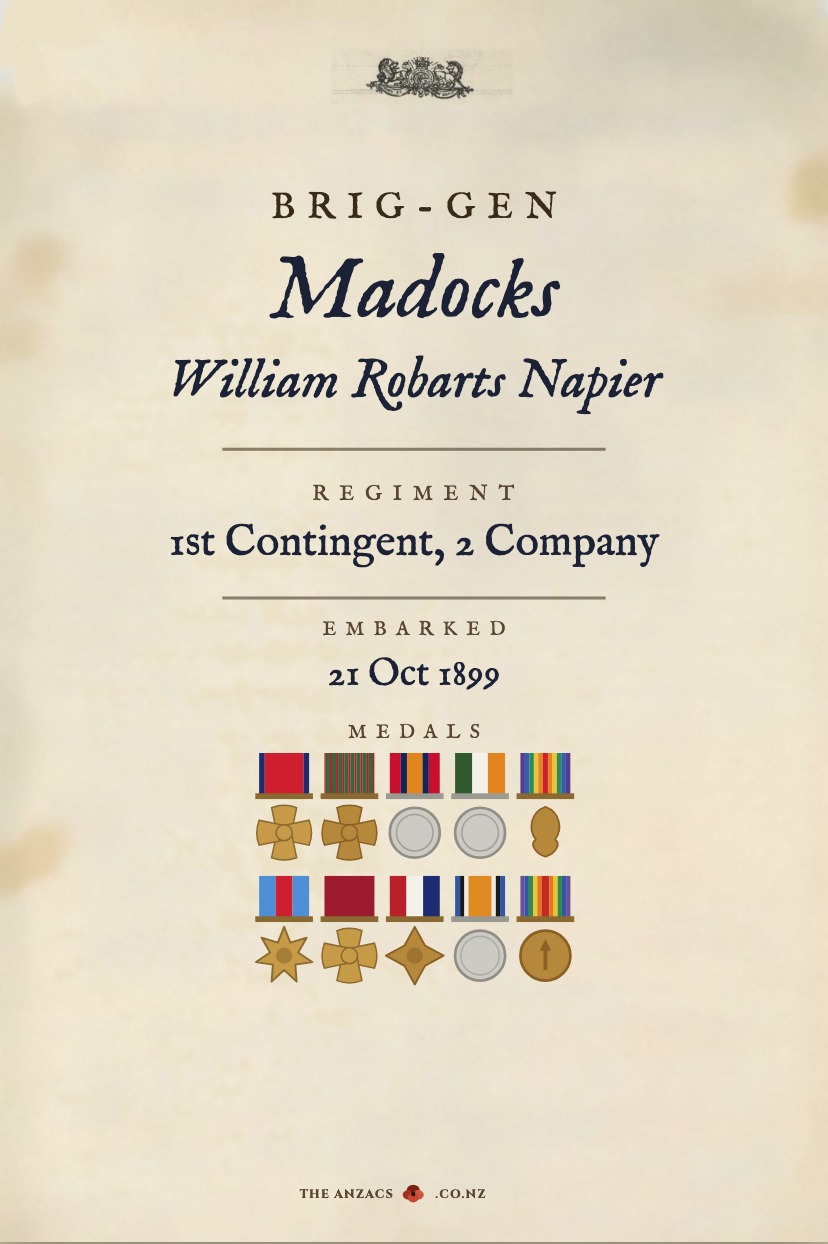
This is the Service Record sign as we would make it from his record: his rank, name, regiment, number and date of embarkation. The medals on the sign are worked out automatically from the embarkation date, so the medals listed above are the ones to rely on.
Photograph
We haven’t hosted a photograph here
Rather than copy someone else’s image onto our own site, we’d rather send you to see it where it’s properly held: his full record at the Auckland War Memorial Museum’s Online Cenotaph.
Sources
- William Robarts Napier Madocks, Online Cenotaph, Auckland War Memorial Museum.
- NZHistory nominal roll: William R N Madocks
- NZ War Graves Project, Cenotaph 33767
- Papers Past, Manawatu Standard 16 February 1900, 'Gallant charge of New Zealanders'
- Papers Past, Auckland Star 26 March 1931, 'The Passing Show'
- Papers Past, New Zealand Herald 28 September 1936, 'Empire visitors'
- Papers Past, New Zealand Herald 19 February 1903, 'A New Zealand wedding'
- Papers Past, Ashburton Guardian 30 October 1946, 'South African War veteran'
- Papers Past, Evening Post 30 October 1946, 'General Madocks dead'
- Papers Past, Auckland Star 27 May 1901, 'Back from the war'
- King's College London archives: Hamilton papers, correspondence with Brigadier General William Madocks
What we could not confirm
Birth date uncertain: Online Cenotaph 1 Jan 1870 (a family tree gives 2 Sep 1870), NZ War Graves Project 8 Aug 1870; an age of 75 at death in Oct 1946 implies a birth between late 1870 and late 1871. Use 'born 1870'.
DSO: Cenotaph lists it without a date. Papers Past in April 1901 said he had been left out of the DSO list and received a brevet majority instead, and a 1936 profile places the DSO in the First World War. A web-search snippet suggested 'Brevet Major and DSO dated 29 Nov 1900', which I could not confirm. Do not give a DSO date on the page.
Dates of promotion to Lieutenant-Colonel and Brigadier-General not found (Brigadier-General about 1917 is inferred from the 1936 Herald profile).
Online Cenotaph says 'WW1 vessel Waiwera' and shows rank Lieutenant Colonel: the first is an error, the second is an intermediate rank.
Sons: Online Cenotaph says one died in a car crash and one in a plane crash; the Auckland Star of 1931 says two motor accidents. Sons not named.
Not verified: a search snippet said he was Assistant Adjutant-General at HQ No. 5 Area, British Troops in France, at Lille in May 1919. Left out of the timeline.
How long he stayed with the contingent in South Africa, and the ship home from South Africa to Sydney, were not found.
Burial place and place of death (Hampshire per War Graves Project) not confirmed beyond that index.