First Contingent 1899 · Boer War · Auckland Mounted Rifles, Gallipoli 1915
Sergeant William Mahood
William Mahood was an Irish-born farmer from Tirau who had already served three years with the Cape Mounted Rifles in the early 1880s before he sailed with the First Contingent in 1899. At Jasfontein in December 1899 he rode back under fire to rescue a dismounted comrade, Trooper Parkes.
In 1914 he enlisted again with the Auckland Mounted Rifles, reportedly aged 53 but giving his age as 36. He served in Egypt and at Gallipoli, was hurt and invalided home, and was discharged medically unfit in May 1916. He never married and died in Hamilton in 1947, aged 86.
His story
Growing up in Ireland
William was born on 13 December 1860, the son of James George and Eliza Ann Mahood, and grew up working on the family farm in Ireland. His family's address in later years was in County Cavan.
Source: Online Cenotaph record C33951The Cape Mounted Rifles, then New Zealand
At about 20 he went out to South Africa aboard the Nubian and joined the Cape Mounted Rifles on 8 February 1881, serving close to three years, including the Basuto campaigns. He then went back to Ireland and came to Auckland in December 1886. He worked on the main trunk railway construction between Te Awamutu and Otorohanga, then at Ohakune and Waitetuna near Raglan.
Source: Online Cenotaph record C33951Sergeant in the First Contingent
Mahood was farming at Tirau when the First Contingent was raised. Newspapers of October 1899 list him as a sergeant of the Waikato Mounted Rifles among the men chosen. He embarked on the Waiwera on 21 October 1899.
Source: Online Cenotaph record C33951; Papers Past, Evening Star 24 Oct 1899The rescue at Jasfontein
With General French's force, the New Zealanders took part in an engagement at Jasfontein. When Trooper W. E. Parkes's horse was shot and he fell, Sergeant Mahood of the Waikato Mounted Rifles rode back for him, joined by Trooper P. R. Hubbard; Parkes mounted behind Mahood and the two rode back to camp to cheers. The New Zealand Herald correspondent's account (dated Arundel camp, 23 December 1899) was printed widely in January 1900.
Source: Papers Past, Poverty Bay Herald 25 Jan 1900 and Press 23 Jan 1900; Online Cenotaph record C33951Kimberley to Diamond Hill, and 'Mahood's Foot'
The Cenotaph credits him with the clasps Relief of Kimberley, Driefontein, Johannesburg and Diamond Hill. On the march to Johannesburg the men who had lost their horses were formed into a foot party under his command, nicknamed 'Mahood's Foot', and were given the job of driving sheep and cattle.
Source: Online Cenotaph record C33951 (citing Stowers)Home to the Waikato
He was welcomed home with other First Contingent men at a smoke concert in Hamilton in February 1901. He took up contract ploughing at Putaruru (1901) and Pirongia (1902), farmed on the Pirongia-Otorohanga Road, and was recorded as a ploughing contractor at Otorohanga from 1911.
Source: Papers Past, Auckland Star 13 Feb 1901; Online Cenotaph record C33951Enlisting again at 53
Mahood enlisted on 15 August 1914, a single farmer at Otorohanga, and the Cenotaph records that he gave his age as 36 when he was actually 53. He became a sergeant (13/408) in the Auckland Mounted Rifles of the Main Body, which sailed in the convoy that left Wellington on 16 October 1914. The Auckland Mounted Rifles used the Star of India (HMNZT 8) and Waimana (HMNZT 12); records do not say which carried him.
Source: Online Cenotaph record C33951; NZEF Project record (nzef.adfa.edu.au, pid 155662)Egypt and Gallipoli
He served in Egypt and on Gallipoli in 1915. The record notes dysentery in 1915, a leg injury (one entry says from a horse accident, another that he was severely wounded in the leg at Gallipoli) and a fractured right ankle for which he received a small disability pension. He was invalided home and discharged as medically unfit on 10 May 1916.
Source: Online Cenotaph record C33951Retirement and death
He kept ploughing and farming until about 1931, then retired to Cambridge and later Hamilton. He died in Hamilton on 7 April 1947, aged 86, after a heart attack, at the home of Mr and Mrs E. S. Day, with whom he lived. He had never married. He is buried at Hautapu Cemetery, Cambridge.
Source: Online Cenotaph record C33951
Rank and insignia
The rank he held, and the badge a soldier of that rank wore. These are simplified illustrations.
His medals
“Documented” means a source we name says he received it. “Listed on the Online Cenotaph” means the museum’s record lists the medal but we could not confirm it elsewhere. “Entitled” means his service dates qualified him, but we have not seen a record of the medal itself. The drawings are simplified illustrations.
His ships
Afterwards
After his discharge in 1916 William Mahood went back to the land around Otorohanga, where he had been a contract ploughman since before the war. He retired around 1931, moving to Cambridge and then Hamilton, and lived his last years with Mr and Mrs E. S. Day. He never married. He died on 7 April 1947 and was buried at Hautapu Cemetery in Cambridge (Area D, Row 2).
Auckland Museum's Boer War display includes his uniform and a photograph of him with two other Waikato men of the First Contingent.
His sign
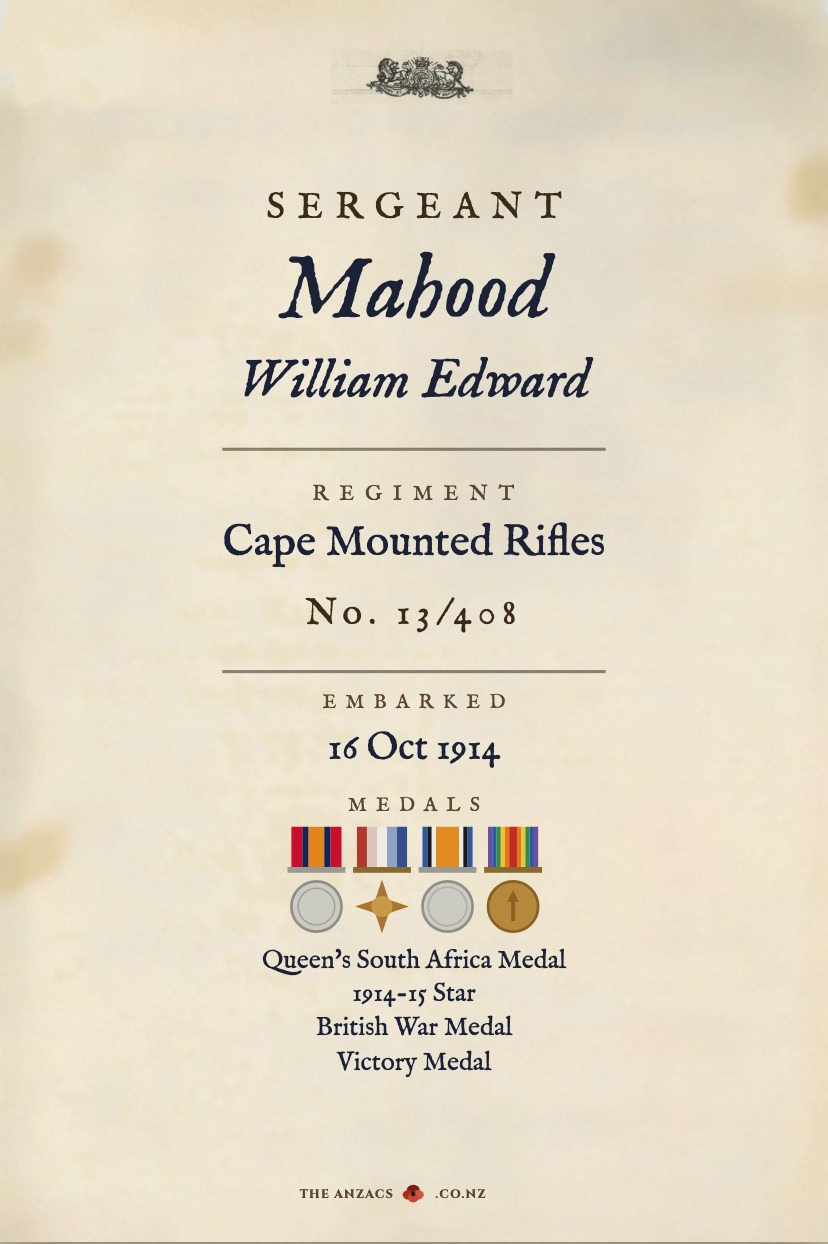
This is the Service Record sign as we would make it from his record: his rank, name, regiment, number and date of embarkation. The medals on the sign are worked out automatically from the embarkation date, so the medals listed above are the ones to rely on.
Photograph
We haven’t hosted a photograph here
Rather than copy someone else’s image onto our own site, we’d rather send you to see it where it’s properly held: his full record at the Auckland War Memorial Museum’s Online Cenotaph.
Sources
- William Edward Mahood, Online Cenotaph, Auckland War Memorial Museum.
- NZEF Project (UNSW Canberra): William Edward Mahood, 13/408
- Papers Past: Evening Star, 24 Oct 1899 (contingent list)
- Papers Past: Poverty Bay Herald, 25 Jan 1900 (The Engagement at Jasfontein)
- Papers Past: Press, 23 Jan 1900 (An Exciting Affair)
- Papers Past: Auckland Star, 13 Feb 1901 (Returned Troopers)
What we could not confirm
Birth year: Cenotaph gives 13 December 1860 (and says he enlisted in 1914 aged 53 but claimed 36). The NZEF Project database shows 1880 and age 33 at enlistment, i.e. the age he declared, and gives age at death as 65; Cenotaph says 86. We follow the Cenotaph (1860/86).
A search-result snippet for the NZ History soldier page gives the birthplace as Canningstown, County Cavan; we could not open that page, so only 'Ireland (County Cavan family)' is stated.
Cenotaph shows odd entries: 'Discharge 1 August 1902, wounded in action' under the First Contingent, and a Cape Mounted Rifles 'Basuto Wars' record with an 8 February 1881 start. No source we read dates his return from South Africa precisely; Papers Past shows him home by early February 1901.
The note 'did not claim his campaign medal' sits beside his Cape Mounted Rifles service; it is not clear if it affects the Queen's South Africa Medal, which the Cenotaph lists with four clasps.
The injury entries conflict: horse accident, severe Gallipoli leg wound, and a fractured right ankle (1920 pension list). Exact dates not found.
The specific ship and exact embarkation date for him personally in 1914 are unknown.
Archives NZ file R10927767 could not be opened (JavaScript catalogue).