First Contingent 1899 · Prisoner at Koornspruit · Royal Field Artillery, DSO · First World War
Lieutenant-Colonel George Ralph Miller
George Miller, the third son of Sir Henry Miller of Fernbrook, Oamaru (Speaker of the Legislative Council), sailed on the Waiwera as Private 77. He was taken prisoner at Koornspruit in March 1900, released at Pretoria, and stayed on in South Africa with the Transvaal Constabulary before taking a commission in the British Army.
As an artillery officer in the Royal Field Artillery he served through the First World War, was wounded twice and mentioned in despatches three times, and won the Distinguished Service Order in 1919. He was a Home Guard colonel in the Second World War, and died in England in 1948.
His story
Fernbrook, Oamaru
George Ralph Miller was born on 23 December 1874, the third son of Henry John Miller and Jessie (née Orbell). His father, later Sir Henry Miller (knighted 1901), was a runholder at Fernbrook near Oamaru and Speaker of the Legislative Council from 1892 to 1903. George was educated at Waitaki Boys' High School.
Source: Online Cenotaph C34855; thepeerage.com p51298; Wikipedia 'Henry Miller (New Zealand politician)'; Papers Past, New Zealand Times 24 Apr 1916Sailing on the Waiwera
Miller joined the First Contingent and embarked as Private 77 in No. 1 Company. The Cenotaph lists his earlier volunteer unit as the Heretaunga Mounted Rifles; his mother, Lady Miller of Fernbrook, was his next of kin.
Source: Online Cenotaph C34855; Papers Past, New Zealand Mail 20 Dec 1900 (lists '77 Pte. G. R. Miller, Oamaru')Kimberley and capture at Koornspruit
Miller was at Kimberley camp in February 1900. In March 1900 he was captured at Koornspruit (Sanna's Post); a casualty list printed in April 1900 named 'G. R. Miller (Oamaru, son of the Speaker of the Legislative Council)' among the First Contingent men taken prisoner there.
Source: Online Cenotaph C34855 (citing Stowers, p. 170); Papers Past, Woodville Examiner 11 Apr 1900 'The War'Released; Transvaal Constabulary
He was released at Pretoria in June 1900 and from July to October 1900 served in the Provisional Transvaal Constabulary. He then left South Africa on the S.S. Orient.
Source: Online Cenotaph C34855 (citing Stowers, p. 170)A commission in the British artillery
Miller accepted a commission in the Royal Horse Artillery (the Cenotaph also calls his regiment Royal Field Artillery) and sailed for London in August 1901 to join. In 1905 he was a lieutenant in the 92nd Battery, Royal Field Artillery, at Aldershot.
Source: Online Cenotaph C34855First World War
Miller served with the British Expeditionary Force in the Royal Field Artillery and was a major by April 1916. On 21 February 1916 he married Violet Mary Teschemaker, daughter of the late W. H. Teschemaker of Kauro Hill, Otago, at a London church in Walton Street; a New Zealand paper reported the wedding as that of 'Major George Ralph Miller, R.F.A.'
Source: Papers Past, New Zealand Times 24 Apr 1916 'Notes for Women'; thepeerage.com p51298; Online Cenotaph C34855Wounded, mentioned, and the DSO
He was wounded twice and mentioned in despatches three times, reached the acting rank of lieutenant colonel, and was awarded the Distinguished Service Order, dated 1 June 1919.
Source: thepeerage.com p51298 (citing Burke's Peerage 2003); Online Cenotaph C34855Family and the Home Guard
Miller and Violet had two sons, born in 1917 and 1920. In the Second World War he commanded a Home Guard unit and was made a colonel in 1945.
Source: thepeerage.com p51298; Online Cenotaph C34855Death
George Miller died in 1948 and is buried in Essex, England. The exact date and place of death were not found.
Source: thepeerage.com p51298; Online Cenotaph C34855
Rank and insignia
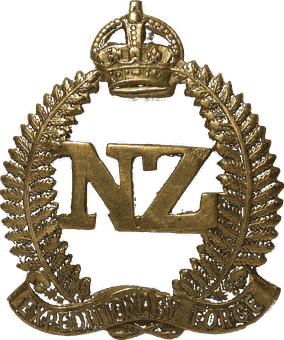
The rank he held, and the badge a soldier of that rank wore. These are simplified illustrations.
His medals
“Documented” means a source we name says he received it. “Listed on the Online Cenotaph” means the museum’s record lists the medal but we could not confirm it elsewhere. “Entitled” means his service dates qualified him, but we have not seen a record of the medal itself. The drawings are simplified illustrations.
His ships
Afterwards
Miller made his career in the British Army and lived in England. He was a regular artillery officer before and during the First World War, commanded a Home Guard unit in the Second, and died in 1948; he is buried in Essex. His wife Violet (d. 1981) and their two sons survived him.
His sign
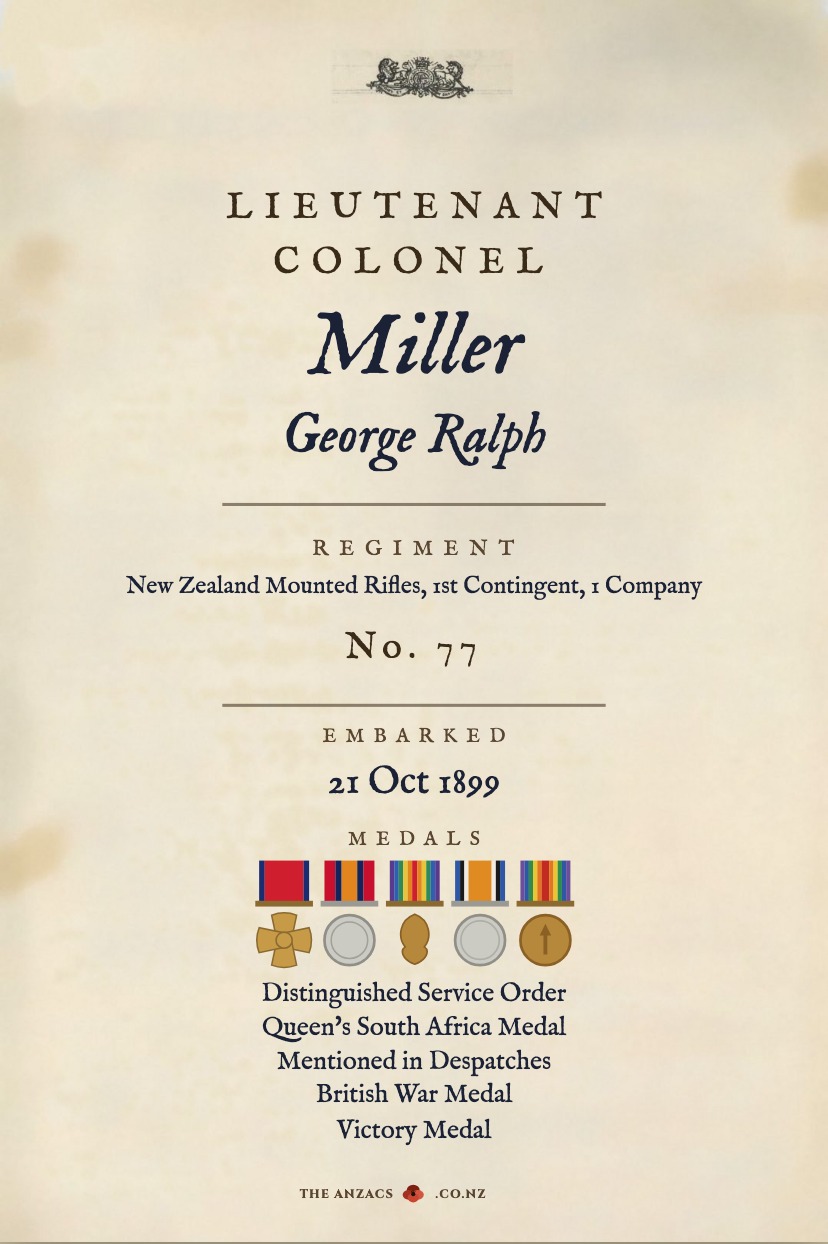
This is the Service Record sign as we would make it from his record: his rank, name, regiment, number and date of embarkation. The medals on the sign are worked out automatically from the embarkation date, so the medals listed above are the ones to rely on.
Photograph
We haven’t hosted a photograph here
Rather than copy someone else’s image onto our own site, we’d rather send you to see it where it’s properly held: his full record at the Auckland War Memorial Museum’s Online Cenotaph.
Sources
- George Ralph Miller, Online Cenotaph, Auckland War Memorial Museum.
- thepeerage.com: Lt.-Col. George Ralph Miller (citing Burke's Peerage 2003)
- Wikipedia: Henry Miller (New Zealand politician)
- Papers Past: The War, Woodville Examiner 11 Apr 1900
- Papers Past: The Transvaal War, New Zealand Mail 20 Dec 1900
- Papers Past: Notes for Women, New Zealand Times 24 Apr 1916
What we could not confirm
Birthplace is not recorded; the Oamaru connection is from his father's Fernbrook home, his mother's address on the Cenotaph and Waitaki Boys' High School.
The Cenotaph says Royal Horse Artillery for his 1901 commission, and Royal Field Artillery for later service; his actual commissioning date, regiment and rank, service dates in France or elsewhere, wound dates and DSO citation were not found. The 1919 date is from the Cenotaph (a London Gazette issue of 1919 was not read).
1914 Star or 1914-15 Star: not claimed, because the date he went overseas is not known.
Death: only the year 1948 (thepeerage.com, itself citing Burke's Peerage); burial 'in Essex' from the Cenotaph. No grave or parish found. The WWII Home Guard colonelcy (1945) comes from the Cenotaph alone.
The Cenotaph's 'Heretaunga Mounted Rifles' as an earlier unit has not been checked against Papers Past; the NZ Herald list of October 1899 was not searched for Miller.
The same name is common; identity is anchored by number 77, the Oamaru address and the Speaker's-son notice in April 1900.
Archives NZ file R20522167 and the Harper/Clements/Johns book on New Zealanders in other services were not viewed.