First Contingent 1899 · Boer War (twice) · Otago Infantry, Gallipoli and the Western Front · MP for Wellington South
Lieutenant Colonel George Mitchell
George Mitchell was a Balclutha painter and Volunteer mounted rifleman who sailed as Trooper 160 with the First Contingent in October 1899, was invalided home with enteric fever in 1900, and went back to South Africa in 1902 with the Eighth Contingent as a regimental quartermaster sergeant. He rose through the Southland Territorial ranks and in December 1914 sailed with the Otago Infantry Battalion as a major.
He was twice wounded at Gallipoli, finishing with a permanent limp, and by 1917 was a lieutenant colonel commanding NZ base and reserve units in France, winning the DSO and a Serbian order. After the war he sat in Parliament for Wellington South (1919-22), served on the Wellington City Council and Harbour Board, and died in 1939.
His story
A Balclutha painter
George Mitchell was born at Balclutha in the Clutha district of South Otago, one of a large family. His father, London-born George Frederick Mitchell, was a painter and decorator, and George learned the trade alongside his brothers. In June 1898 he joined the Volunteer Corps as a trooper in the Clutha Mounted Rifles, where he became a good horseman and a reliable rifle shot in unit competitions.
Source: Online Cenotaph record C36462 (nzwargraves.org.nz Cenotaph 36462 for next of kin and birthplace); Medals Reunited NZ, 'Mitchell, George DSO, OSK' (19 Feb 2021); Wikipedia, 'George Mitchell (New Zealand politician)'Sails with the First Contingent
Chosen from the hundreds of volunteers, Mitchell went into camp at Karori and was posted to No. 2 Company (largely South Islanders) as Trooper 160. The Contingent of 214 men left Wellington on the Waiwera on the afternoon of 21 October 1899, farewelled by thousands on the wharf, and reached Cape Town on 20 November.
Source: Online Cenotaph record C36462; Medals Reunited NZ article (quotes Evening Post, 18 Oct 1920)Slingersfontein, Kimberley and Paardeberg
With General French's cavalry column in the Cape Colony, the Contingent fought at Jasfontein and Slingersfontein. On 15 January 1900 Mitchell was one of four troopers who, with Captain Madocks, Lieutenant Hughes and a sergeant, fixed bayonets and charged to save a threatened position held with the Yorkshire Regiment. The column then joined the Relief of Kimberley and the fighting at Paardeberg and Driefontein. Mitchell was made a temporary sergeant during this campaign.
Source: Medals Reunited NZ article (citing Lt-Gen French's despatch of 2 Feb 1900 and Archives NZ file); Online Cenotaph record C36462 (QSA clasps)Enteric fever and the voyage home
At Springfontein on 30 March 1900 Mitchell fell ill with enteric fever and pleurisy. He was sent to Kimberley and then Cape Town, lost his temporary rank, and after four months in hospital was invalided home. He left Cape Town on 21 October 1900 on the Wilcannia for Australia and came on to New Zealand by the Mokoia. He had been overseas 337 days. After a few months working near Balclutha, he wrote to the Defence Minister asking for an officer's commission and a return to the war.
Source: Medals Reunited NZ article (from his military file); the article's arrival date for Wellington ('23 September') cannot be right and is not repeated hereSecond tour with the Eighth Contingent
His request was granted in December 1901. As Regimental Quartermaster Sergeant (number 5873) he sailed from Lyttelton on the Cornwall with G Squadron of the South Island Regiment, Eighth Contingent, reaching Durban in March 1902. The Contingent guarded blockhouse lines in the Transvaal during the last drives of the war, and Colonel Davies's report singled out the RQMS for keeping the Contingent supplied. Mitchell was mentioned by name in Lord Kitchener's final despatch of 23 June 1902 (London Gazette 29 July 1902). He came home on the Britannic, ill with bronchitis for the voyage.
Source: Online Cenotaph record C36462 (8th Contingent embarkation on Cornwall; QSA clasp South Africa 1902); Medals Reunited NZ article (MiD citation and details of the train accident at Machavie, which the article misdates to 1900)Officer in the Territorials
Mitchell managed a wholesale firm in Invercargill, transferred to the Otago Rifle Volunteers as a colour sergeant (October 1902), and married Alice Mary Bain at Dunedin in January 1904. He was commissioned lieutenant in 1904, captain in 1907, adjutant of the 4th (later 14th South Otago) Battalion in 1908, and in October 1909 major and second-in-command of the 8th (Southland) Rifles. The family lived at 'The Retreat' near Invercargill (Cenotaph: Waikawa).
Source: Medals Reunited NZ article; Online Cenotaph record C36462 (address, marriage, occupation)Volunteers for the Expeditionary Force
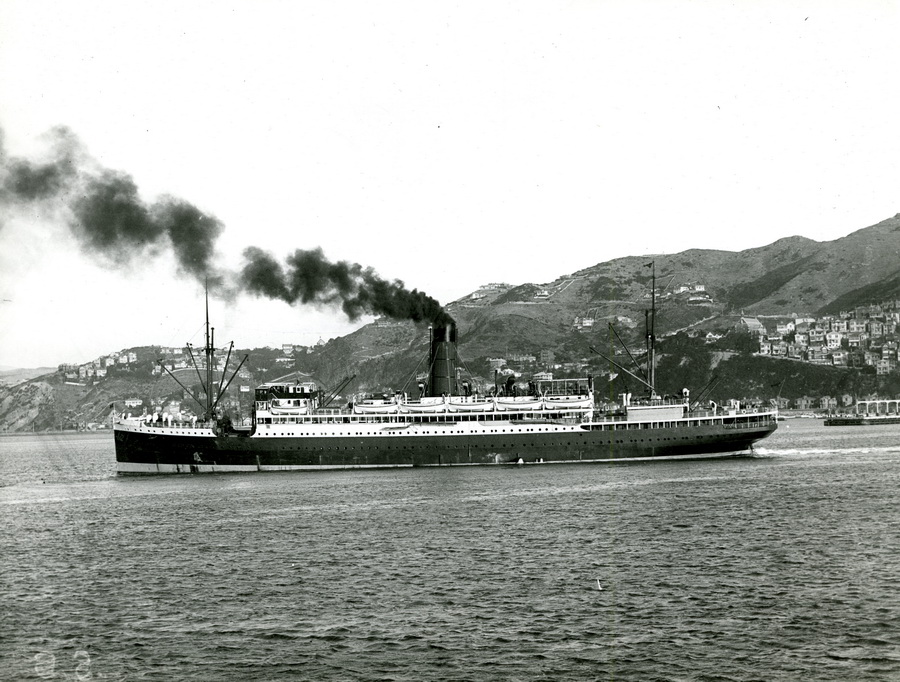
Missed for the Main Body, Mitchell was picked for the 2nd Reinforcements and, unusually, allowed to keep his Territorial rank of major. He took command of the 10th (North Otago) Company of the Otago Infantry Battalion and sailed from Wellington on the Willochra on 14 December 1914. The reinforcements reached Suez on 28 January 1915 and joined the NZ force in Egypt.
Source: NZEF Project (nzef.adfa.edu.au, record for 8/1173: embarked Wellington on Willochra, 14 Dec 1914); nzwargraves.org.nz Cenotaph 36462 (Suez 28 Jan 1915); Medals Reunited NZ articleGallipoli, wounded twice
The Otago Battalion landed at Anzac Cove on the afternoon of 25 April 1915. On the night attack of 2 May Mitchell fell into an unseen trench and broke ribs, but carried on, still heavily bandaged. During the August offensive he led his men towards Chunuk Bair on 6-7 August and was shot through the left foot. He was evacuated to Egypt, then to hospital in England, and the injury left him with a permanent limp and the nickname 'Hoppy'. The Cenotaph records two wounds in the First World War.
Source: Medals Reunited NZ article (quotes a letter from Lt-Col Athelstan Moore); Online Cenotaph record C36462 (wounded twice); WikipediaReserve battalions, Etaples and the DSO
After convalescence he held training commands at Sling Camp, was appointed temporary lieutenant colonel on 10 October 1916 commanding the 3rd (Reserve) Battalion, and in early 1917 took charge of the NZ Infantry and General Reserve Depot at Etaples, handling thousands of New Zealanders passing to and from the front, including during the September 1917 disturbances. Conscientious objectors including Archibald Baxter were sent to Etaples and punished under his authority; accounts of Mitchell's attitude differ, with the objector Mark Briggs finding him fair. In January 1918 he went back to command the 3rd Otago (Reserve) Battalion and the NZ Entrenching Group. He was gazetted an Officer of the Serbian Order of the Star of Karageorge (15 February 1917), Mentioned in Despatches (28 December 1917) and appointed to the DSO for distinguished service in France and Flanders (1 January 1918).
Source: Online Cenotaph record C36462 (London Gazette citations); NZEF Project record for 8/1173; Medals Reunited NZ article; Wikipedia, 'George Mitchell (New Zealand politician)'Home to New Zealand
Mitchell left England on 11 May 1919 on the Northumberland in charge of demobilised troops and reached Wellington on 25 July 1919. He had served 4 years and 146 days overseas in the NZEF, and was discharged on arrival.
Source: Medals Reunited NZ article; Online Cenotaph record C36462 (Lieutenant Colonel, 25 July 1919)Parliament and public life
The family moved to Wellington in 1919. Standing as an Independent Liberal, Mitchell won the Wellington South seat from Labour's Bob Semple at the 1919 election and held it for one term until 1922. He served on the Wellington Harbour Board (1921-29, chair 1923-25) and the Wellington City Council (1923-25 and 1927-31), and was president of the Returned Soldiers' Association and active in South African War veterans' and war relief bodies. His first wife Alice died in 1923; he married Birdie George in 1933. He died in a Wellington private hospital on 16 March 1939 and was buried at Karori Cemetery with a guard of honour of returned men.
Source: Wikipedia, 'George Mitchell (New Zealand politician)' (citing Evening Post obituary 17 Mar 1939); Medals Reunited NZ article; Online Cenotaph record C36462 (burial)
Rank and insignia
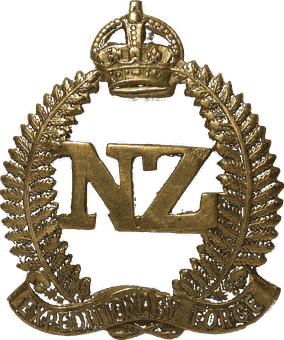
The rank he held, and the badge a soldier of that rank wore. These are simplified illustrations.
His medals
“Documented” means a source we name says he received it. “Listed on the Online Cenotaph” means the museum’s record lists the medal but we could not confirm it elsewhere. “Entitled” means his service dates qualified him, but we have not seen a record of the medal itself. The drawings are simplified illustrations.
His ships
Afterwards
After the war Mitchell moved his family to Karori in Wellington, bought land on the Wairarapa side of the hills, and entered politics as an Independent Liberal. He won Wellington South in 1919, was defeated in 1922, and then worked as manager of a Wellington cartage firm and, from 1924, of the Wellington Show Association, alongside long service on the Harbour Board and City Council and in the Returned Soldiers' Association and the South African War Veterans' Association. His first wife Alice died in 1923 and he married Birdie Christina George in 1933. He died on 16 March 1939 in a Wellington private hospital and was buried at Karori Cemetery, beside his first wife, in the Church of England section (Cenotaph: 'CH ENG2, Plot 316 G'). Newspapers and his headstone style him 'Colonel'; he was discharged a lieutenant colonel.
His sign
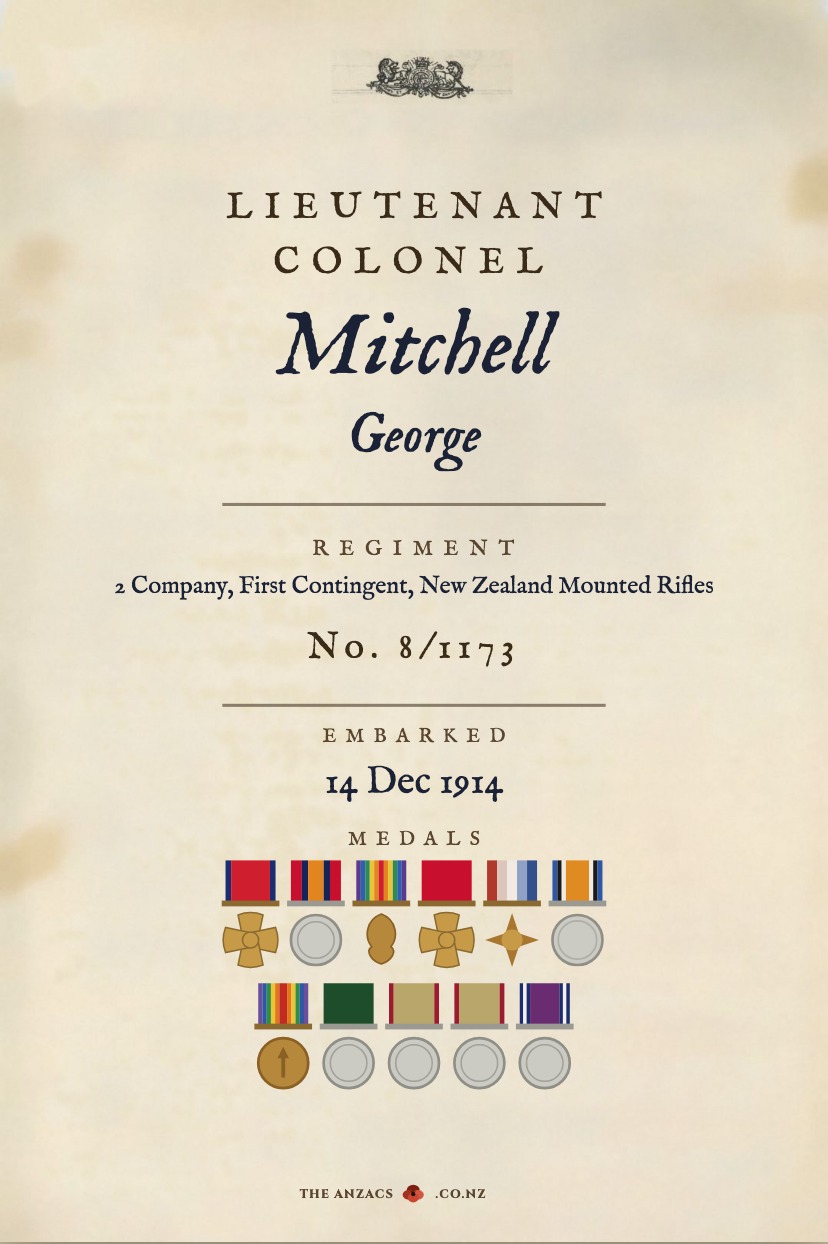
This is the Service Record sign as we would make it from his record: his rank, name, regiment, number and date of embarkation. The medals on the sign are worked out automatically from the embarkation date, so the medals listed above are the ones to rely on.
Photograph
We haven’t hosted a photograph here
Rather than copy someone else’s image onto our own site, we’d rather send you to see it where it’s properly held: his full record at the Auckland War Memorial Museum’s Online Cenotaph.
Sources
- George Mitchell, Online Cenotaph, Auckland War Memorial Museum.
- NZ War Graves Project, Cenotaph 36462 (birthplace, next of kin, embarkations)
- NZEF Project (UNSW), record for 8/1173 George Mitchell
- Wikipedia, George Mitchell (New Zealand politician)
- Medals Reunited NZ, 'Mitchell, George DSO, OSK' (19 Feb 2021)
What we could not confirm
Identity is secure: the Cenotaph record lists Trooper 160 (First Contingent), 5873 (Eighth) and 8/1173 (NZEF), and the same man is the MP for Wellington South. The Cenotaph's note that he 'served as an MP after the war' is correct and is not a mix-up with another George Mitchell.
Birth date conflict: Online Cenotaph says 19 April 1877; Wikipedia text says 10 April (infobox 19 April); the NZ War Graves Project gives 9 August 1877. Death age is given as 62 (Cenotaph) or 61 (NZ War Graves; also the arithmetic from 19 April 1877). Birth place Balclutha is consistent.
Date he became a substantive Lieutenant Colonel: Cenotaph says 15 March 1917; Medals Reunited says 15 April 1917 (temporary rank from 10 October 1916).
The Medals Reunited NZ article is a detailed secondary source based on his military file but has several internal date errors (for example it dates the Machavie train accident 1900 rather than 1902, and gives garbled dates for Egypt and for his 1900 return). Detail from it should be treated as medium confidence until checked against his Archives NZ file (R21376090 and R20522182).
Family home: Cenotaph and NZEF record say 'The Retreat, Waikawa, Southland'; Medals Reunited says Waikiwi (Invercargill).
The same article calls him a 'First Day Lander' at Gallipoli. He reached Egypt only in late January 1915 and the Otago Battalion landed on 25 April, so this is plausible, but we have not seen a direct nominal-roll confirmation.
Papers Past could not be searched for him in depth (not done in this pass); his Evening Post obituary of 17 March 1939 is cited by Wikipedia but not read directly.
Wikipedia says he was in the 'Southland Regiment' and the Cenotaph says Otago Infantry Battalion; he appears to have been a Southland Territorial officer attached to the Otago Infantry Battalion.