First Contingent 1899 · Marlborough · 21st Reinforcements, Machine-gun Section, 1917
Corporal Edward Moore
Edward Moore was a Blenheim surveyor's hand and the son of Marlborough's Chief Stock Inspector. He sailed with the First Contingent as a trooper in No. 2 Company and came home with a Queen's South Africa Medal carrying five clasps, including Relief of Kimberley and Paardeberg.
He turned to surveying and sheep farming in Marlborough and, in 1915, married. In February 1917, at about 40, he went to the First World War again as a corporal in the machine-gun section of the 21st Reinforcements.
His story
A Blenheim upbringing
Edward Amyas Wilmot Moore was the son of John Moore, Chief Stock Inspector for Marlborough, and Mary Elizabeth Moore. The family lived in Weld Street, Blenheim, and Edward worked as a survey hand before enlisting.
Source: Online Cenotaph record C33774; NZHistory soldier record (Moore, reg. no. 158, Marlborough, survey hand)Sailing on the Waiwera
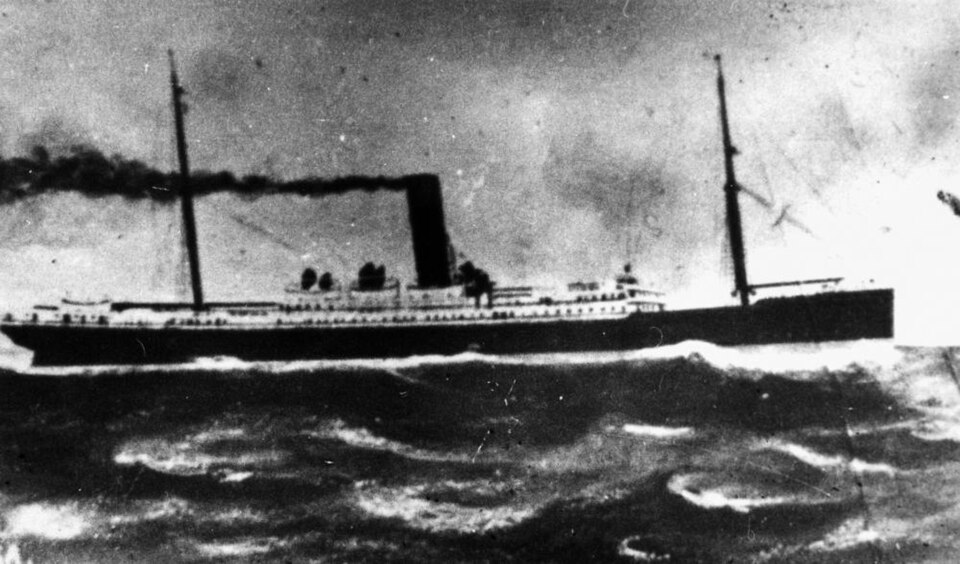
Single and living in Blenheim, Moore enlisted as a trooper (number 158) in No. 2 Company of the First Contingent and embarked on the Waiwera on 21 October 1899. His father was his next of kin.
Source: Online Cenotaph C33774; NZHistory soldier recordSouth Africa
The Cenotaph lists the Queen's South Africa Medal with clasps for the Relief of Kimberley, Paardeberg, Driefontein, Johannesburg and Diamond Hill. His record also names the Provisional Transvaal Constabulary among his units, though dates for that service were not found.
Source: Online Cenotaph C33774; Auckland Museum 'Good Luck to Our Boys' display noteHome to Marlborough
By September 1901 he was back in Blenheim: the Marlborough Express listed E. W. Moore among First Contingent men who were to call at the police station for balance of pay and gratuity. The Cenotaph notes that in 1901 he was surveying in Queen Charlotte Sound.
Source: Marlborough Express 23 Sep 1901 (Papers Past MEX19010923.2.7); Online Cenotaph C33774Surveyor and sheep farmer
He worked as a surveyor and became a sheep farmer, running a property he called 'Valhalla' at Kekerengu on the Marlborough coast. In 1915 he married Margaret Mildred Rutherford. A January 1917 Marlborough Land Board notice also shows an Edward Amyas Wilmot Moore applying for grazing land in the Woodbank run country.
Source: Online Cenotaph C33774; Marlborough Express 30 Jan 1917 (Papers Past MEX19170130.2.21.7)Off again with the 21st Reinforcements
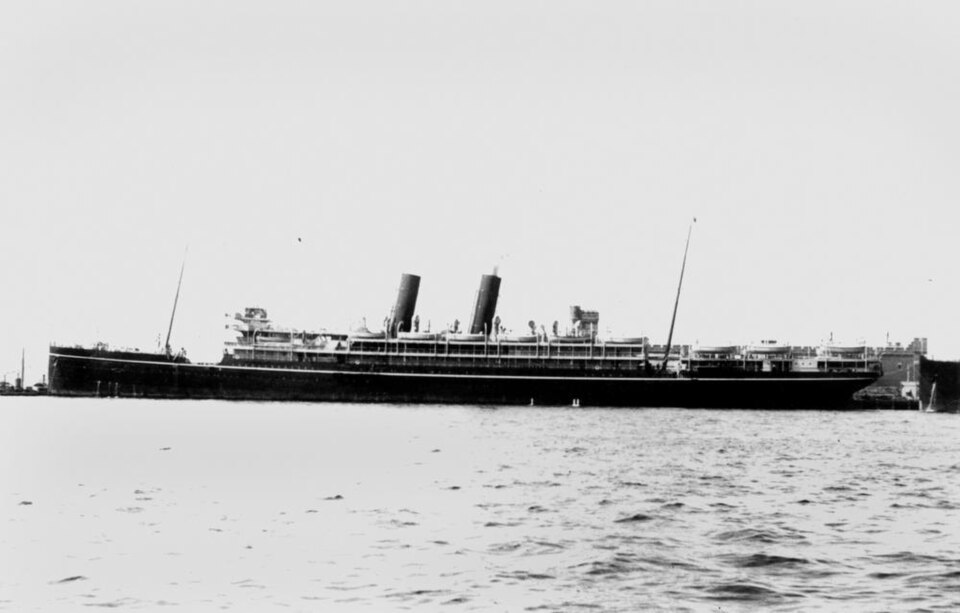
Moore enlisted for the First World War (number 28595) and embarked on the Manuka on 8 February 1917 as a corporal in the machine-gun section of the 21st Reinforcements, Mounted Rifles Brigade. The Cenotaph note says the party changed ships at Sydney (to the Morea) and again at Bombay (to the Mashobra) before reaching Suez in early April 1917.
Source: Online Cenotaph C33774 (citing NZEF Nominal Rolls Vol. III)War service
The Cenotaph shows he served between 1914 and 1919 and received the British War Medal and Victory Medal, but it lists no wounds, promotions or return date. His movements after landing at Suez could not be traced from the sources reached.
Source: Online Cenotaph C33774Death
Moore died on 30 December 1954, aged 78. His wife Margaret, who was his next of kin at 'Valhalla', Kekerengu, is also recorded as having died in 1954.
Source: Online Cenotaph C33774
Rank and insignia
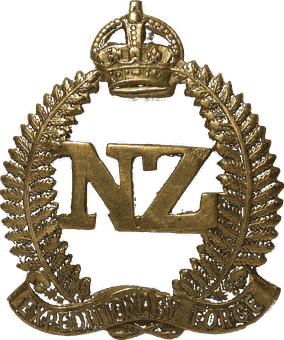
The rank he held, and the badge a soldier of that rank wore. These are simplified illustrations.
His medals
“Documented” means a source we name says he received it. “Listed on the Online Cenotaph” means the museum’s record lists the medal but we could not confirm it elsewhere. “Entitled” means his service dates qualified him, but we have not seen a record of the medal itself. The drawings are simplified illustrations.
His ships
Afterwards
Moore lived out his life as a Marlborough sheep farmer at 'Valhalla', Kekerengu. His father John Moore died at Wairau in 1927 and his mother in 1925. His photograph in uniform is part of Auckland Museum's 'Good Luck to Our Boys' Boer War display. He died on 30 December 1954, the same year as his wife Margaret.
His sign
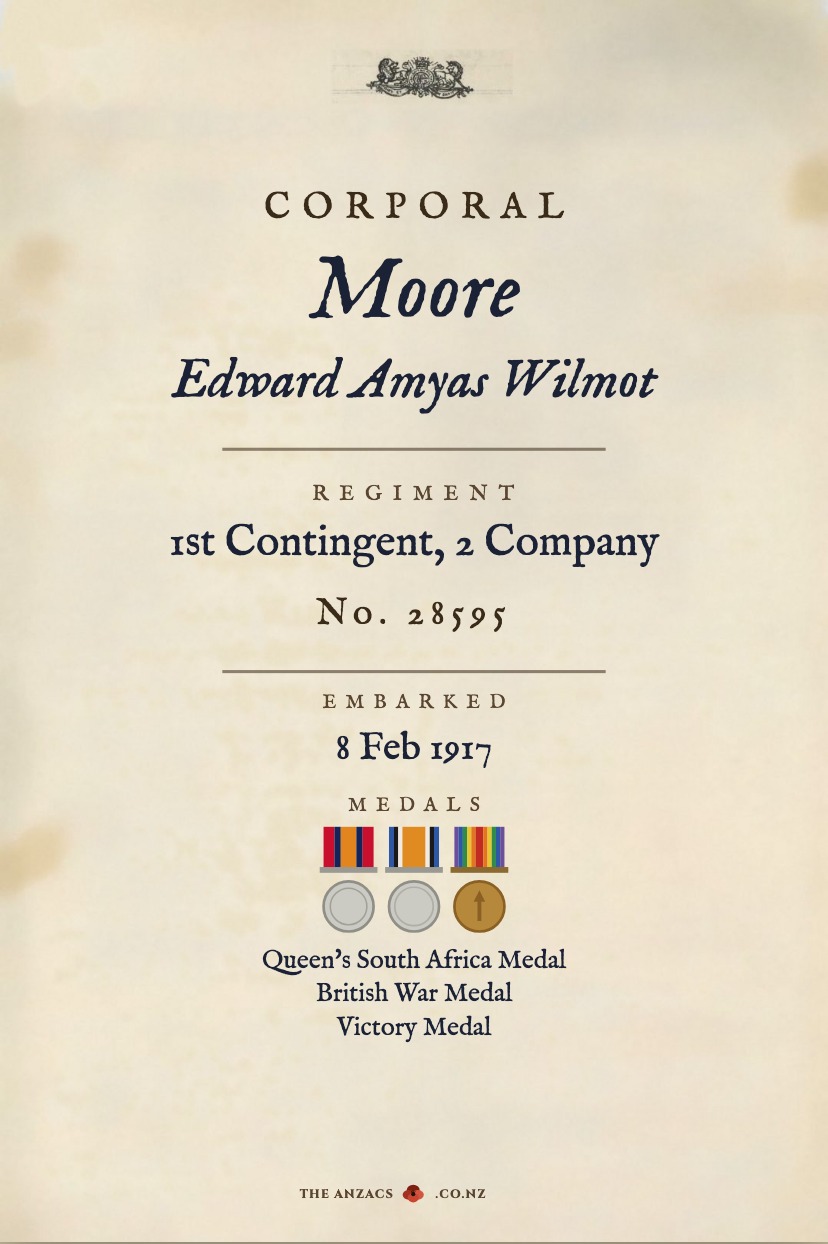
This is the Service Record sign as we would make it from his record: his rank, name, regiment, number and date of embarkation. The medals on the sign are worked out automatically from the embarkation date, so the medals listed above are the ones to rely on.
Photograph
We haven’t hosted a photograph here
Rather than copy someone else’s image onto our own site, we’d rather send you to see it where it’s properly held: his full record at the Auckland War Memorial Museum’s Online Cenotaph.
Sources
- Edward Amyas Wilmot Moore, Online Cenotaph, Auckland War Memorial Museum.
- NZHistory soldier record, Edward Wilmot Moore
- Papers Past, Marlborough Express, 23 Sep 1901
- Papers Past, Marlborough Express, 30 Jan 1917 (Land Board notice)
What we could not confirm
The Cenotaph's clasps list (Kimberley, Paardeberg, Driefontein, Johannesburg, Diamond Hill) is taken at face value; the QSA medal roll itself was not checked.
The Provisional Transvaal Constabulary is listed among his units, but dates and nature of that service were not found. His return from South Africa (possibly 1900-01) and the ship are not known.
The Cenotaph 'Campaign' field says Western Front 1914-1919, but the voyage via Sydney and Bombay to Suez points to Egypt and Palestine first. His actual theatre and any wounds are unconfirmed; no WWI narrative found.
Birth date 1 January 1876 is a placeholder; age 78 at death fits 1876.
NZHistory spells his name 'Edward Wilmot Moore'; the Marlborough Express 1901 notice reads 'E. W. Moore'. Identity rests on Blenheim, First Contingent and the Weld Street address.
The January 1917 Land Board application for the Woodbank run is attributed by name only; a link to 'Valhalla', Kekerengu, is not confirmed.
The Cenotaph note 'Father was named John Moore' and 'died 1927, Wairau' are family details recorded there; not independently checked.
No Papers Past obituary or place of death for 1954 was found; do not state where he died.
Roster 'number' 28595 is the WWI number; the South African number is 158.