First Contingent 1899 · Lord Roberts's bodyguard · NZ Staff Corps · Gallipoli and France 1915-1916
Major Wilson Cameron Morrison
Wilson Cameron Morrison went to South Africa in 1899 as a trooper in the Hawera Mounted Rifles and was picked, on merit, to represent the First Contingent in Lord Roberts's colonial bodyguard, one of four men who stood close guard on the Field Marshal himself. He was later commissioned, served in further contingents, and became a regular officer of the New Zealand Staff Corps.
In 1915 he sailed as a staff major with the 6th Reinforcements, served at Gallipoli and in France, and was gassed. He ended the war as General Staff Officer for the Canterbury Military District and died of heart failure after influenza on 25 November 1918, aged 43.
His story
Naseby to Hawera
Wilson Morrison was born at Naseby in Central Otago on 10 December 1874 and educated in Christchurch, joining the Queen's Cadets in 1889. He later moved to Wellington and served in volunteer corps there, and by 1899 was a trooper in the Hawera Mounted Rifles in Taranaki, working as a farmer.
Source: Sun (Christchurch), 26 Nov 1918, 'Personal' (Papers Past SUNCH19181126.2.6); Online Cenotaph record C34733; NZEF Project record 11/1625 (birthplace Naseby)Leaves with the First Contingent
Morrison was one of five Hawera Mounted Rifles volunteers who left Hawera by the morning train on 9 October 1899 for the camp at Karori, Wellington, with Lieutenant Bartlett. On 21 October he embarked on the Waiwera as Trooper 37, No. 1 Company, New Zealand Mounted Rifles.
Source: Hawera & Normanby Star, 9 Oct 1899 (Papers Past HNS18991009.2.13); Evening Post, 10 Oct 1899; Online Cenotaph record C34733Lord Roberts's bodyguard
In South Africa Morrison was recommended for promotion, but was instead chosen on merit to represent the First Contingent in the colonial bodyguard of the Commander-in-Chief, Lord Roberts, alongside one man each from the Second and Third Contingents. He was then one of four colonial soldiers (the others a Queenslander and two South Australians) picked as special sentries, with one of them always within arm's length of the Field Marshal. He wrote home about it, and Lord Roberts told the men he intended to take his bodyguard to England.
Source: Evening Post, 27 Sep 1900 (Papers Past EP19000927.2.38); Hawera & Normanby Star, 5 Oct 1900 (HNS19001005.2.30); Feilding Star, 28 Sep 1900; A. St Clair Inglis, Souvenir Album (quoted on the Cenotaph)Commissioned in later contingents
In January 1901 Morrison, by now a lieutenant, was on a short visit to Hawera, where he was given a warm welcome, before returning to South Africa with the Sixth Contingent. According to his obituary he later became a captain in the Tenth Contingent (1902). He held the Queen's South Africa Medal with four clasps and the King's South Africa Medal with two, and was mentioned in despatches.
Source: Wanganui Herald, 28 Jan 1901 and Press, 29 Jan 1901 (Papers Past); Sun (Christchurch), 26 Nov 1918; Otago Witness, 4 Dec 1918A regular officer
Back in New Zealand he continued in the volunteer service and, when the Territorial system began, joined the New Zealand Staff Corps. By 1913 he was a captain on the staff commanding the Palmerston North area, living at 11 Albert Street, Palmerston North. He married Olive Catherine Muir (the date is not confirmed; see flags). A few days after war broke out in August 1914 he was appointed General Staff Officer for the Wellington Military District with the temporary rank of major.
Source: Sun (Christchurch), 26 Nov 1918; The Observer, 13 Sep 1913 (Papers Past TO19130913.2.7); Online Cenotaph record C34733; NZEF Project record 11/1625Sails for the Dardanelles
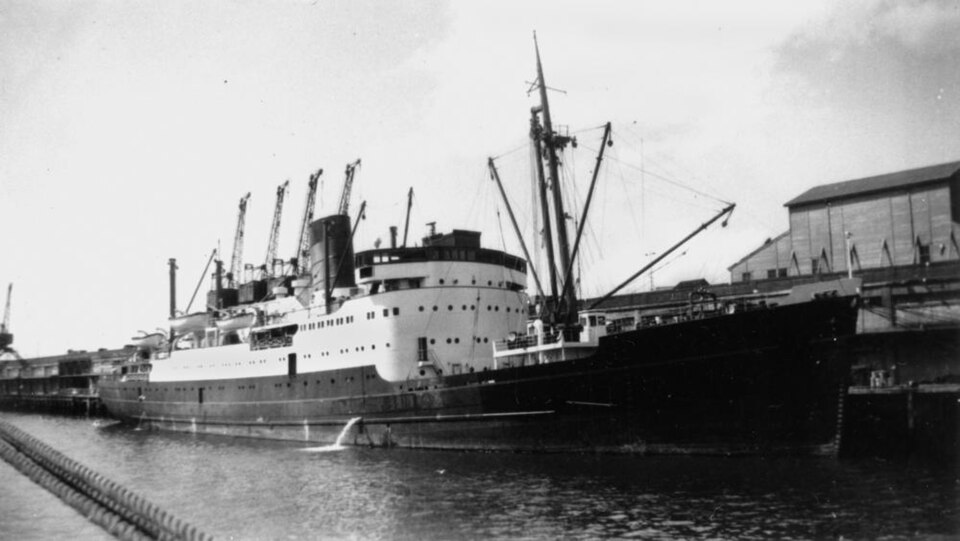
Morrison embarked at Wellington on 14 August 1915 on the Tofua (HMNZT 28) as a major with the 6th Reinforcements, Wellington Mounted Rifles, as a staff officer. He was gazetted major on 19 September 1915. His obituary says he saw considerable service on Gallipoli and later in France.
Source: NZEF Project record 11/1625 (Tofua, HMNZT 28, 14 Aug 1915; war service Egypt, Gallipoli, Western Front); Sun (Christchurch), 26 Nov 1918Gassed and invalided home
Morrison was invalided to New Zealand after being gassed, arriving home about November 1916, and spent time recovering at the Queen Mary Hospital at Hanmer. He was passed fit for service by late February 1917 and posted to Christchurch.
Source: Sun (Christchurch), 26 Feb 1917 (Papers Past SUNCH19170226.2.111.1) and 26 Nov 1918Staff officer in Christchurch
From February 1917 Morrison was General Staff Officer for the Canterbury Military District, working under Colonel R. A. Chaffey. His rank of major in the Staff Corps was made substantive from 11 October 1917. He helped examine pupils at the Canterbury Aviation Company's flying school, inspected territorial camps, and attended the Defence Conference in Wellington in August 1918.
Source: Sun (Christchurch), 26 Feb 1917, 8 Oct 1917, 19 Feb 1918, 17 Apr 1918; New Zealand Herald, 16 Jan 1918; Press, 26 Nov 1918Death in the influenza epidemic
Morrison died on 25 November 1918, at his home in Christchurch, from heart failure following an attack of influenza. He was 43 and left a widow and three young daughters. He was buried at Linwood Cemetery, probably on 27 November. The Commonwealth War Graves Commission records him, and one register gives the cause as 'died of wounds (gas)', reflecting his earlier gassing.
Source: Sun (Christchurch) and Press, 26 Nov 1918; Online Cenotaph record C34733; nzwargraves.org.nz node 19169 (CWGC data)
Rank and insignia
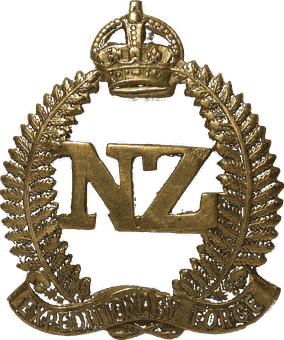
The rank he held, and the badge a soldier of that rank wore. These are simplified illustrations.
His medals
“Documented” means a source we name says he received it. “Listed on the Online Cenotaph” means the museum’s record lists the medal but we could not confirm it elsewhere. “Entitled” means his service dates qualified him, but we have not seen a record of the medal itself. The drawings are simplified illustrations.
His ships
Afterwards
Morrison lived in Christchurch while General Staff Officer for the Canterbury Military District; the Cenotaph and NZEF record give the family address as 26 Wairarapa Terrace, Fendalton, while the Press obituary says he died at his residence in Stafford Street, Lower Riccarton. His wife was Olive Catherine (nee Muir); they had three young daughters. He was buried at Linwood Cemetery, Christchurch (Block 48, Plot 158), on or about 27 November 1918. He is commemorated by the Commonwealth War Graves Commission, which lists him as a major of the NZ Division staff, and the Cenotaph also records him among the 1918 influenza victims.
His sign
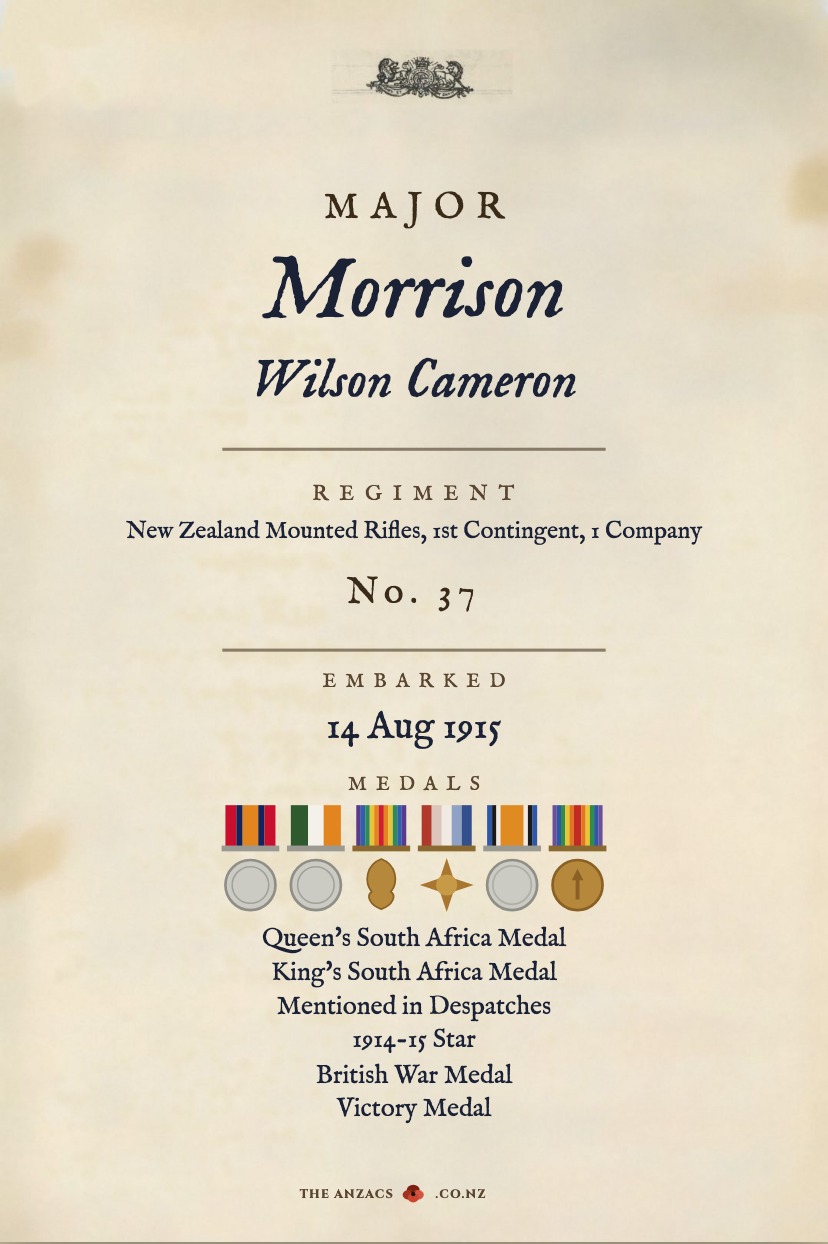
This is the Service Record sign as we would make it from his record: his rank, name, regiment, number and date of embarkation. The medals on the sign are worked out automatically from the embarkation date, so the medals listed above are the ones to rely on.
Photograph
We haven’t hosted a photograph here
Rather than copy someone else’s image onto our own site, we’d rather send you to see it where it’s properly held: his full record at the Auckland War Memorial Museum’s Online Cenotaph.
Sources
- Wilson Cameron Morrison, Online Cenotaph, Auckland War Memorial Museum.
- NZ War Graves Project, Wilson Cameron Morrison (CWGC data)
- NZEF Project (UNSW), record for 11/1625 Wilson Cameron Morrison
- Sun (Christchurch), 26 Nov 1918, 'Personal' (Papers Past)
- Press, 26 Nov 1918, 'Obituary: Major W. C. Morrison' (Papers Past)
- Evening Post, 27 Sep 1900 (Lord Roberts's bodyguard) (Papers Past)
- Hawera & Normanby Star, 5 Oct 1900 (Papers Past)
- Sun (Christchurch), 26 Feb 1917 (Papers Past)
What we could not confirm
Identity: confirmed by number 37 / 11/1625, birth at Naseby and Hawera Mounted Rifles. The Cenotaph lists three numbers (37, 11/625, 11/1625); 11/625 is an earlier Wellington Mounted Rifles Main Body number belonging to another man in the NZEF Project and may be a database error.
Cause of death: obituaries and the Cenotaph say heart failure following influenza; CWGC/NZ War Graves list 'died of wounds (gas)'. Both may be true (he was gassed in 1916).
Death address: Sun and Cenotaph say Wairarapa Terrace, Fendalton; the Press obituary says Stafford Street, Lower Riccarton.
Marriage date: Cenotaph gives 14 August 1915, which is the day he embarked, so probably a data artefact; the NZEF nominal roll already lists him as married with a wife at Palmerston North and he had three daughters by 1918. Actual marriage date not found.
Which reinforcements: the Press/Otago Witness obituaries say he commanded the 5th Reinforcements as a captain; the NZEF Project and Cenotaph record him as Major, 6th Reinforcements, Tofua, 14 August 1915. The latter is used here.
Commissions in 1901-02 (Lieutenant, 6th Contingent; Captain, 10th Contingent) rest on the 1918 obituary and Jan 1901 news items; the 10th Contingent nominal roll was not checked.
Return voyage ship and date not found; QSA/KSA clasps not itemised; his Archives NZ file (R20524678) was not viewed.
Cenotaph occupation 'farmer' (1899) is from the Cenotaph; the 'Hawera' newspapers also call him a member of the Hawera Mounted Rifles; one 1900 article says he was earlier a member of a Wellington corps (text cut off).