First Contingent 1899 · Eighth Contingent 1902 · Maori Contingent, Gallipoli 1915
Captain William Pitt
William Tutepuaki (Wiremu) Pitt was a Ngati Porou clerk and footballer from Gisborne who sailed as Private 98 with the First Contingent in October 1899. In South Africa he was a sergeant, was taken prisoner at Koornspruit in March 1900 and got away, and in 1902 he went back as a lieutenant and paymaster with the Eighth Contingent.
In 1915 he commanded B Company, made up of East Coast men, of the First Maori Contingent as a captain, and served at Gallipoli before being invalided home with heart disease. In later life he worked for the Native Department and was a leading figure in Maori affairs and rugby around Gisborne. He died on his sixtieth birthday, 1 June 1937.
His story
A Gisborne boy
William Pitt was born at Gisborne in 1877, the son of Chowell Dean Pitt and Maata Te Owai, and was of Ngati Porou descent. He worked as a clerk, lived for a time in Wellington, and was a prominent footballer who later captained the Poverty Bay representative side for several seasons.
Source: Online Cenotaph record C53081; Evening Post and other papers, 1 Jun 1937 (Papers Past obituary, e.g. HBHETR19370601.2.33.1)Sails with the First Contingent
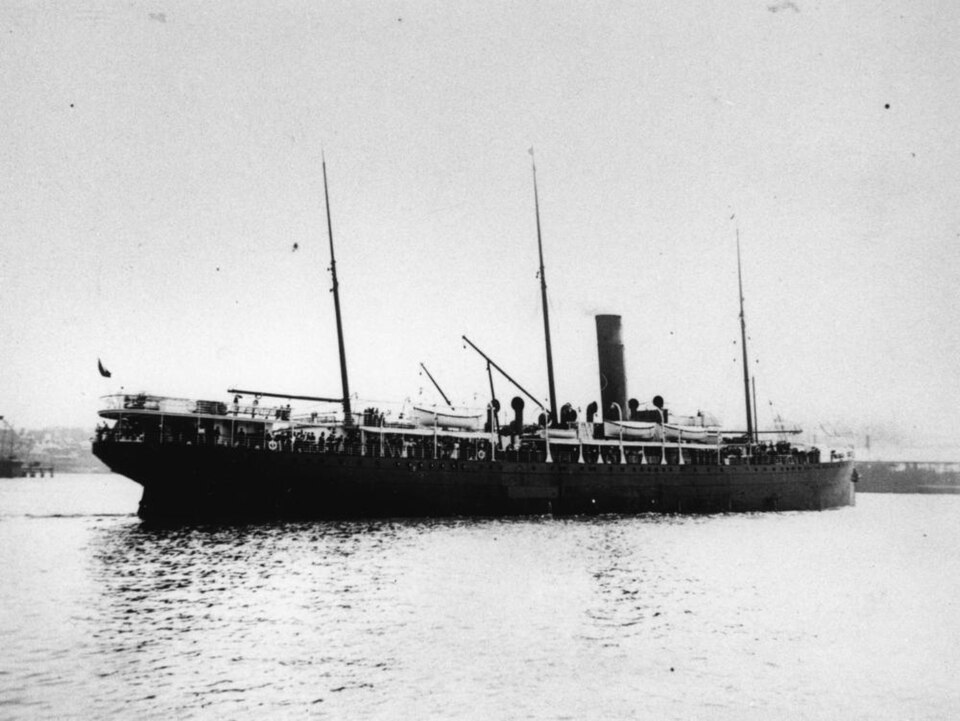
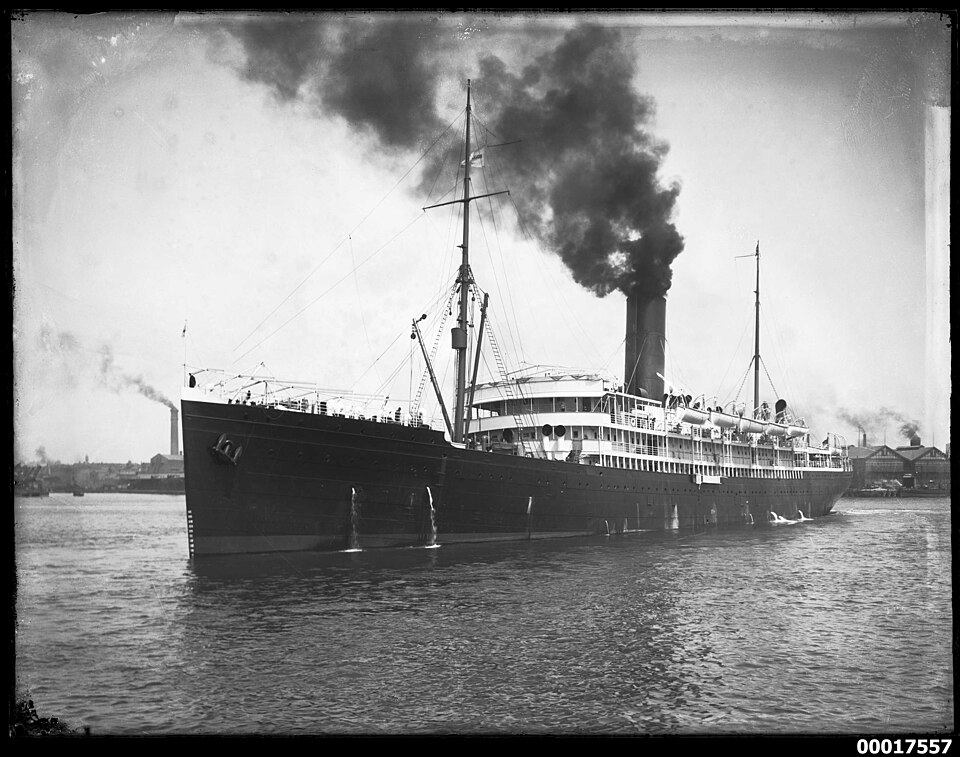
Pitt enlisted at the outbreak of the war and embarked on the Waiwera on 21 October 1899 as Private 98, 1 Company, New Zealand Mounted Rifles, aged 22.
Source: Online Cenotaph record C53081Kimberley, Paardeberg and Driefontein
He served in the actions of the Relief of Kimberley, Paardeberg and Driefontein, and by February 1900 was a sergeant, detached for duty on fit horses at Kimberley Camp.
Source: Online Cenotaph record C53081 (Stowers, Kiwi versus Boer, p. 174)Captured at Koornspruit and escapes
In March 1900 Pitt was taken prisoner at Koornspruit. Left in temporary charge of a wounded military attache whom he was told to take to a nearby farm, he did so, then quietly slipped away with the wagon and returned to Bloemfontein. The Cenotaph also records that he joined the Orange River Colony Provisional Mounted Police in May 1900 and left Cape Town on the Tongariro in April 1900; these dates do not fit together and need checking.
Source: Online Cenotaph record C53081 (quoting Stowers, p. 174)Paymaster of the Eighth Contingent
Pitt went back to South Africa as a lieutenant on the regimental staff of the North Island Regiment, Eighth Contingent. In the January 1902 camp at Auckland he was both paymaster and adjutant, and the commanding officer complimented him on the system he had set up for paying the men. He sailed from Auckland on the Surrey in early February 1902 and qualified for the King's South Africa Medal with the 1901 and 1902 clasps.
Source: Evening Post, 15 Jan 1902 and New Zealand Times, 17 Jan 1902 (Papers Past EP19020115.2.33, NZTIM19020117.2.22); Online Cenotaph record C53081Marriage and public life
Pitt married Katherine (Kitty) Rangikawhiti Rogers, whose father W. Rogers was of Ohinemutu, Rotorua (the Cenotaph gives a wedding date of 5 January 1909, but other entries on the record say 1908 and December 1909). The Cenotaph lists his later work with the Native Lands Commission as a post-war occupation.
Source: Online Cenotaph record C53081Captain of B Company
Pitt enlisted at Wellington on 26 October 1914, aged 37, and was appointed Captain in command of B Company of the First Maori (Native) Contingent, which was made up of the East Coast men. He embarked from Auckland on the Warrimoo (HMNZT 20) on 14 February 1915. His wife followed him as far as Alexandria, where their daughter was born in 1915; newspapers called her the first Maori baby born in Egypt.
Source: NZEF Project record 16/499 (Warrimoo, Auckland, 14 Feb 1915); Poverty Bay Herald, 19 Jan 1916 (Papers Past PBH19160119.2.26); Online Cenotaph record C53081Gallipoli and illness
Pitt served with the Maori Contingent in the fighting at Gallipoli. He became ill, was sent back from Egypt, and returned to New Zealand on the Tahiti with the invalids who arrived in late December 1915, acting as adjutant for the party, with Mrs Pitt and their baby aboard. A medical board in Wellington found him unfit for further service. The Cenotaph records heart disease and a small war pension.
Source: Otago Witness, 29 Dec 1915 and Colonist, 30 Dec 1915 (Papers Past OW19151229.2.50, TC19151230.2.24); Poverty Bay Herald, 19 Jan 1916; Online Cenotaph record C53081 (1920 disability list)Welcome home in Gisborne
On 19 January 1916 a large gathering of Gisborne Maori welcomed him at Kaiti pa, with the Hon. A. T. Ngata present; he was the first officer of his company to return to Gisborne. The Poverty Bay Herald noted that he looked well and that his discharge was ordered to be taken at Wellington on 26 January. In September 1917 a parliamentary committee referred his petition for an inquiry into the way his appointment was ended to the Government for favourable consideration.
Source: Poverty Bay Herald, 19 Jan 1916; Colonist, 27 Sep 1917 (Papers Past TC19170927.2.50)Leader in Gisborne
Pitt was president of the Gisborne Returned Soldiers' Association and secretary of the trustees of the Maori Soldiers' Fund in 1917. In the 1920s and 1930s he was a Maori welfare officer with the Native Department working on land development schemes, a member of the Maori Rugby Advisory Board, chairman of the Tairawhiti Association (1931), and manager of the East Coast Maori rugby team that year. He lived at 421 Gladstone Road, Gisborne.
Source: New Zealand Times, 30 Aug 1917; Poverty Bay Herald, 10 Jul 1931; Evening Post, 20 Aug 1931; obituary notices 1-2 Jun 1937 (Papers Past); Online Cenotaph record C53081Death
Pitt died at Gisborne on 1 June 1937, his sixtieth birthday. Press Association obituaries called him a leading member of the Maori race. He was buried at Taruheru Cemetery on 3 June 1937.
Source: Hawke's Bay Herald-Tribune, Southland Times, Wanganui Chronicle and others, 1-2 Jun 1937 (Papers Past); Gisborne District Council cemetery database (Taruheru 3143)
Rank and insignia
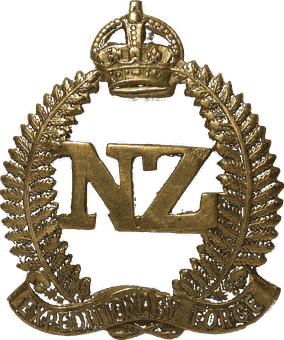
The rank he held, and the badge a soldier of that rank wore. These are simplified illustrations.
His medals
“Documented” means a source we name says he received it. “Listed on the Online Cenotaph” means the museum’s record lists the medal but we could not confirm it elsewhere. “Entitled” means his service dates qualified him, but we have not seen a record of the medal itself. The drawings are simplified illustrations.
His ships
Afterwards
After his discharge Pitt made his home in Gisborne. He was a Maori welfare officer in the Native Department, a long-time member of the Maori Rugby Advisory Board, and president of the Returned Soldiers' Association locally. He died on 1 June 1937 and is buried at Taruheru Cemetery, Gisborne (Block S; the Cenotaph says plot 94, the council register plot 95); his headstone reads 'Capt W.T. Pitt, Maori Pioneer Battalion'. The Cenotaph also lists him on Gisborne's South African War memorial and the Gisborne War Memorial Theatre.
His sign
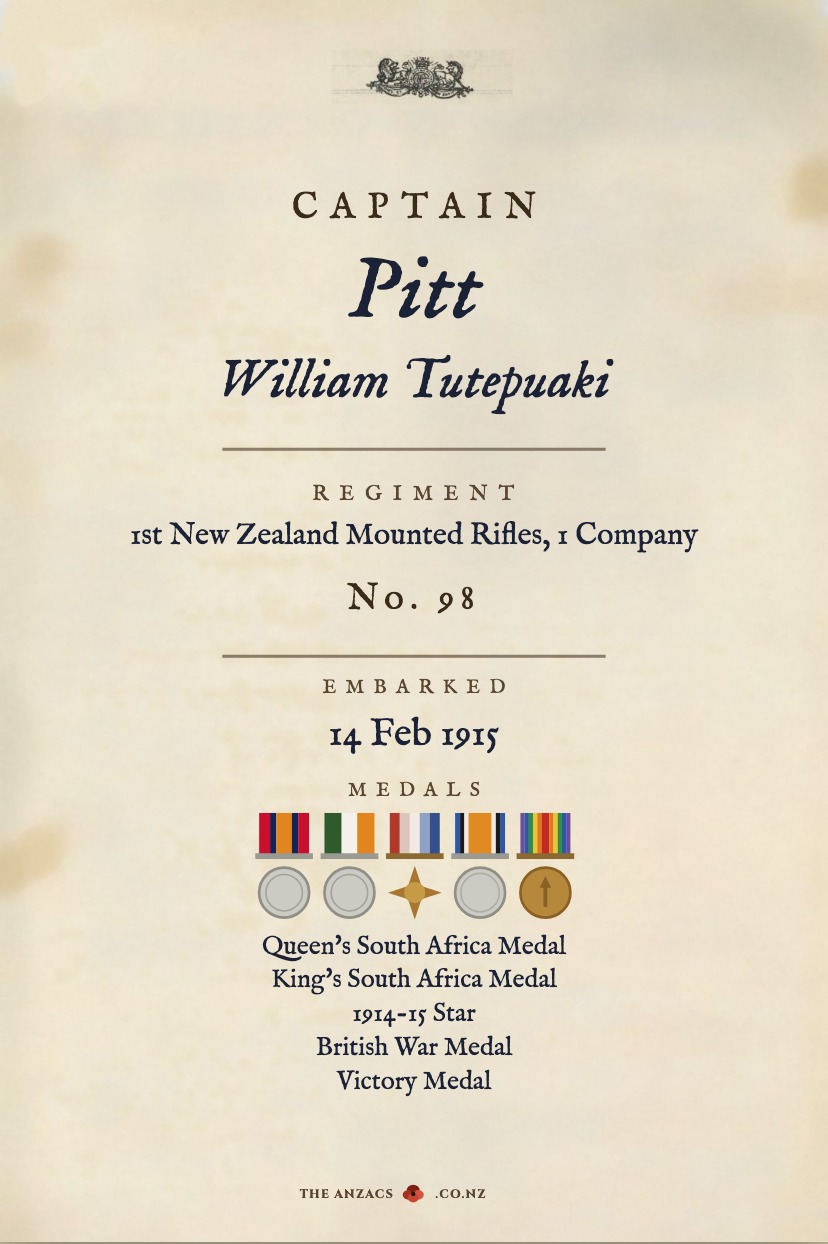
This is the Service Record sign as we would make it from his record: his rank, name, regiment, number and date of embarkation. The medals on the sign are worked out automatically from the embarkation date, so the medals listed above are the ones to rely on.
Photograph
We haven’t hosted a photograph here
Rather than copy someone else’s image onto our own site, we’d rather send you to see it where it’s properly held: his full record at the Auckland War Memorial Museum’s Online Cenotaph.
Sources
- William Tutepuaki Pitt, Online Cenotaph, Auckland War Memorial Museum.
- NZEF Project (UNSW), record for 16/499 William Tutepuaki Pitt
- Gisborne District Council cemetery database, Taruheru 3143
- Poverty Bay Herald, 19 Jan 1916, 'Captain Pitt's return' (Papers Past)
- Otago Witness, 29 Dec 1915, 'Back from the war' (Papers Past)
- Evening Post, 15 Jan 1902, 'Our Eighth Contingent' (Papers Past)
- Hawke's Bay Herald-Tribune, 1 Jun 1937, obituary (Papers Past)
- Colonist, 27 Sep 1917, 'Maori officer's petition' (Papers Past)
What we could not confirm
Birth date 1 June 1877 is inferred from newspaper reports that he died on his 60th birthday on 1 June 1937 (age 60 also on the cemetery register); no birth certificate seen. Cenotaph gives only '1877, Gisborne'.
Wedding date conflicts on the Cenotaph: 5 January 1909, December 1909, and a 1 January 1908 'married' entry. Not resolved. NOK 'Mrs E. R. Pitt' is probably a clerical error for his wife.
Cenotaph says the Pioneer Battalion and the 1937 obituaries say he served 'on Gallipoli and in France', but the Papers Past reports show he was invalided home from Egypt in December 1915 and discharged in 1916, so France is doubtful. The Pioneer Battalion was formed in 1916 from the Maori Contingent he had already left; the headstone wording reflects later usage.
Cenotaph timeline in South Africa is inconsistent: captured March 1900, left Cape Town on the Tongariro in April 1900, joined the Orange River Colony Provisional Mounted Police in May 1900. Source is Stowers p. 174 via the Cenotaph; original not seen.
Eighth Contingent: Cenotaph says he enlisted 21 January 1902 at Wellington, but he was already acting as paymaster/adjutant at the Auckland camp by 15 January 1902.
Burial plot: Cenotaph says Block S plot 94; Gisborne District Council register says plot 95.
The 1917 petition about the end of his NZEF appointment was referred for consideration, outcome not found.
Not checked: NZHistory soldier page (blocked), Te Ara photograph of Te Puea Herangi and William Pitt, 28maoribattalion.org.nz entry (blocked), Cowan's 'The Maoris in the Great War', Archives NZ files R20801688 and R7880673.