Commander of the First Contingent 1899 · Boer War · Commandant, NZ Military Forces 1914-1919
Major-General Sir Alfred Robin
Alfred William Robin was a Dunedin coachbuilder and volunteer cavalry officer who, as a major, commanded the First Contingent that sailed on the Waiwera on 21 October 1899. He led the 1st New Zealand Regiment in South Africa, came home a national celebrity, and rose to be the first colonial to hold the country's top military post.
In 1914 he offered to serve overseas but the Government kept him at home. As Commandant of the New Zealand Military Forces from September 1914 he organised the reinforcements and training that kept the Expeditionary Force in the field. He was knighted in 1916 and retired as a major-general.
His story
A Dunedin coachbuilder's son
Alfred Robin was born at Riddells Creek, Victoria, on 12 August 1860, the son of James Robin, then a baker, and his second wife Anne McDougall. The family moved to Dunedin about 1861, and James Robin built up a thriving coach and carriage business. Alfred went to Milton Hall school and for one year (1873) to the High School of Otago, then joined the family firm as an apprentice and later became a working partner. At school he was battery bombardier in the artillery cadet corps.
Source: Te Ara, Dictionary of NZ Biography (Phillip O'Shea), 'Robin, Alfred William'; Online Cenotaph C34317Volunteer officer
Between 1878 and 1883 he served in the New Zealand Regiment of Volunteer Artillery, the Southland Hussars and the Dunedin Cavalry Volunteers (as sergeant-major). The cavalry unit became the Otago Hussars in 1886; Robin was commissioned lieutenant on 3 July 1889 and captain on 7 February 1891, and commanded the Hussars until 1898. In 1897 he selected, trained and commanded the mounted section of New Zealand's contingent for Queen Victoria's Diamond Jubilee and commanded the colonial section of the bodyguard escorting the Queen to Windsor. He resigned his business partnership in 1898 and on 7 December 1898 became major commanding the new Otago Battalion of Mounted Rifle Volunteers.
Source: Te Ara DNZB; Online Cenotaph C34317Commanding the First Contingent
Robin accepted a commission in the permanent forces in September 1899 and was instructing South Island mounted rifle units when the Boer War began. The Government appointed him Major in command of the First Contingent, about 215 men. They went under canvas at Karori, and the Waiwera sailed from Wellington on 21 October 1899, the anniversary of Trafalgar as one newspaper noted. The other officers were Captains Davies and Madocks and Lieutenants Chaytor, Bartlett, Neave, Canavan, Johnston and Lindsay.
Source: Te Ara DNZB; Wikipedia 'Alfred Robin'; Papers Past, Evening Post 21 Oct 1899 and New Zealand Mail 26 Oct 1899 (officers' list)The 1st New Zealand Regiment
In South Africa the contingent fought with General French's cavalry and was often split up to support mobile columns. From May 1900 to April 1901 Robin commanded the 1st New Zealand Regiment, a combined formation of the first three contingents. He was promoted lieutenant-colonel on 25 June 1900, was mentioned in despatches three times (including the Gazettes of 4 May 1900 and 16 April 1901) and was made a Companion of the Bath on 19 April 1901. British and colonial senior officers admired his competence and his ability to inspire loyalty.
Source: Te Ara DNZB; Online Cenotaph C34317; Wikipedia 'Alfred Robin'Home as a celebrity
Robin returned in charge of the troops aboard the Tongariro (1 April to 8 May 1901) and was received with illuminated addresses, swords and caskets. His portrait appeared on commemorative medals, post office stationery and even a Christmas card. On 14 January 1902 he was given a brevet colonelcy.
Source: Te Ara DNZB; Online Cenotaph C34317; Papers Past, Taranaki Herald 1 May 1901 (Robin 'in charge of the troops on board the Tongariro')Head of the General Staff
From 1901 to 1906 Robin commanded the Otago Militia and Volunteer District. In December 1906 he joined the new Council of Defence as Chief of the General Staff, the first colonial to hold the country's highest military position, and helped to put compulsory military training into effect after 1909.
Source: Te Ara DNZB; Online Cenotaph C34317London and back
When Major-General Godley became Commandant in December 1910, Robin became Adjutant and Quartermaster-General. He received the Colonial Auxiliary Forces Officers' Decoration in 1911 and a CMG in 1912, and in 1912 went to London as New Zealand's representative on the Imperial General Staff at the War Office. He returned in December 1913 and resumed as Quartermaster-General on 13 February 1914.
Source: Te Ara DNZBHolding the home front
On the outbreak of war Robin offered to serve overseas, but the Government judged his recent experience too valuable and kept him in New Zealand. When Godley left to command the Expeditionary Force, Robin was appointed Commandant of the New Zealand military forces within New Zealand on 10 September 1914. He organised reinforcements, training and supplies for the NZEF. He became Brigadier-General on 18 June 1915, KCMG in 1916 and, on Godley's recommendation, Major-General on 21 October 1916. He ceased to be Quartermaster-General on 5 May 1919 and gave up command on 10 December 1919, declining a post at the High Commission in London.
Source: Te Ara DNZB; Online Cenotaph C34317; Wikipedia 'Alfred Robin'Samoa, scouting and veterans
In 1920 Robin was briefly acting Administrator of Western Samoa, and on 1 January 1921 he was placed on the retired list. France made him a Chevalier of the Légion d'honneur in 1922. In retirement he was president of the First New Zealand Mounted Rifles' Association from its foundation in 1901 until his death, took part in the South African War Veterans' Association, was Wellington metropolitan commissioner of the Boy Scouts for over ten years (Silver Wolf, April 1933), and supported the St John Ambulance Brigade (Knight of Grace of St John, 17 May 1929).
Source: Te Ara DNZB; Online Cenotaph C34317Death in Wellington
Sir Alfred Robin died at his Wellington home on 2 June 1935 after an illness of several months. He had never married; his sister Miss Margaret Robin had kept house for him. He declined a military funeral and the burial was private, at Karori Cemetery. Online Cenotaph also lists the King George V Silver Jubilee Medal of 1935 among his awards.
Source: Te Ara DNZB; Papers Past, Dominion 3 June 1935 and Taranaki Daily News 3 June 1935; Online Cenotaph C34317
Rank and insignia
The rank he held, and the badge a soldier of that rank wore. These are simplified illustrations.
His medals
“Documented” means a source we name says he received it. “Listed on the Online Cenotaph” means the museum’s record lists the medal but we could not confirm it elsewhere. “Entitled” means his service dates qualified him, but we have not seen a record of the medal itself. The drawings are simplified illustrations.
His ships
Afterwards
Robin died at his Wellington home on 2 June 1935, aged 74, and was buried at Karori Cemetery (Online Cenotaph gives Area 2, Block B, Row 16, Plot 9; Wikipedia's source places him on the cemetery's 'Warrior's Walk'). He never married. Te Ara describes him as modest, idealistic and hard-working, proud of having risen from the ranks of the volunteers, and an accomplished artist who exhibited with the Otago Art Society between 1885 and 1906. A memorial shield named for him is awarded each year at the New Zealand St John youth competition.
His sign
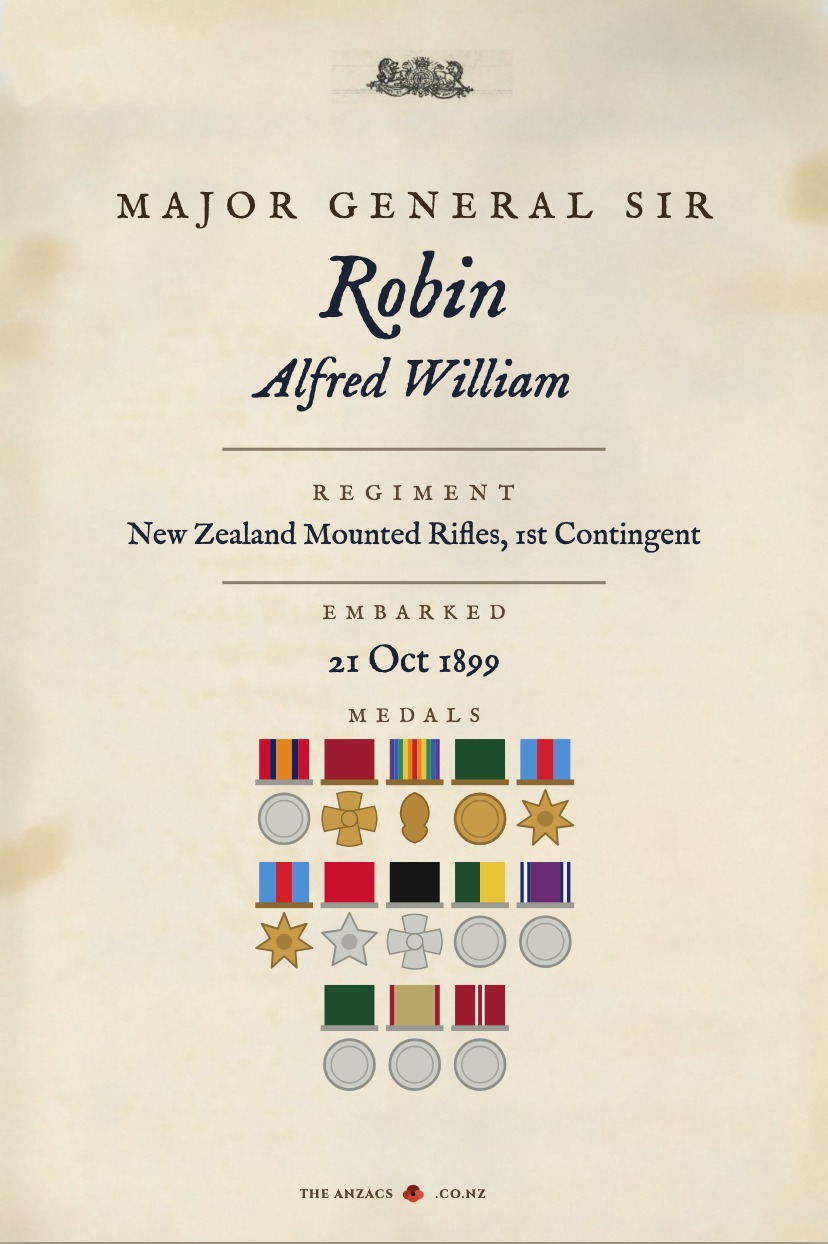
This is the Service Record sign as we would make it from his record: his rank, name, regiment, number and date of embarkation. The medals on the sign are worked out automatically from the embarkation date, so the medals listed above are the ones to rely on.
Photograph
We haven’t hosted a photograph here
Rather than copy someone else’s image onto our own site, we’d rather send you to see it where it’s properly held: his full record at the Auckland War Memorial Museum’s Online Cenotaph.
Sources
- Alfred William Robin, Online Cenotaph, Auckland War Memorial Museum.
- Te Ara, Dictionary of New Zealand Biography: Robin, Alfred William
- Wikipedia: Alfred Robin
- Papers Past, Dominion 3 June 1935, 'Death of Sir Alfred Robin'
- Papers Past, Taranaki Daily News 3 June 1935, 'Distinguished Service'
- Papers Past, Taranaki Herald 1 May 1901, 'Colonel Robin interviewed'
- Papers Past, New Zealand Mail 26 October 1899, 'N.Z. Contingent'
What we could not confirm
Online Cenotaph lists him as 'Married'; Te Ara, Wikipedia and the Dominion obituary all say he never married. Followed the latter.
Cenotaph gives his father as 'James Robin Baker'; Te Ara says James Robin. Followed Te Ara.
Cenotaph says CB, CMG but not KCMG; Te Ara and press obituaries confirm KCMG (1916). A Taranaki Daily News line saying he was knighted in 1912 is wrong (the 1912 honour was CMG).
Regimental number 7005 appears only on Online Cenotaph.
Exact date and port of arrival home on the Tongariro (May 1901) not pinned down; the Evening Post of 8 May 1901 reports a reception at Dunedin. The Cenotaph's 'voyage 1 April to 8 May' is quoted from the record.
Karori grave reference is from Online Cenotaph; not checked against Wellington City Council cemetery records.