First Contingent 1899 · Boer War · Wellington Mounted Rifles 1914-1919 · Historian of the regiment
Major Alexander Wilkie
Alexander Herbert Wilkie grew up in Ashburton, worked as a clerk and public accountant, and sailed with the First Contingent on the Waiwera in 1899. He went back to South Africa in 1902 as a lieutenant and quartermaster with the Ninth Contingent.
In 1914 he was quartermaster of the Wellington Mounted Rifles, serving at Gallipoli and in Sinai and Palestine alongside another First Contingent man, James Whyte. He later wrote the regiment's official war history, sat on the Takapuna borough council, and died in Suva, Fiji, in March 1941.
His story
A journalist's son from Ashburton
Alexander Herbert Wilkie was the son of the late James Wilkie, a journalist, and Isabella Wilkie, who lived on the Great South Road at Ashburton. A 1915 profile says he was born at Oxford, near Christchurch, in 1878 and educated at Ashburton. He joined the Ashburton Rifle Volunteers in 1893 and later transferred to the Canterbury Yeomanry Cavalry, where he won a shooting cup. By 1899 he was a clerk.
Source: Papers Past, Press 14 Oct 1915 ('The fallen and wounded'); NZHistory Boer War roll (alexander-herbert-wilkie-0); Online Cenotaph record C58545Sailing with the First Contingent
He was a private (No. 186) in No. 2 Company of the First Contingent and sailed from Wellington on the Waiwera on 21 October 1899. The Ashburton Guardian later wrote that he was one of the first to volunteer and fought right through the Boer War.
Source: Online Cenotaph record C58545; NZHistory Boer War roll; Papers Past, Ashburton Guardian 26 Jul 1915South Africa, twice over
The 1915 profile says he served throughout the South African War from 1899 to 1902 and was in camp at Vereeniging when peace was signed. The NZHistory roll shows a second engagement: Alexander Herbert Wilkie, a clerk at the Defence Office in Invercargill, sailed on the Kent on 12 March 1902 as Lieutenant and Quartermaster on the staff of the South Island Regiment, Ninth Contingent. The details of his first-contingent service (battles, return date) were not found.
Source: Papers Past, Press 14 Oct 1915; NZHistory Boer War roll (alexander-herbert-wilkie, Ninth Contingent); Online Cenotaph record C58545Accountant and councillor at Ohakune
He settled in the Ruapehu district as a public accountant and auditor, practising at Ohakune and Raetihi. He was a member of the Ohakune Town Board from its beginning and then of the Ohakune Borough Council, was a Justice of the Peace, and was for a time president of the Ohakune Chamber of Commerce. He was still single when he embarked in 1914.
Source: Papers Past, Press 14 Oct 1915; Online Cenotaph record C58545Quartermaster of the Wellington Mounted Rifles
In August 1914 Hon. Captain A. H. Wilkie was named quartermaster of the Wellington Mounted Rifles Regiment, serving under Lieutenant-Colonel Meldrum with Captain J. H. Whyte as second-in-command. He embarked from Wellington on 16 October 1914 on either the Orari (HMNZT 6) or the Arawa (HMNZT 10), as the Cenotaph is not sure which.
Source: Papers Past, Evening Post 24 Aug 1914 and Otago Witness 21 Oct 1914; Online Cenotaph record C58545Gallipoli
Captain Wilkie landed with the regiment at Gallipoli. On 3 June 1915 he wrote to relatives in Ashburton describing the heavy fighting of 29 and 30 May, praising the New Zealanders as steady as rocks, and mentioning that the Turks were so close that bullets were passing his dug-out as he wrote. By mid-October 1915 the Press listed him among those reported to be in hospital, and the Cenotaph records him as wounded at Gallipoli.
Source: Papers Past, Ashburton Guardian 26 Jul 1915; Press 14 Oct 1915; Online Cenotaph record C58545Egypt, Sinai and Palestine
The regiment went on to Sinai and Palestine. A photograph of 'Major Wilkie, Kantara' is in the Auckland Museum collection. The London Gazette of 6 July 1917 mentioned him in despatches. A gazette notice of 10 October 1916, reported in the Otago Witness of 3 January 1917, lists Hon. Major A. H. Wilkie of the Wellington Mounted Rifles among quartermasters confirmed as captains, so his 'Major' rank appears to have been honorary.
Source: Online Cenotaph record C58545 (photo PH-ALB-216; MID London Gazette 6 July 1917 p.6774); Papers Past, Otago Witness 3 Jan 1917Regimental historian and Takapuna councillor
After the war he wrote the Official War History of the Wellington Mounted Rifles Regiment, 1914-1919, published by Whitcombe and Tombs in 1924. He lived at Takapuna on Auckland's North Shore, served six consecutive years on the Takapuna Borough Council, chaired its legal and finance and public services committees, chaired the local Ex-Servicemen's Club smoke concert in 1928, and announced in October 1928 that he would stand for mayor.
Source: NZETC and NZ War Graves Project catalogue entries for Wilkie (1924); Papers Past, Sun (Auckland) 25 Oct 1928; North Shore Gazette 5 Jul 1928Suva, Fiji
He had lived at Suva, Fiji, for several years because of his health. He died at his residence there on 20 March 1941, aged 65, and was given a military funeral. The coffin, under the Union Jack with his Anzac hat and sword on top, was carried by four Fijian members of the Fiji Defence Force, and volleys were fired and the Last Post sounded at the graveside. His wife, Dr Harriet Wilkie, had also served in Egypt and France in the First World War.
Source: Papers Past, Auckland Star 4 Apr 1941; Press 18 Apr 1941; Online Cenotaph record C58545
Rank and insignia
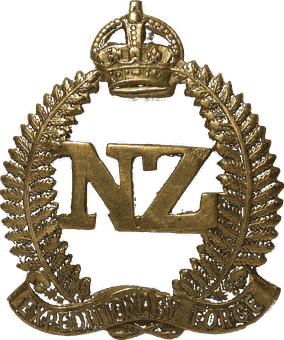
The rank he held, and the badge a soldier of that rank wore. These are simplified illustrations.
His medals
“Documented” means a source we name says he received it. “Listed on the Online Cenotaph” means the museum’s record lists the medal but we could not confirm it elsewhere. “Entitled” means his service dates qualified him, but we have not seen a record of the medal itself. The drawings are simplified illustrations.
His ships
Afterwards
After the war Wilkie settled at Takapuna, where he served on the borough council, and wrote the official history of his regiment (1924). In later years he lived at Suva, Fiji, for his health. He died there on 20 March 1941 aged 65, and was given a full military funeral at which the Fiji Defence Force provided the firing party and the New Zealand military forces and the Returned Soldiers' Association were represented. His grave in Suva has not been located.
His sign
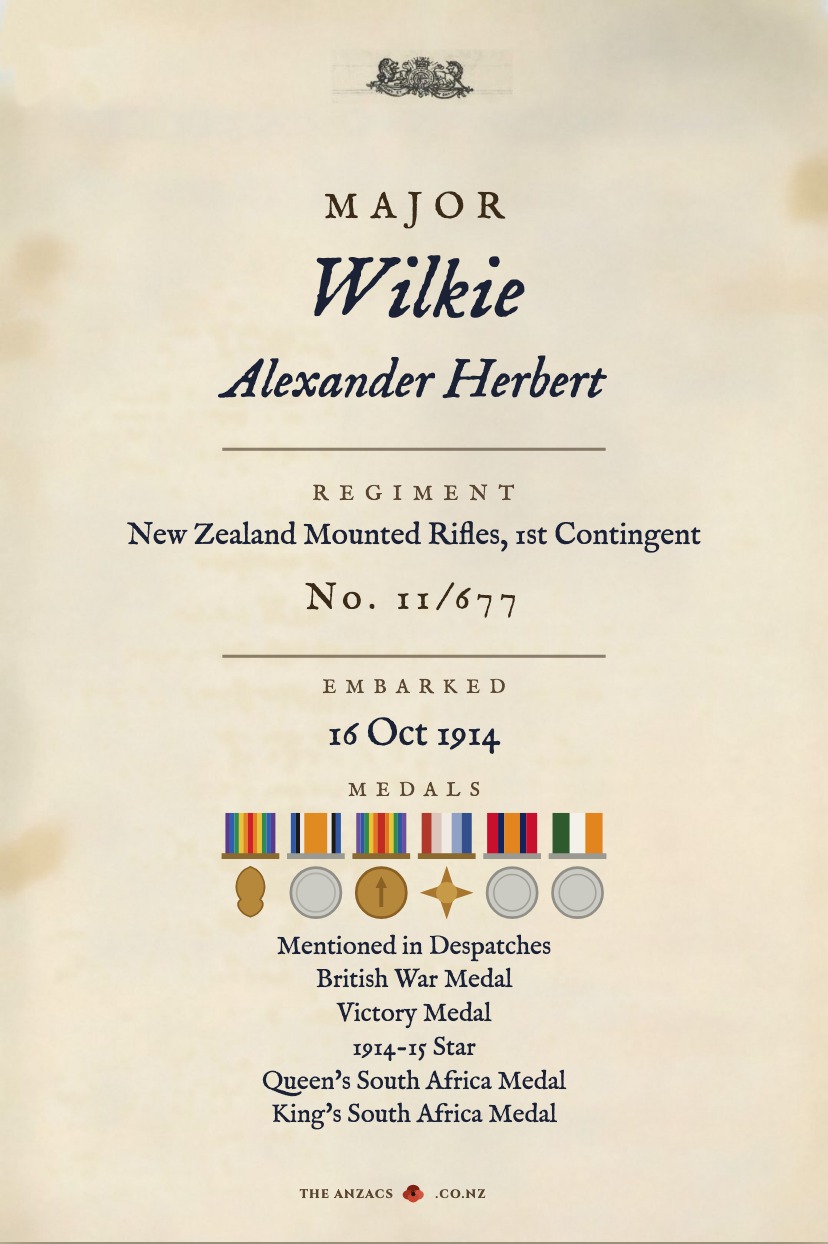
This is the Service Record sign as we would make it from his record: his rank, name, regiment, number and date of embarkation. The medals on the sign are worked out automatically from the embarkation date, so the medals listed above are the ones to rely on.
Photograph
We haven’t hosted a photograph here
Rather than copy someone else’s image onto our own site, we’d rather send you to see it where it’s properly held: his full record at the Auckland War Memorial Museum’s Online Cenotaph.
Sources
- Alexander Herbert Wilkie, Online Cenotaph, Auckland War Memorial Museum.
- NZHistory, Boer War roll: Alexander Herbert Wilkie (1st Contingent)
- NZHistory, Boer War roll: Alexander Herbert Wilkie (9th Contingent)
- Papers Past, Evening Post 24 Aug 1914
- Papers Past, Ashburton Guardian 26 Jul 1915
- Papers Past, Press 14 Oct 1915
- Papers Past, Otago Witness 3 Jan 1917
- Papers Past, Sun (Auckland) 25 Oct 1928
- Papers Past, Auckland Star 4 Apr 1941
- Papers Past, Press 18 Apr 1941
- NZETC, Official War History of the Wellington Mounted Rifles Regiment 1914-1919
What we could not confirm
Death date conflict: Cenotaph says 2 April 1941; the Auckland Star (4 Apr 1941, dispatch dated 31 March) says he died at his Suva residence on 20 March 1941. Use 20 March 1941.
Birth: the 1915 Press profile says Oxford, Canterbury, 1878; the Press obituary (1941) says he died at 65, implying about 1875-76. No birth date found.
Cenotaph NOK mother is 'Mrs Isobella Wilkie'; NZHistory 1st Contingent roll gives 'Mrs T Wilkie' (transcription slip likely); the 9th Contingent roll gives 'Mrs Isabella Wilkie'. Identity of the 1899 and 1902 Wilkie as the same man rests on matching name, mother and Invercargill Defence Office address (also on the Cenotaph).
Rank: Cenotaph shows 'Captain' at embarkation; Aug/Oct 1914 papers say Hon. Captain and Quartermaster. Dec 1916/Jan 1917 gazette lists Hon. Major Wilkie as made captain (quartermaster) from 10 Oct 1916. 'Major' (the title used in 1928 and 1941) looks like an honorary quartermaster's rank, so treat Major as probable but not certain.
No Cenotaph record of him being in a particular battle in South Africa; the 1st Contingent roll (Press 21 Oct 1899) lists 'A. Wilkie, Canterbury Yeomanry Cavalry'. QSA/KSA medals are not listed on the Cenotaph so are marked 'entitled'.
WWI ship: Orari (HMNZT 6) or Arawa (HMNZT 10); return ship and date unknown. Cause of his Gallipoli hospital stay (wound or illness) is not stated in the Press piece; the Cenotaph says wounded.
Wife is named in the Auckland Star as Dr Harriet Wilkie. Marriage date and details not sourced. Burial place in Suva not found (Press says a firing party from the Fiji Defence Force attended at the grave; service by Ven. Archdeacon Harris).
I did not read the full text of Wilkie's own regimental history on NZETC; it may contain further detail about his service as quartermaster.