Most decorated · 5 medals and honours, 3 for gallantry

Second Lieutenant John Wilson

John Hugh Wilson, known as Jack, left Dunedin as an Otago private in 1915 and finished the war a second lieutenant with the Military Cross, the Military Medal and a bar to the Military Medal. Each award came from a different battle. At Messines in 1917 he led two platoons after their officers fell. At Polderhoek Chateau that December he held a tiny isolated post for two days. In October 1918 he captured three German machine-guns on his own. That makes three gallantry awards, all won in the one battalion, 1st Otago.

5medals and honours
3of them for gallantry

His medals and honours

Won for gallantry

FORBRAVERYIN THEFIELD
Gallantry award

Military Medal

7 June 1917 · Messines Ridge, Belgium (Moulin de l'Hospice) · Sergeant, 1st Battalion, Otago Regiment, 2nd Infantry Brigade

Gazetted: Supplement to the London Gazette, issue 30234, 16 August 1917, p. 8430 (name only; McDonald gives the recommendation, Rec. No. 769)

The Battle of Messines opened before dawn on 7 June 1917 with the firing of the great mines under the ridge. The 1st Otago Battalion, beside Canterbury troops, crossed No Man's Land close behind the barrage, waded the valley of the Steenbeek and climbed the slopes beyond. Two German strongpoints, Moulin de l'Hospice and Birthday Farm, were surrounded and taken before their machine-gunners could do much damage. Two platoons had been given the job of storming the mill. Their officers became casualties on the way up, and Sergeant Wilson, a 28-year-old from Dunedin, took charge of both. He led them into the final assault, then kept them steady while they dug in on a line about eighty yards beyond the strongpoint, with German shells landing on the new position. The recommendation praises the example he set to the men under him throughout the attack and the consolidation. Otago's regimental history confirms that it was Wilson who led the two platoons in at the mill, in a fight that cost the Germans five machine-guns and fifty prisoners across the two strongholds.

The Gazette printed names only. The wording of the recommendation comes from McDonald; the regimental history independently names 'Sergt. J. H. Wilson' at the Moulin de l'Hospice.

Counted in his gallantry totalSource: London Gazette 30234 p. 8430 (read); McDonald, Honours and Awards to the NZEF, p. 283; Byrne, Official History of the Otago Regiment, chapter 'The Attack Launched' (read); Auckland Museum Online Cenotaph C58865
FORBRAVERYIN THEFIELD
Bar: a second award

Bar to the Military Medal

3 December 1917 (held out until the early morning of 5 December) · Polderhoek Chateau, near Gheluvelt, Belgium · Sergeant, 1st Battalion, Otago Regiment, 2nd Infantry Brigade

Gazetted: Supplement to the London Gazette, issue 30573, 13 March 1918, p. 3225 (name only; McDonald gives the recommendation, Rec. No. 1765)

Polderhoek Chateau was a German-held strongpoint on the high ground south-east of Ypres. The 2nd Brigade attacked it at noon on 3 December 1917, with 1st Otago on the left and 1st Canterbury on the right. It went wrong at the start, because part of the New Zealand artillery barrage fell on the leading Otago companies. German machine-guns in the blockhouses and the ruins did the rest. Wilson's company lost its officers. He took command, led the survivors forward into the fire and brought them right up beside the Chateau. When it was clear that the company was too small to take the objective, he set up a strong point in a commanding position and kept hitting the Germans from there. The regimental history describes his party of about a dozen men in shell-holes, with a single Lewis gun, in falling snow. They shot down German parties trying to cross the Reutelbeek swamp to get round their flank. Most of their ammunition had been picked up from the dead, and they still had enough bombs to beat off two more attacks in the night. He and his men were relieved early on 5 December, after almost two days and nights in the post. The brigade attack had cost roughly half the men involved.

The citation says all the officers of his company became casualties and that he led the remnant. The regimental history describes him taking over an advanced group of 12 from 4th Company after Captain Hines was wounded the second time. These are consistent but not identical accounts.

Counted in his gallantry totalSource: London Gazette 30573 p. 3225 (read; it carries the note 'M.M.'s gazetted 16th August, 1917'); McDonald p. 283; Byrne, Official History of the Otago Regiment, chapters 'Polderhoek Chateau' and 'Success Denied' (read)
GRI
Gallantry award

Military Cross

23 October 1918 · Near Neuville, east of Solesmes, France (the regimental history places the action at Vertigneul) · Second Lieutenant, 1st Battalion, Otago Regiment, 2nd Infantry Brigade (8th Company)

Gazetted: Supplement to the London Gazette, issue 31219, 8 March 1919, p. 3253 (name); citation in supplement 31583, 4 October 1919, p. 12380

On 23 October 1918 the 2nd Brigade opened the New Zealand Division's part of a big British advance east of Solesmes. At 8.40 a.m. 1st Otago passed through the 42nd Division and went forward, with 8th Company on the left. Second Lieutenant Wilson, by now an officer, commanded the leading platoon of his company. He helped the company on his right to clear a German machine-gun post. He then found three more machine-guns in a strong point that was holding up the advance. He brought up a Lewis gun and had his gunner rest it on his shoulder so it could fire into the post. With the Germans pinned down, Wilson dropped the gun, ran forward and took the three guns and the survivors of their crews on his own. The regimental history records the same day's fighting briefly: a platoon of 8th Company under 'Second-Lieutenant J. Wilson, M.M.' attacked the flank of a stronghold near the Crucifix, with such force and skill that it fell at once. That night the battalion's 10th and 14th Companies crossed the Ecaillon River in the dark and pushed on towards Beaudignies.

The Gazette says 'near Neuville'; Byrne puts the 8th Company stronghold east of Vertigneul. Both are on the same advance on the same day, and Byrne's 'Second-Lieutenant J. Wilson, M.M.' fits no other Otago officer I could find, but Byrne does not mention the Lewis gun or the three guns, so the match rests on date, unit, rank and the Military Medal.

Counted in his gallantry totalSource: London Gazette 31219 p. 3253 and 31583 p. 12380 (both read); McDonald p. 283; Byrne, chapter 'Vertigneul and Salesches' (read)

Every other medal and honour (2)

GEORGIVS V BRITT OMN REX ET IND IMP
British War Medal 1914-201915-1919Issued to those who served in a theatre of war, or at sea, between 1914 and 1920. It is listed on his Online Cenotaph record.
Victory Medal1915-1919The Allied Victory Medal went to everyone who served in a theatre of war and was awarded the British War Medal. It is listed on his Online Cenotaph record.

His story

  1. Born

    Wilson was born on this date. The sources read do not give where. Before enlisting he lived at St Leonards, Dunedin, and was single. His father, W. Wilson, was at the same address. His religion is recorded as Presbyterian.

    Source: Auckland Museum Online Cenotaph C58865; NZEF Project (nzef.adfa.edu.au)
  2. Embarks as a private

    He left Wellington with the 5th Reinforcements, Otago Infantry Battalion, on HMNZT 24 Maunganui. The ship carried 2,299 men on three transports and reached Suez on 24 July 1915.

    Source: Auckland Museum Online Cenotaph C58865
  3. Messines

    As a sergeant in 1st Otago he took over two platoons at the Moulin de l'Hospice when their officers fell, and was awarded the Military Medal.

    Source: Byrne, Official History of the Otago Regiment; McDonald; London Gazette 30234
  4. Polderhoek Chateau

    He led the survivors of his company up to the Chateau, then held a small isolated post for nearly two days and nights. This brought a bar to the Military Medal, gazetted on 13 March 1918.

    Source: Byrne; McDonald; London Gazette 30573
  5. Commissioned

    At some point after the bar was gazetted in March 1918 he was commissioned second lieutenant in 1st Otago. The date of commission was not found in the sources read.

    Source: London Gazette 31219 (gives him as 2nd Lt); NZEF Project
  6. Capture of three machine-guns

    Commanding the leading platoon of 8th Company, 1st Otago, in the advance east of Solesmes, he took three machine-guns and their crews on his own. This earned the Military Cross.

    Source: London Gazette 31583 p. 12380; Byrne
  7. Military Cross gazetted

    His name appeared in the London Gazette of 8 March 1919, and the citation was published in the supplement of 4 October 1919.

    Source: London Gazette 31219 p. 3253; 31583 p. 12380
  8. Death

    Auckland Museum's record gives his death on Stewart Island on this date, at the age of 76. It also lists a Second World War service number, 822283.

    Source: Auckland Museum Online Cenotaph C58865

Rank and insignia

The ranks he held, and the badge a soldier of that rank wore. These are simplified illustrations.

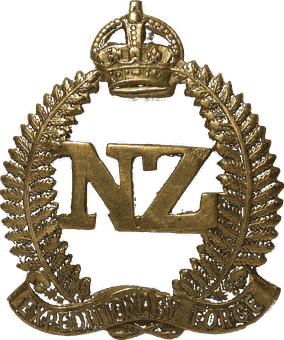
New Zealand Expeditionary Force 1914 to 1918 badge
PrivateJune 1915 (on embarkation)No rank badge: a private soldier wore none
Sergeantby 7 June 1917Three chevrons
Second Lieutenantby October 1918 (date of commission not found)Shoulder strap: one pip

His ships

HMNZT 24 MaunganuiTroopshipLeft Wellington on 13 June 1915 and reached Suez on 24 July 1915 with the 5th Reinforcements.

Afterwards

The sources read do not say when he returned to New Zealand. According to the Auckland Museum record, he died on Stewart Island on 18 July 1965. He was 76. The same record lists a Second World War service number, 822283, though I did not find what that service involved. I did not trace a funeral notice, an obituary or a burial place. His portrait appears in the first volume of 'Onward', the book of NZEF portraits.

He is not well known, but his record is unusual. He won three gallantry awards in three separate actions, and in the first two he took command when the officers around him had fallen. The Otago Regiment history names him at both Messines and Polderhoek, and his Military Cross citation describes the Lewis gun fired from a gunner's shoulder.

Later awards, not counted here: Auckland Museum's record lists a WW2 service number (822283). No WW2 awards were found..

His sign

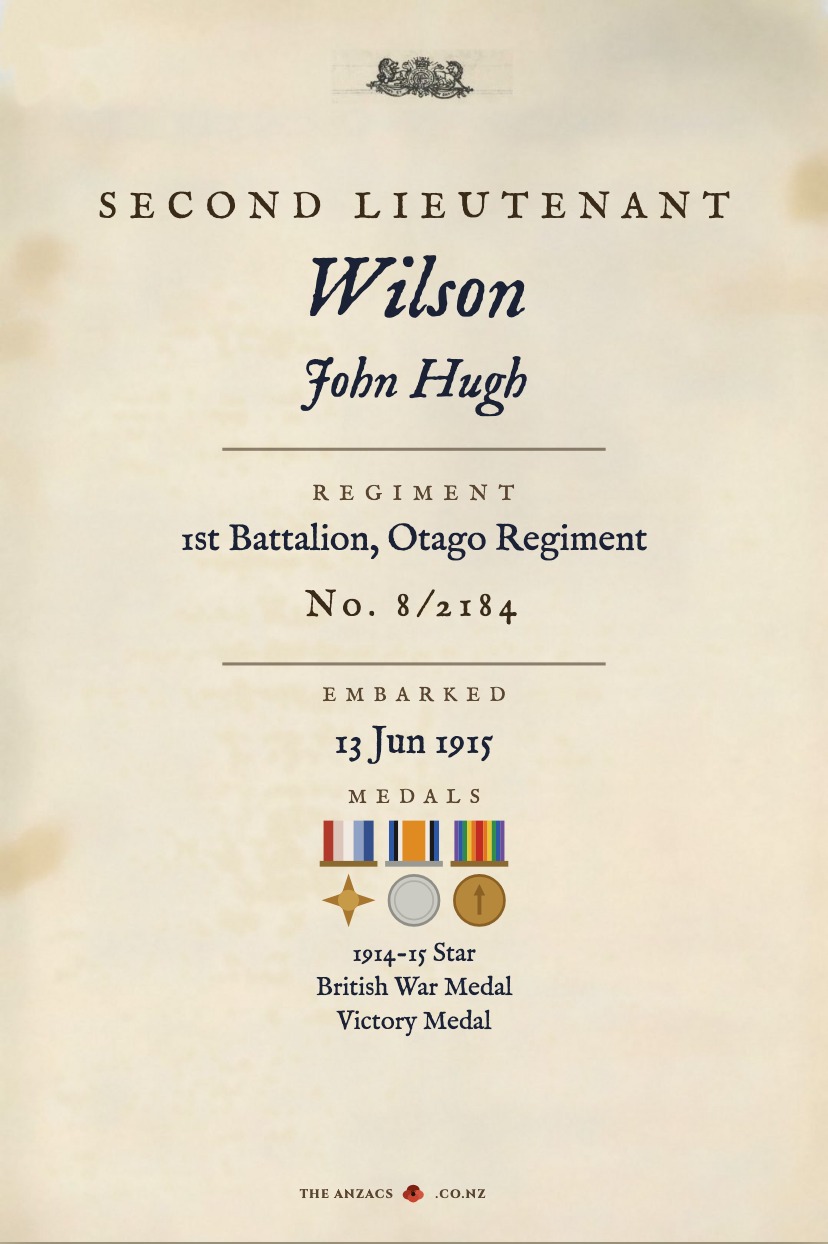
This is the Service Record sign as we would make it from his record: his rank, name, regiment, number and date of embarkation. The medals on the sign are worked out automatically, so the medals listed above are the ones to rely on.

The Service Record for John Hugh Wilson
The Service Record

Photograph

We haven’t hosted a photograph here

Rather than copy someone else’s image onto our own site, we’d rather send you to see it where it’s properly held: his full record at the Auckland War Memorial Museum’s Online Cenotaph.

Sources

What we could not confirm

Identity: John Hugh Wilson, 8/2184, 5th Reinforcements Otago Infantry, embarked 13 June 1915 on Maunganui, 1st Bn Otago Regiment. The service number appears in the London Gazette for both the Military Medal (p. 8430) and the bar (p. 3225), and McDonald gives the same number for all three awards. The Online Cenotaph has only one John Hugh Wilson. He is not the Wilson on theanzacs.co.nz's first-contingent roll.

The Military Cross place name differs between sources: the Gazette says 'near Neuville', the regimental history places 8th Company's action east of Vertigneul. The date and unit agree. Byrne does not mention the Lewis gun or the three machine-guns.

The London Gazette printed names only for the Military Medal, the bar and the Military Cross. The Military Cross citation was published separately on 4 October 1919. The wording of the other two recommendations comes from McDonald.

Date of commission as second lieutenant not found; place of birth not recorded in the sources read; no obituary or burial place found.

The WW2 service number 822283 is Auckland Museum's attribution; I did not check it against a WW2 record.

The Cenotaph lists the British War Medal and Victory Medal only (no 1914-15 Star), so totalMedalsCount is 5 on that basis. No mention in despatches is recorded for him in McDonald or the Cenotaph.

Papers Past could not be searched usefully, so no contemporary newspaper account of his awards was read.

Concept, design and execution by Unlimited Potential